
José Manuel Restrepo: ‘Colombia is an almost unconditional and key ally for the US to achieve its goals in Venezuela’
The vice president-elect says that Abelardo de la Espriella’s government, which begins on August 7, does not fit into the far right, the right or the center, and that its guiding principle is pragmatism
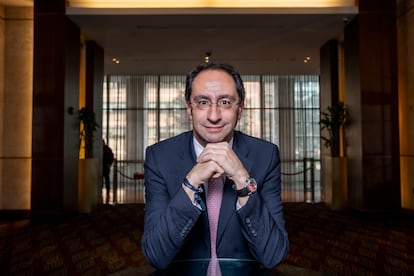

José Manuel Restrepo is temporarily working from the business center of an exclusive hotel in Bogotá’s financial district. An economist, former minister and now vice president-elect, the 55-year-old Bogotá native is a key spokesman for the incoming administration of Colombia led by Abelardo de la Espriella. Restrepo is involved in assembling the government team, handling part of the international relations portfolio for a president greatly focused on that area, and activating links with trade groups, academics and the media.
In the midst of a crisis after outgoing President Gustavo Petro announced he would not recognize the far-right leader as the winner of the presidential election, and despite the fact that transition meetings between both teams have been suspended, Restrepo exudes calm as he speaks with EL PAÍS during a slot that had originally been set aside for talks with the outgoing administration.
Question. Colombia is going through an anguishing situation. The outgoing president said on Monday that he does not recognize Abelardo de la Espriella as the president-elect, but rather [the leftist candidate] Iván Cepeda. How do you explain what is happening?
Answer. Two things are happening here. First, something unprecedented in Colombia’s history: the outgoing president crossed a democratic red line by refusing to accept the popular verdict, the rule of law, the decision ratified by the Registraduría and recognized by the National Electoral Council. The president-elect is Abelardo de la Espriella; that much must be clear to the entire international community. Colombia is an institutional country, a solid democracy. But the message that’s been sent is grave, and that is why we are calling for constitutional resistance, which means understanding that authority does not rest with whoever claims to be elected but with compliance with the Constitution and the law; that when someone exceeds that limit they will not be heeded; and that all institutions must respond to defend the Constitution: the security forces, the judiciary, the media, citizens, business leaders, absolutely everyone.
Q. Have they responded?
A. Yes, and it demonstrates that the Constitution prevails in Colombia. My message rejects the euphemisms that go against it, such as civil disobedience, which at its core is a call to violence, to front-line confrontation — something Colombians do not want to repeat. Or the call to refuse to recognize the president-elect, an attitude that is hardly coherent with someone who supposedly acted within and was elected under a democracy, because it does not represent a democratic opposition.
Q. You mentioned a second factor...
A. The other is that the outgoing president’s argument is spurious and irrational. He raises questions about electronic matters even though electronic voting does not exist in Colombia. There is a physical vote: validated, verified and counted with witnesses. It seems Petro is lost, as if he were governing another country — a constant over these past four years. Now he has focused on creating this smokescreen, surely to hide the disaster of his administration.
Q. You speak to the international community, and you recently met with European Union ambassadors. Is Europe a priority for the incoming government?
A. That was the latest of several meetings with diplomatic missions. My role is to open opportunities in international trade, foreign investment and cooperation, among other areas. We aim for Colombia to be a protagonist in the fifth industrial revolution, for example. With the European Union we discussed our security plan, our role on the United Nations Security Council, the importance of attracting investment and the possibilities to expand trade. We want Colombia to broaden its efforts in Indo-Asia, which have been largely limited to South Korea, to include Japan, Malaysia, Indonesia and India… we will address China later. I have said the same about the Middle East. Under Abelardo de la Espriella, Colombia must open itself to new possibilities for international engagement. It is part of building a ‘miracle homeland’ that sees the world as a vast channel of opportunities for growth.
Q. What will the relationship with the United States be like? The president-elect received support from Donald Trump...
A. With the United States we share the view of preserving democracy, defending private enterprise and respecting freedoms. Those elements make conversation easier with a country that expects from Colombia what the outgoing government has been unable to achieve: active action against drug trafficking. It abandoned aerial fumigation, manual eradication, forced crop substitution and the pursuit of drug traffickers’ assets when it withdrew from the Egmont Group. We must first ensure that we resume action against drug trafficking to open opportunities; the clearest example is that the United States is convinced and committed to restoring democracy and market rules in Venezuela.
Q. What role would Colombia play in Venezuela?
A. We are the most obvious, almost unconditional and crucial ally for the United States. We have an opportunity. By guaranteeing security and orderly management of migration issues, Colombia can play a leading role in restoring democracy there. Next week I will travel to the United States together with the designated finance and commerce ministers to meet with multilateral agencies and investors. We will present our economic growth strategy and fiscal adjustment plan to them.
Q. Will Colombia be aligned with Trump?
A. We must be aligned with democracy, with freedoms, with defending private enterprise; never with nationalization, the destruction of freedoms, refusal to recognize democracy, the creation of poverty or disrespect for market rules. We see a new scenario in Latin America, with many nations heading in this direction, and that opens the possibility of strengthening all multilateral forums. The Petro government and other leftist governments did something shameful — they practically dismantled the Pacific Alliance. It is time to revive bodies like that; Colombia is the world’s twelfth economy and it must be revived.
Q. And what is the stance toward Delcy Rodríguez’s government?
A. Our approach is through the United States, which already has a path set out and has been working to collect investment resources. There is a great opportunity: let us move hand in hand with the United States.
Q. What will your role be in government, considering vice presidents do not have predefined functions?
A. I will not hold an official post. I will be free to operate where the president needs me. That said, I will bring together portfolios aligned with priorities in fiscal adjustment, the growth agenda, education, innovation, science and international relations — wherever I can be useful to the country.
Q. How would you characterize De la Espriella’s future government?
A. One focused on execution and regional outreach, serving the Colombian people; a government of results, honest and transparent, that will show public management can be done well, serve the people and recover what we have lost: security, prosperity and care for the most vulnerable.
Q. Would you call it far-right, right-wing, populist...?
A. I would not call it left, right or center. Those labels matter little to the people, and that was the key to the campaign’s success and will be the key to the government’s success. People are not looking for a category — they have a problem and seek solutions. When they can’t get their hands on a medication they need, they do not care whether the answer comes from the left, the right or the center. We don’t use ideological labels; we seek solutions. That said, there are essential principles we will guarantee. First, the freedoms — all of them: business, employment, speech, press, religious, cultural and scientific freedoms. Then private enterprise. Each person can classify those principles as they wish...
Q. Even as left?
A. Not the so-called 21st-century left, which does not defend freedoms, does not defend private enterprise, remains at the rhetorical level rather than in execution, seeks populism, and populism does not provide solutions. We represent a different logic. On environmental issues, for example, we have said there must be sustainability and that the supposed dilemma between growth and environmental protection is false. We hold a pragmatic conviction that without sustainability you cannot achieve balanced growth, but if you block growth for ideological reasons in the name of the environment, it will not fare well. We must achieve a healthy balance.
Q. The president-elect has had a litigious past with the press. How will his government behave toward the media?
A. The president-elect has said he understands his role as head of state, a symbol of national unity, and is deeply respectful of the Constitution and the law. He defends its principles, including freedom of the press. But he has also said — and he is right — that freedom of the press cannot be based on slander or libel, and if such acts occur, the Constitution provides a legitimate right to defend oneself against them. When that happens, he will naturally exercise that right. But under no circumstances will there be any attack on press freedom.
Sign up for our weekly newsletter to get more English-language news coverage from EL PAÍS USA Edition









































