
Four intractable crises facing Colombia’s next president
Violence, the deficit, the collapse of the healthcare system, and corruption await the winner of the presidential elections
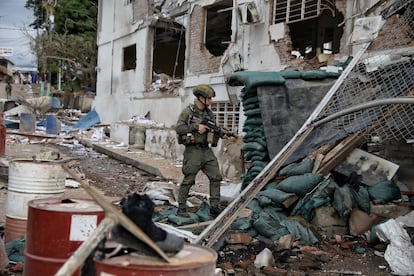

In Catatumbo, a region on the border with Venezuela, women have been giving birth at home for months. It is not for lack of hospitals but because they are afraid to take the roads and get caught in the crossfire between two guerrilla groups. Babies take months to be registered, farmers fear stepping on mines, and children hide when they see drones flying overhead laden with explosives. Those who stayed do not venture out and live locked up as if during a pandemic. Those who could leave fled, and the region has lost nearly 100,000 residents over the past year. “We are not part of this war, but we are in it,” a community leader told EL PAÍS, fearing he could be killed. This Sunday, Colombia holds the first round of its presidential elections. It does so with that war in the background, and with three other deep wounds that no candidate has fully explained how they intend to heal.
Whoever wins on June 21, 2026 — a runoff is expected— will inherit a country with structural problems no president has been able to solve. Polls show only three candidates have real chances, and the three have proposed very different solutions for the same old problems. Iván Cepeda, a left-wing senator, promises to continue Gustavo Petro’s social legacy. Paloma Valencia, a right-wing senator, seeks to restore the conservatism of former president Álvaro Uribe. And Abelardo de la Espriella, a far-right lawyer, presents himself as the outsider aiming to break everything apart.
“Whoever wins the elections will inherit a Colombia very different from that of 2022, one in which completely different visions coexist about the best way to improve the economy, public finances, security, and to close inequality gaps,” says Víctor Aguilar, Crisis Group analyst for Latin America. “The next government will have to show great political skill to reach agreements if it wants to maintain governability, given that a large sector of the population will not share its vision.”
Violence has marked this campaign even before it began. In June 2025, presidential hopeful Miguel Uribe Turbay was shot in broad daylight at a rally in Bogotá and died shortly afterward. The three leading candidates have all reported death threats. And MOE, an electoral observation organization, warned that 386 municipalities — just over a third of the country — faced a risk of political violence before May 31.
Common crime is causing concern in the cities, but above all there is alarm at the territorial control of armed groups that over the past decade have occupied the spaces left by the FARC after the 2016 peace agreement. In the first five months of 2026, Colombia has recorded 54 massacres and 233 fatalities, while the ranks of drug gangs, guerrillas, and paramilitaries are growing, in many cases with the forced recruitment of minors.
Petro’s flagship policy of negotiating simultaneously with all armed groups not only failed to demobilize them but also did not halt the expansion of their territorial control. A February poll revealed that more than half of Colombians felt less safe because of those negotiations. Many communities today live under the fear of extortion, forced recruitment, and kidnapping.
What to do about this divides the candidates radically. De la Espriella promises a 90-day shock plan: an air offensive backed by the United States and Israel, forced coca eradication, and 10 maximum-security mega-prisons financed with private capital, in the style of Nayib Bukele in El Salvador. Valencia proposes reviving the policies of her mentor Uribe, whose presidency was marked by the defeats of the FARC and the power and massacres of the paramilitaries. Cepeda favors continuing dialogue with conditions and, above all, providing opportunities so that crime is not the best option for many of the country’s young people.
After violence, economic issues are another major concern for Colombians. Public finances face a deficit of up to 7% of GDP and a net debt approaching 58%, its highest level in two decades. The government spends more than it generates, and the new president will have to correct that with revenues that do not yet exist, with painful cuts, or with both. The economy is growing — up to 3% in 2026 — but more than half of Colombians who work still do so in the informal sector: without a contract, without social security, without a safety net.
The country’s economic elites are inflexible against Petro’s policies and fear Cepeda’s rise, but the president has achieved some gains that have benefited the most forgotten: multidimensional poverty fell by 23% in the last four years, unemployment reached its lowest level since 2001 and the minimum wage rose 23% in January, the largest increase of the century. According to the United Nations Development Programme (UNDP), someone in the poorest 10% of Colombians takes 10 generations to reach a middle income, and Petro has tried to shorten that path.
“The next government will inherit serious economic challenges,” explains Paola James Santamaria, co-author of the latest Center for Economic Research report on Colombia. “Growth has been limited by weak investment, high interest rates and a narrow fiscal margin, while the country’s social problems still require sustained public investment.” The dilemma, she says, will be how to tackle inequality without ignoring fiscal pressures. “The debate should not focus solely on cutting spending, but also on how to increase revenues and sustain social gains in an economically viable way.”
On February 13, 2026, Kevin Acosta, a seven-year-old boy with severe hemophilia, died in Bogotá. Kevin needed the medication that allowed his blood to clot every 28 days, but the company managing his medical care stopped supplying it in December. When the boy fell from a bicycle and suffered an intracranial hemorrhage, the system did not respond in time.
President Petro’s reaction, in a televised Cabinet meeting, was to indirectly blame the mother — “If you don’t let a hemophiliac child ride a bicycle, he faces fewer risks,” he said — but his death was a reminder that Colombia’s health system, which for decades was a model in Latin America, is on the brink of collapse.
Since the 1990s, Colombia has delegated the management of public health to private or public companies that receive state funds and distribute them among doctors, hospitals, and medicines. But the so-called EPS now owe 25.7 trillion pesos ($7 billion) to hospitals and clinics. The result is a shortage of treatments, medicines that do not arrive, and months-long waiting lists. Petro insists the main problem is corruption among the private entities that handle public resources, so the state’s role should be strengthened, and he has underfunded the system arguing that giving them more money would mean a greater theft. He also tried to reform the system with a law that Congress blocked.
Colombia arrives at these elections with the worst corruption perception index of the last decade, yet almost no one is talking about it in this campaign. Petro came to power championing the fight against the corrupt, which he attributed to the traditional right, and he ends his term with two former ministers in prison, accused of leading a criminal organization that allegedly diverted more than 612 billion pesos ($168 million) to pay kickbacks to members of congress in exchange for legislative support.
A 2017 case, the so-called “robe cartel,” illustrates the before-and-after paradox: anti-corruption prosecutor Luis Gustavo Moreno was convicted of corruption. That same Moreno today defends those implicated in the Petro government’s scandal.
Sign up for our weekly newsletter to get more English-language news coverage from EL PAÍS USA Edition









































