
The killing of child soldiers: The dilemma facing Gustavo Petro’s government
The recent deaths of 15 forcibly recruited minors in military operations have sparked an unprecedented crisis for the Colombian president
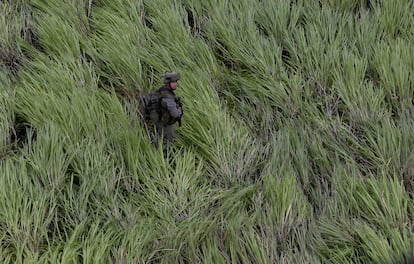
In the early hours of November 13, the Colombian jungle crackled in the darkness. A column of 150 guerrillas, camouflaged in olive green, advanced through the undergrowth with the objective, according to the Ministry of Defense, of ambushing a group of 20 young soldiers deployed in the area. Among the platoon were two high-priority targets for the authorities: trusted men of Iván Mordisco, the guerrilla leader of a FARC dissident group and one of Colombia’s most wanted criminals. They didn’t get that far. Three planes dropped several bombs on them. They were also surrounded on the ground. The order was given by Colombian President Gustavo Petro himself, while he was hosting dozens of world leaders at the CELAC summit on the shores of the Caribbean Sea. The main targets escaped, but 19 rank-and-file combatants died in the attack. Seven were minors forcibly recruited by the guerrillas. Carem Smith Cubillos Miraña was 13 years old. The oldest, Martha Elena Abarca Vilches, was 17.
The bombing, which occurred in the Amazonian region of Guaviare, unleashed a political earthquake whose aftershocks continue almost two weeks later. Petro acknowledged that he knew children could be killed and assumed responsibility. But he did not back down. His unwavering support for the Minister of Defense, retired General Pedro Sánchez, bewildered his base: a left wing that can hardly defend an operation in which children, who were also victims of the conflict, died. The president had broken one of the limits he himself had set: to avoid armed operations when children were present. “It wasn’t a kindergarten. It was an armed camp,” Sánchez justified.
The crisis, far from subsiding, has since escalated. Following the bombing in Guaviare, details emerged of another military operation in the Amazonas department a month earlier. Troops were again searching for Iván Mordisco, but instead captured four people and killed four others. All of them were minors. Four more children killed without the military striking at the core of the guerrillas. One of the wounded was only 10 years old. The army reported that it had neutralized Mordisco’s security detail, a ring allegedly made up of soldiers between the ages of 10 and 15. Two other attacks in August killed four more children. The conflict is a complex mix of political, ethical, and security issues.
The war — silent beyond Colombia’s borders, thunderous within — once again places the country before a familiar dilemma. In 2019, under the government of Iván Duque, the deaths of at least seven children in a bombing led to the resignation of Defense Minister Guillermo Botero. Two years later, another attack that killed seven more children politically sank his successor, Diego Molano. From the opposition, Petro was a fierce critic of those killings. And upon assuming the presidency, he restricted attacks when there were indications of the presence of minors. “We must prevent the war from continuing to take children,” he said. It was his red line.
But, to the surprise of his base, he has gone back on that word, leaving a trail of more than a dozen dead children and failing to capture primary targets. The same people who attacked Duque then are justifying the attacks now. Petro, who condemned Donald Trump’s bombing of drug-running boats in the Caribbean, has lost coherence in his arguments.
The government is posing a perverse paradox, one also championed by the right: if the state halts bombings to prevent the deaths of minors, armed groups could increasingly use children as human shields. “Saying to stop the bombings during offensive actions by drug traffickers is inviting them to recruit more boys and girls,” Petro warned. The president’s allies have focused on the cruelty of child recruitment — which the state has been unable to stop — rather than on the deadly military operation, but this issue is a stinging one for the more ideological left. And it divides.
Even historical figures in human rights, such as Iván Cepeda — a candidate to succeed Petro — have avoided taking firm stances. Opposition congresswoman Katherine Miranda publicly challenged him: “Dear Iván Cepeda, I invite you to denounce President Petro and Minister Pedro Sánchez for serious violations of International Humanitarian Law. Consistency doesn’t depend on the government in power.”
The debate has also reopened another concern: the state of Colombian intelligence. “Let’s assume the Guaviare operation was defensive, aimed at saving the lives of those 20 soldiers. What about the others?” asks Vladimir Rodríguez, a former official at the Ministry of Defense during the period when the Petro administration suspended operations that put minors at risk. “I’m not against bombings, but they have to be done right. Intelligence should allow us to be surgical. We have to kill the recruiter, not the recruit.” For him, the problem is clear: “There’s a failure in field intelligence or in the way it’s being processed to reach the president.” Since the beginning of his term, Petro has faced criticism on this front: he has relieved experienced officers, appointed less experienced commanders, and announced a break with international cooperation agencies.
The bombs, in any case, resurrect a terrifying and silent reality: the recruitment of hundreds of children every year. A practice of war that usually occurs far from the large cities, in inaccessible regions where the state is absent, where the law is not enforced. In places where mothers have all their children kidnapped and, when they are murdered, they cannot go to bury them for fear of being killed too.
It is one of the most difficult crimes to document. In 2024, the Prosecutor’s Office received 604 reports. But in the first half of this year alone, the department of Cauca registered 800 cases. These figures, however, are insufficient to capture the full extent of the phenomenon, which is now also spreading through social media. In August, the Special Jurisdiction for Peace warned that TikTok has become a key tool for recruiting minors into the armed conflict.
But recruiters continue their search, especially in rural schools. There they find poverty, neglect, and an absent state. They coerce them, but they also persuade them. “They start by paying them 100,000 pesos — about $25 — and tell them that as combatants they can earn two or three million,” Emilse Jiménez, a leader and advocate for children’s rights, explained to EL PAÍS. For many children, the only path that offers a future is war.
Sign up for our weekly newsletter to get more English-language news coverage from EL PAÍS USA Edition









































