
In reversal, Colombia’s Petro defends the air strikes he previously condemned
The president rejects calls to suspend military action against armed groups, saying it would be like helping them recruit more children
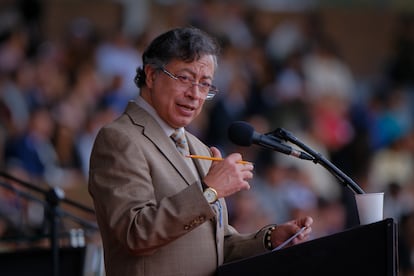

The reversal is striking. Gustavo Petro, the first leftist president of contemporary Colombia, has closed ranks in defense of the type of military operations he used to condemn in the past, when he was a member of the opposition. “To say that the bombings should stop during offensive action by drug traffickers is to invite them to recruit more children,” he wrote on his social media accounts this Tuesday, dismissing the message from the Ombudswoman, Iris Marín, who had publicly asked him to suspend the strikes and reassess the situation. “I reiterate that we have not violated IHL [International Humanitarian Law] in the bombings I ordered. To say that the bombings should stop when we are operating within IHL is incredibly naive,” the president insisted on X, his preferred media outlet. He had previously conceded that bombings “always carry a risk,” but that he had decided to accept it.
A total of 15 minors have died in military operations carried out by the Armed Forces between August and November in the departments of Guaviare, Amazonas, and Arauca, the National Institute of Legal Medicine confirmed on Monday. Specifically, the deaths of seven minors in Guaviare on November 10, in what is now considered the worst bombing of the Petro era, sparked a heated public debate on human rights amidst a complex security crisis.
Petro’s predecessor, the conservative Iván Duque, approved a strike in 2019 in a rural area of the Caquetá department, which he initially described as “an impeccable operation,” a demonstration of “heroism” and “coordination.” Supported by forensic reports, Senator Roy Barreras — then in the opposition, now a presidential candidate — accused the minister of defense at the time, Guillermo Botero, of concealing the deaths of seven minors in that military action. The barrage of accusations ultimately cost him his position, as he resigned in the face of the imminent approval of a no-confidence vote in Congress.
“If the government knew there were minors there before the bombing in Caquetá, we are dealing with a war crime, that is, a crime against humanity,” stated Petro, then a senator, at the time. In the final stretch of the Duque administration, scandals involving the deaths of minors in bombings resurfaced. His last defense minister, Diego Molano, even referred to those victims of forced recruitment as “war machines.”

In his three years in power, Petro has adopted several security policies he once criticized. Air strikes are one of them. Among the early announcements by Iván Velásquez, his first minister of defense, was the suspension of strikes on camps belonging to illegal groups where minors might be present. This measure severely restricted such attacks, given that the recruitment of minors is a constant practice among the various armed groups, including the so-called dissidents of the now-defunct FARC guerrillas; the Gulf Clan, the country’s largest drug trafficking organization; and the ELN, the last remaining armed insurgency.
Military bombings only resurfaced after a Gulf Clan ambush killed four soldiers in Segovia, in northeastern Antioquia, in February 2024. Shortly later, in March, Petro followed through on his threat to relentlessly bomb the largest drug trafficking organization in that same region of Colombia. In 2025, under the new Defense Minister Pedro Sánchez, a retired Air Force general, the government has carried out more than a dozen air strikes, mostly against the dissident faction of Iván Mordisco, the self-styled Central General Staff or EMC.
Sánchez, who became famous as the special forces general who commanded the search for four Indigenous children lost in the Amazon rainforest, became the first military defense minister since the 1991 Constitution. Faced with the inefficacy of his total peace policy — which sought to negotiate simultaneously with all armed groups — and the deterioration of security, President Petro opted for a pragmatic response that more than one observer considers a step backward.
Laura Bonilla, deputy director of the Peace and Reconciliation Foundation (Pares), believes that Petro’s turn was cemented when he appointed Pedro Sánchez as his defense minister. “He did so fully aware that he would give a more militaristic twist to his entire security policy,” the expert points out. The Armed Forces favor air strikes because they don’t risk any military casualties, despite the potential consequences for civilians, including children and teenagers, she explains. “The president is currently very much committed to that perception,” she opines. In this matter, she adds, there is a great deal of electoral calculation involved and an effort by the Armed Forces to show quick and decisive results to the United States at a very delicate moment in relations between two traditional allies.
The reactions keep coming in. A no-confidence vote against Defense Minister Sánchez was filed this Tuesday, with the signatures of several congressmen allied with the government, not just those from the opposition. “As I have done in the past, I reiterate my position that actions of this nature are clearly prohibited by humanitarian law,” stated Senator Iván Cepeda, the presidential candidate for the ruling Historical Pact. “The death of any child is a tragedy; those of us who are parents know this. And we must combat the recruitment of minors,” declared Roy Barreras, who is seeking to challenge him within the so-called Broad Front, the coalition that supports Petro. “But a head of state — and I will be — must protect the lives of all, including those of children, soldiers, and all Colombians.”
Another candidate from the Broad Front, former interior minister Juan Fernando Cristo, opined that “renouncing the use of the state’s offensive air capacity through bombing is not sensible at this time.” The underlying problem, he added, is the surge in the recruitment of minors, “with Mordisco’s organization being the one that most frequently resorts to this abhorrent violation of all human rights norms and International Humanitarian Law.”
Humberto de la Calle, a former peace negotiator with the now-defunct FARC who is often critical of Petro, echoed the president’s sentiments: “The big problem is that if the alleged presence of minors leads to the suspension of military action, recruitment will skyrocket. The cure is worse than the disease.”
Sign up for our weekly newsletter to get more English-language news coverage from EL PAÍS USA Edition









































