
De la Espriella’s far-right banners
The winner of the first round of the Colombian presidential election has used misogynistic and homophobic language, admires Milei and Bukele, promises to cut 40% of state bureaucracy, and wants to reopen debates over abortion and child adoption rights
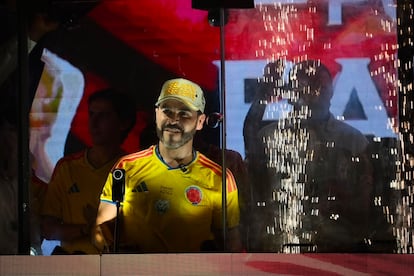

Colombia swung to the far right this Sunday, voting overwhelmingly for a candidate who won the support of 10 million citizens, Abelardo de la Espriella, the top vote-getter in the presidential first round. The criminal defense lawyer, who has never held elected office and once defended Alex Saab, Nicolás Maduro’s alleged front man in Venezuela, promises a shake-up of individual and collective rights: from putting God back into schools to pulling Colombia out of the United Nations. He still needs to mobilize votes for a runoff on June 21 against a left that represents the continuity of Gustavo Petro’s government. De la Espriella will be carried forward by very local banners, such as anti-Petrista sentiment, and by very global ones, like promises already voiced by far-right leaders around the world. Political leaders ranging from President Javier Milei of Argentina to Santiago Abascal, head of the hard-right Vox party in Spain, have already celebrated De la Espriella’s first-round victory.
Nayib Bukele’s prisons and Javier Milei’s chainsaw
Abelardo de la Espriella is very familiar with the global far-right wave: he admires Nayib Bukele’s mega-prisons in El Salvador and promises to build 10 of them with the help of private companies to run them. He also admires Argentine president Javier Milei’s symbolic chainsaw, and vows to cut state bureaucracy by 40% by eliminating positions held by about 700,000 government employees and contractors. Like his far-right counterparts worldwide, he dislikes international organizations and has already said he is not interested in Colombia having an embassy at the United Nations: “The UN is a political directory of the left,” he says.
Jair Bolsonaro’s military-style patriotism
The echoes with the global far right are also aesthetic. As Jair Bolsonaro did in Brazil, he has appropriated the national soccer jersey for campaigning: thousands attend his events wearing the yellow shirt, a garment that will be even more cherished as the World Cup opens in a few days. The patriotism evident in each of his slogans: the “defender of the homeland” is “steadfast for the homeland” and wants to build a “Miracle Homeland.” He also uses a clearly militaristic tone, equating public service as a president to fulfilling one’s “military service.” It has become popular among his supporters to mimic the military salute with the right hand to the forehead.
The Trump–style entrepreneurial outsider
Like Donald Trump, he likes to display the luxury in which he lives and insists he has been a successful businessman boosted by his law firm, “who never lived off the state’s teat.” That is perhaps the most important trait he shares with the global far right: presenting himself as an outsider, an anti-establishment candidate who comes to change the faces of those he calls “the usual suspects” — what Milei would call “the caste.” De la Espriella repeats in every speech that he represents “the nevers,” meaning those who do not feel unrepresented by Petro’s progressivism nor by the traditional right-wing parties.
Against abortion and LGBTI rights
Although he identified as an atheist for years, De la Espriella converted to Catholicism after an aunt’s death and now raises the conservative banners of several supporting Christian churches: he says the Constitutional Court ruling that decriminalized abortion up to 24 weeks in 2022 “must be an object of debate,” because he “is a defender of the life of the defenseless.” He has not attacked same-sex marriage, “since they should have certain property rights,” but he is against allowing same-sex couples to adopt: “I know what a child needs, because I have four children; a child needs a father and a mother, those roles.” He also repeats the international hoax that schools are trying to impose a “gender ideology” on children. “I do not accept that our children be conditioned, contaminated with gender ideology to try to change their view of sexuality,” he has said. “We must put God back into our children’s classes,” he declared at the launch of his campaign.
A misogynistic and homophobic tone
De la Espriella, who frequently talks about the supposed enormous size of his testicles, has been noted in the campaign for both his misogynistic and homophobic remarks. On a radio program he asked one of the hosts to zoom in on his genital area in a campaign photo to boast about the size of his penis. “With that photo I won some really cool votes from female voters,” he said. In another interview, when a reporter asked him a question about ethics and the law, he called her ignorant for not having studied law. And when referring to the only openly gay candidate in the race, the economist Juan Daniel Oviedo, his homophobia surfaced: “His condition can’t be fixed,” he said, laughing, in an interview. Oviedo, for his part, has reported that De la Espriella’s supporters have shouted homophobic insults at him in the street.
‘Hard-line’ stance against peace policies
Millions of Colombians voted for Abelardo de la Espriella tired of Gustavo Petro’s government, especially because of the security crisis that is partly the result of a ‘Total Peace’ policy that has failed to negotiate the demobilization of all armed groups. On the contrary, almost all armed groups — guerrillas and paramilitaries — have found ways to get stronger under the current administration, which has seen an increase in child soldier recruitment, clashes that have left hundreds of civilians dead, and a spike in drug trafficking.
Abelardo de la Espriella offers the same security promised by every hard-line leader of the far right, but that is not a brand-new banner for Colombia: it is the same banner waved for years by Álvaro Uribe Vélez, the former president who came to power in 2002 promising a hard-line approach against the FARC guerrilla. In Colombia people already speak of post-Uribismo, since De la Espriella did not need Uribe’s support to become the right’s candidate (as happened in past elections), yet he admires Uribe’s security policy that prioritized funding for the Defense Ministry over other agendas (education, culture or health): he wants to prioritize war policies over peace policies. De la Espriella, like Uribe, speaks out against the institutions created by the peace agreement between former president Juan Manuel Santos and the former FARC guerrilla, such as the JEP, the special jurisdiction that tries guerrillas and members of the military. “That is not a justice court, it is a political directory of the radical left, instituted to persecute the country’s heroes,” he said, referring to the military tried there for killing civilians. If he wins, he has already said he will seek to prevent the JEP from extending its working periods.
Sign up for our weekly newsletter to get more English-language news coverage from EL PAÍS USA Edition









































