
The FBI investigated writer Carlos Monsiváis over links to the Black Panthers and the Chicano movement
Documents obtained by EL PAÍS reveal that the Mexican author was under FBI scrutiny at least from 1969 to 1974
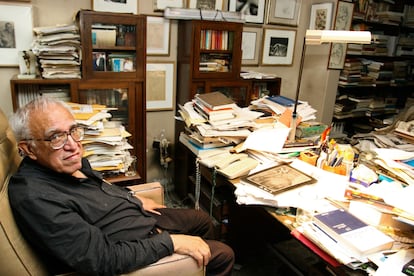

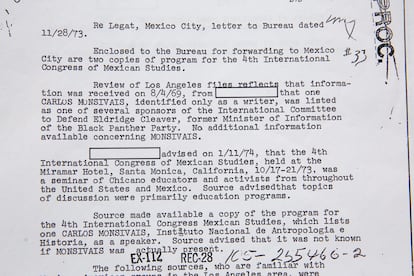
The first report reached the Federal Bureau of Investigation (FBI) on August 4, 1969. An informant claimed that the Mexican writer Carlos Monsiváis (Mexico City, 1938–2010) and other prominent figures had expressed support for Eldridge Cleaver, one of the best-known leaders of the Black Panthers, who was then living in exile in Algeria after being accused of attempting to kill two police officers in California. That public backing of someone the U.S. government considered one of the country’s leading radical figures was enough to put the author of Mexican postcards on Washington’s blacklist, according to declassified FBI documents obtained by EL PAÍS.
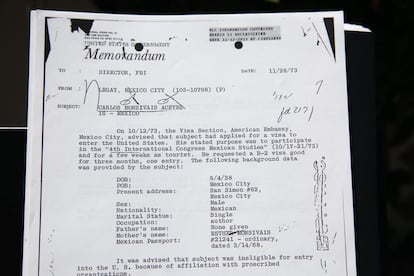
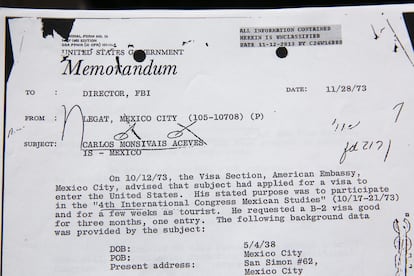
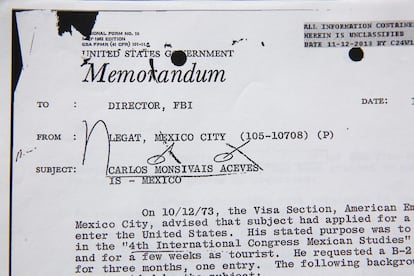
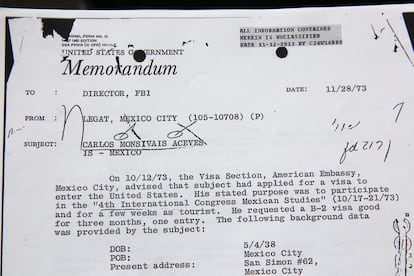
Four years later, in November 1973, the agency again turned its attention to Monsiváis. The writer had applied for a tourist visa to attend an academic conference organized by the University of California, Los Angeles (UCLA). The visa was granted without delay, but intelligence services triggered alerts.
“It was reported that the individual was not eligible to enter the United States due to his affiliation with proscribed organizations,” notes a report the U.S. Embassy in Mexico City sent to the director of the FBI. By “proscribed” the diplomatic mission meant banned groups, including the Black Panthers and activists from the Chicano movement, who at that time were leading mass protests against the Vietnam War in Los Angeles.
Political tensions in southern California were at one of their most volatile points. That same year, outrage intensified after the death of journalist Rubén Salazar. A tear gas projectile fired by a police officer struck the Los Angeles Times reporter in the face and killed him while he was covering a Chicano movement demonstration in the city. The FBI feared Monsiváis might add fuel to that fire.
Interested in US dissent
Considered the father of modern chronicling in Mexico, Monsiváis was a consistent critic of U.S. interventionism, particularly the influence Washington exerted across Latin America. He was concerned about Mexico’s political, economic and cultural subordination to its northern neighbor, as well as the criminalization of migrants.
Mexican intelligence agencies also kept close watch on the author of A new catechism for recalcitrant indians. A file from the Directorate General of Political and Social Investigations (DGIPS), cited by El Universal, described him as an “indecipherable specimen” and a “resentful individual,” and accused him of having profited personally from the Tlatelolco student massacre that occurred on October 2, 1968.
An old interview published a few days ago by El Universal again placed Monsiváis at the center of discussion. In the piece, the chronicler allegedly made several references to former Mexican president Andrés Manuel López Obrador; however, the journalist Edmundo Cázarez was unable to confirm the interview’s authenticity when the outlet requested the recording. The newspaper apologized and withdrew the story.
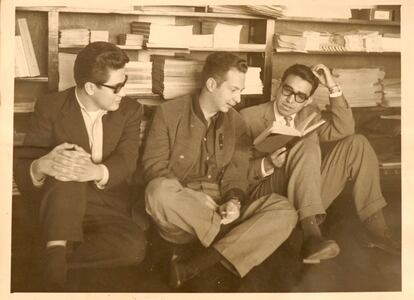
Monsiváis lived in the United States for a time during the 1960s, where he closely observed the civil rights struggles and social movements that transformed that era. “One felt that you were seeing something different, something that would necessarily permeate Mexico, which to a large extent is shaped by American influence,” he said in 1997 on a television program of the City University of New York (CUNY). “All these movements of the ’60s had a formidable consequence by creating what didn’t exist in Mexico,” he added.
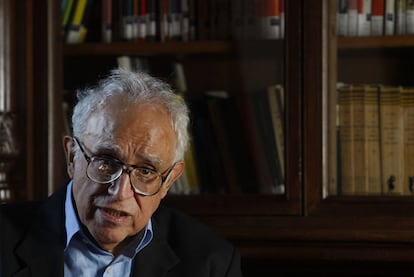
People close to the writer say he always maintained an interest in U.S. resistance groups. “All expressions of political and cultural independence within the United States: the Chicano movement, the Black Panthers, the Students for a Democratic Society. He had the ability to approach them, ask questions, observe how they lived. He was interested in the nature of dissidence within the United States,” recalls the Mexican historian Lorenzo Meyer, who took part in the 1973 academic convention for which Monsiváis applied for a tourist visa. “He was very eager to know what was happening north of our border regarding critiques and dissidence of imperialist policy.”
Meyer recalls the event with difficulty: the Fourth International Congress of Mexican Studies, held over five days in October 1973 at the Miramar Hotel in Santa Monica, California. The historian participated on the ‘Political Parties’ panel, while Monsiváis attended the first day of the event on the panel ‘Past, Present and Future of Contemporary Mexico,’ where he shared a session with the poet José Emilio Pacheco.
“It was a fairly large meeting, but there was no extraordinary incident worth remembering. It was one of many encounters between U.S. and Mexican academics. Politicians also attended. Among them was the man who years later would become president of Mexico: (José) López Portillo,” Meyer recalls.
The L.A. investigation
The FBI wanted to know what the writer had done in the days following the UCLA conference. Monsiváis stated on his visa application that he would remain in the United States for a few more days visiting, without specifying where he would be or with whom. His information card identified him as “author,” “single,” residing in “San Simón,” and the child of “Esther Monsiváis.” In the field for the father’s name, the embassy wrote: “He did not provide it.”
In December 1970, an informant claimed that Monsiváis was “one of the members of the ‘Nueva Izquierda’ (New Left) group in Mexico that published a magazine distributed in local universities,” according to an FBI document. The source said the publication had no name and that Monsiváis, along with other figures, had collaborated with the organization since May 1963.
In light of that allegation and the possibility that the writer had participated in Chicano movement activities in Los Angeles, the FBI ordered new sources to be sought who could provide information about his visit. “Based on the results of these inquiries in Los Angeles, a determination will be made as to whether to conduct further investigations on this matter,” the document states.
On January 15, 1974, another FBI report recorded the agency’s efforts to reconstruct Monsiváis’s participation in the UCLA academic congress. Agents obtained the event program, with the participants’ names, and a source told them the discussions had focused mainly on “educational programs.” But they could not confirm whether the Mexican writer had attended.
Because of that uncertainty, the FBI turned to another informant, described in the file as a person “familiar with Mexican-American groups in Los Angeles.” Agents interviewed this person three times between December 14, 1973, and January 8, 1974. The response was unequivocal: they said they “were unable to provide information” about Monsiváis, meaning they had not seen him at any events in the city. Even so, the government asked its informants “to remain alert for any information concerning the subject.”
Shortly thereafter, the FBI closed the inquiry. “In view of the fact that there are no outstanding leads in this matter, (the FBI office in) Los Angeles is not conducting any further investigation,” the report concludes.
For Lorenzo Meyer, these declassified documents reflect “an example of idleness by U.S. intelligence services” and “a waste of time and stupidity by the FBI in spending American taxpayers’ money following figures like Carlos Monsiváis.” The historian believes the writer’s critical positions and his closeness to activists were well known and did not justify an investigation of this kind.
Monsiváis continued traveling to the United States in subsequent decades and his criticism of Washington never abated. He died in June 2010 at the age of 72. “The interesting thing is he never had restrictions on going to the United States,” Meyer says. “Until his death he continued going back and forth.”
Sign up for our weekly newsletter to get more English-language news coverage from EL PAÍS USA Edition









































