
Solomy Balungi Bossa, member of the International Criminal Court: ‘Trump views us the same way as terrorists and drug peddlers’
The 70-year-old Ugandan is one of the ICC judges sanctioned by Washington due to the court’s ongoing investigations involving the United States and Israel
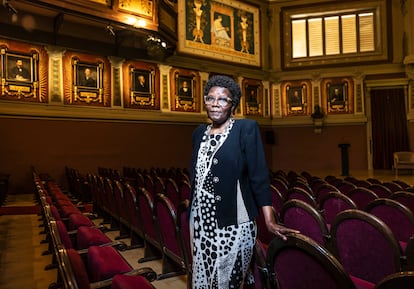

Solomy Balungi Bossa, 70, is a Ugandan appeals judge at the International Criminal Court (ICC). She’s one of the judges who have been sanctioned by President Donald Trump for conducting investigations involving the United States and Israel.
She recently participated in an event in Madrid that was part of a campaign organized by the Eumans civic movement and No Peace Without Justice (NPWJ) — supported by six Nobel laureates — to defend the work of international justice. Before joining the ICC in 2018 for a nine-year term, Bossa worked at the United Nations International Criminal Tribunal for Rwanda (ICTR).
Question. During a public event, you once said: “I became a judge to help women.” What’s the first instance of discrimination you remember?
Answer. The Uganda Women Lawyers Association had a legal aid project for women who had problems with the law and who were indigent. It’s really the first time I realized the dire situation in which women find themselves, for no fault of their own. Society is structured like that.
I represented a client who was a nurse and the man said, “Don’t go to work. Sit around and look after the children.” So she quit her career. Then, the man turned against her. He sold all their property. We were in and out of court.
One woman came to us and said: “I have AIDS. I was infected by a man who died and now his family says I killed him. They want to throw me and the children out of the house. I have nowhere to go.”
This experience exposed me to the structural problems of our patriarchal society. The law isn’t very helpful, either. At that time, divorce grounds were different for men and women. Women were prevailed upon not to complain, even when there was domestic abuse. It still happens.
When I became a judge, I thought I could make a difference in the pronouncements I made.
Q. You’re an appeals judge at the International Criminal Court. Previously, you worked at the United Nations International Criminal Tribunal for Rwanda (ICTR). You’ve received several awards over the course of your career. But do you still feel, from time to time – in work meetings or in your daily life – that there’s someone in the room who undervalues you because you are a woman?
A. Yes. That has never stopped. It depends on the man you are interacting with, of course. You come across countries and laws that govern the entire world, and they’re skewed in favor of men. This is a continuous struggle for women. We’re not seen in the same way as men on the international scene. In fact, I believe that, in the International Criminal Court, we’re [only] there because they made specific rules to ensure gender representation.
Q. A judge accumulates many human stories. Of all the ones you’ve heard throughout your career, is there one that particularly moved you?
A. That’s a difficult question. There are [various cases] of murder, for example. Sometimes it’s the force or the cruelty that’s unleashed on the victim. Even for domestic crime, it can move you: there’s a case that can stick [in your mind] and you can never forget it. But at the international level, [the cruelty] is so much more magnified. It’s unleashed on so many innocent people, with no signs of contrition from the perpetrators – it really shakes one’s belief in humanity. I would name the Rwandan genocide, because I tried several cases [related to] that situation.
Q. What has your work taught you about human nature?
A. My assessment is that human nature has not changed one bit. We are still unnecessarily cruel, selfish. I don’t know how to describe our situation. But also, there’s a lot of good that good people do. Unfortunately, the bad things outshine the good.
Q. Last year, the Trump administration sanctioned you and your fellow colleagues at the International Criminal Court following separate investigations linked to American and Israeli officials in Afghanistan and Gaza. What exactly do these sanctions entail? And how do they affect you personally, the ICC and the NGOs that you collaborate with on the ground?
A. These sanctions are a disaster. First of all, they’re a shock to us as professionals doing our work. Secondly, they don’t [bode] well for the course of international justice. Judges should not be punished for doing their work. Even internet banking becomes difficult, because you can’t update any app [or transfer money]. All [the banking apps] are related to the U.S. system.
Q. And do these sanctions also have an impact on the Gazan population?
A. Sanctions do have an impact on Gaza’s population. [They have] an impact because judges feel coerced. If the people who investigate these crimes – [the people] who would be able to provide the evidence – are sanctioned and they cannot assist the prosecutor, what does that tell [us] about law and order in the world? It is a threat to the individual judges. It’s a disaster for the victims of international crime.
Q. What do you think Trump was trying to achieve with that decision?
A. Our interpretation isn’t very different from what governments have told us: they want to see a change of attitude. That means that they want us to decide the cases as they want them to be decided. But that’s not our duty. Our duty is to decide the cases based on the facts and the law.
Q. This past April, the Coalition for the International Criminal Court called on the European Union to protect them from Trump’s sanctions. Has that appeal been sufficiently heeded?
A. They’re trying, especially after the last meeting [of the Assembly of State Parties, the ICC’s management oversight body, composed of representatives of EU states]. This gave us hope that they’re ready to fight for the court. They rallied and condemned the sanctions. But the process is slow and tedious. As you know, the European Union has failed to pass the blocking statute, an instrument to neutralize the effects of foreign sanctions, which would have alleviated the situation.
There have also been judges who dealt with the situation in Ukraine, and who were issued with arrest warrants [and were] tried and convicted in absentia by Russia. That’s another situation we’re dealing with.
Q. Would you say that the way Trump treats the ICC – given these sanctions – is more like how one treats a criminal or a terrorist organization, rather than an institution that works for peace and justice?
A. The conclusion isn’t misplaced, because this executive order lists us sanctioned judges as terrorists, drug peddlers… we’re all in the same category. That’s how he views us.
Q. Earlier this year, Venezuelan opposition leader María Corina Machado presented her Nobel Peace Prize to Trump. On the framed medal, she inscribed her gratitude to him for “promoting peace through strength.” Is that even possible? Why do you think force and military action seem to be viewed more favorably now than deterrence?
A. Initially, the world order was put in place to ensure that people don’t use power to attack others and disrupt world peace. There have [since] been rules that have been governing this. Of course, they’ve been broken sometimes and there have been consequences for breaking those rules… [but] now, it appears that there are no consequences. The people who have the power and the might can do whatever they want. That’s the worrying trend.
Q. The ICC was created to combat impunity and prevent genocide, war crimes, and crimes against humanity. After what happened in Gaza and Ukraine, do you think international judicial institutions are losing credibility? Is it more difficult now than it was five years ago to invoke the enforcement of international human rights law?
A. That depends on what world leaders do, because they have the power to restore [the] status quo. Governments must restore world order. Because, without the rule of law, I don’t think there’s much that can be done.
I wouldn’t say that the courts are to blame for the situation they find themselves in. The courts were set up by the states. It’s incumbent upon those states to ensure that the courts function optimally. I think it’s their primary responsibility. The citizens and international organizations and all the rest have only [a] secondary responsibility, in my view.
Q. Do you think the international community could have done more to prevent or stop the massacre in Gaza?
A. That’s a very difficult question. The international community needs to do more. But not only in Gaza. There are massacres in Sudan, the Democratic Republic of Congo, Mali, Ukraine... and none of them should be happening in this century, not after the world powers established the Nuremberg trials or after the Rwandan genocide, when it was said, “Never again.” Every institution must do its part.
Q. How often does frustration arise when working at the International Criminal Court?
A. (Laughs) It’s not easy to be a judge in the first place. A judge’s life is very, very lonely, because a judge is not allowed to do many things. When you add sanctions, it gets even more lonely and more difficult. But we have to be resilient and we have to try our best. The circumstances really leave us in bad shape, but we soldier on.
Q. What was your last moment of satisfaction within the ICC?
A. Maybe [it will come] when I successfully finish my term and the sanctions against me are lifted. Because I think, then, my contribution will be realized. The fact that I’m sanctioned means that some quarters view me as not having been doing a good job. But of course, that doesn’t matter to me very much, because my conscience is very clear. I do what I do because I believe it’s right.
Q. How do you think the suspension of Chief Prosecutor Karim Khan – after being accused of sexual harassment – might affect the reputation of the ICC?
A. The jury is still deliberating. We don’t know what the evidence is or what the verdict will be. I only hope that the way this matter is handled leaves the reputation of the International Criminal Court intact.
Translated by Avik Jain Chatlani.
Sign up for our weekly newsletter to get more English-language news coverage from EL PAÍS USA Edition









































