
Genocide, the power of a word: A history of the crime of crimes
Coined to define the Nazi massacres, it has become the most discussed word of the year. Leading world experts reflect on its legal, political, and moral significance amid the Gaza war


In the spring of 1994, as Hutu murderers known as the Interahamwe (those who fight together) perpetrated the genocide in Rwanda (800,000 Tutsis and moderate Hutus were killed in three months), the White House decided to look the other way. “The United States did virtually nothing to try to stop it,” wrote Samantha Power in her book, A Problem from Hell: America and the Age of Genocide. Published in 2002, the impact of this essay by the American diplomat was enormous because it held up a mirror to the United States — and the world — as hundreds of thousands of people in Cambodia, Iraq, Rwanda, Bosnia, and Kosovo were murdered for their religious, national, or ethnic affiliation. The wind of realpolitik had swept away the “never again” that seemed to have settled in the international consciousness after the Second World War and the Nuremberg and Tokyo trials against the war criminals of Germany and Japan.
Power recounts how, although members of the U.S. administration during the era of Democrat Bill Clinton used the word genocide in private, they were prohibited from doing so in public. If the United States had publicly acknowledged that a crime of this magnitude was taking place, it would have been impossible to explain its passivity. “They were afraid that its use would trigger calls for intervention that they were unwilling to comply with,” writes Powers, who served as Barack Obama’s ambassador to the United Nations.

The word genocide was coined by Polish jurist Raphael Lemkin during World War II, combining the Greek prefix genos, meaning tribe, and the Latin suffix cide, meaning killing, to designate what Winston Churchill had called “a crime without a name” in reference to the atrocities of Nazism in occupied Europe. When he first defined it in his book Axis Rule in Occupied Europe, written in 1943 and published in 1944, Soviet troops had not yet liberated Auschwitz, and the gas chambers were still a secret that many refused to believe. The jurist was also unaware that most of his family had been murdered in the night and fog of the Nazis. Lemkin had in mind the Armenian genocide carried out by the Ottoman Empire at the beginning of the 20th century and the boundless brutality of the Nazi occupation. In fact, in the essay and in his autobiography Totally Unofficial (Berg Institute) he makes as many references to the suffering of Poles and Slovenians as to that of the Jews.
For Lemkin, for example, “destroying or degrading the economic foundations of national groups” leads to genocide, as he explains in the chapter dedicated to explaining the term in his book. He argues that the Nazis created objective conditions under which national groups such as “Jews, Poles, or Slovenes” had to carry out “a genuine daily struggle for bread and survival.” For the Polish jurist, genocide “does not necessarily signify mass killings,” but “refers to a coordinated plan aimed at destruction of the essential foundations of the life of national groups so that these groups wither and die like plants that have suffered a blight.”
Published 15 years after Samantha Power’s essay, another book on the word also had a huge impact. A cross between an autobiography, an essay, and a true-life novel, East West Street, by international law expert and late writer Philippe Sands, is one of the most interesting works on the birth of universal justice. “I receive about 20 requests a week to talk about the book and about genocide,” explains Sands by phone from London. “I suspect it played a role in the global reflection on crimes against humanity and genocide, but it also came out at a time when these issues were increasingly occupying a prominent place in public debate due to current events around the world.”

The book combines the story of Sands himself, part of whose family was exterminated during the Holocaust, with the account of the inventor of the concept of crimes against humanity, Hersch Lauterpacht, and his rivalry with Lemkin. The destinies of these two jurists and Sands’ grandfather, Leon Buchholz, intersected in Lviv, now in Ukraine, a city where many paths of European history converge.
The underlying reflection is whether there is a hierarchy between crimes against humanity — the murder of individuals — and genocide — which pursues the annihilation of human groups for what they are — and whether we can speak of a gradation in the legal and historical narrative of horror. “There is no hierarchy between the two,” explains Sands. “In legal and human terms, they are equally terrible. But in the popular imagination, the concept of genocide has gained a lot of ground, although I refuse to accept it. This is due to the power of the word invented by Lemkin. The concept of genocide opens up avenues in the imagination. Words have enormous powers, and this one has a special power.”
With the Israeli massacre in Gaza, the concept of genocide has once again gained great relevance in public debate: in talk shows, parliaments, conferences, expert debates, newspapers, the United Nations, and in political strife, the word appears again and again. This report does not purport to determine whether or not a genocide is occurring in the Gaza Strip due to the Israeli offensive following the Hamas-led attacks of October 7, 2023, although a growing number of humanitarian organizations, historians, and experts — both Israeli and international — consider this an indisputable fact. In a moving interview last August with La Repubblica journalist Francesca Caferri, Israeli writer David Grossman stated about Gaza: “Now, with immense pain and a broken heart, I have to face what is happening before my eyes. Genocide. It’s a word that causes avalanches: once you utter it, it only gets bigger, like an avalanche. And it brings even more destruction and suffering.”

The Israeli government vehemently denies this, and almost no politician, with the exception of Spain’s Prime Minister Pedro Sánchez, has dared to utter the word that designates absolute evil. When asked specifically about this issue in May, French President Emmanuel Macron asserted that it should be historians who determine, in the future, whether the barbarity in Gaza constituted genocide. Other politicians believe that international courts should rule.
Genocide is an enormously powerful and often controversial concept. Although all independent historians consider that the Armenian people suffered genocide at the beginning of the 20th century, Turkey continues to prosecute anyone who dares to say so. Although the word existed and appears in the prosecution documents, the Nazi leaders were not convicted of genocide at Nuremberg. International justice has never considered the greatest crime in history, which bears no comparison, to be genocide.

Israeli historian Omer Bartov, a professor at Brown and author of books such as Tales from the Borderlands: Making and Unmaking the Galician Past and Genocide, the Holocaust and Israel-Palestine: First-Person History in Times of Crisis, made waves internationally when he published an op-ed in The New York Times last July entitled I’m a Genocide Scholar: I Know It When I See It. “The crime of genocide has existed since ancient times,” he explains via email. “But it wasn’t defined as the crime of crimes until the 20th century, when the technical and bureaucratic means became available to perpetrate it efficiently against entire groups. Modern genocide is, in many ways, the result of the redefinition of groups as nations, especially the rise of ethnonationalism, as well as ideologies dedicated to defining unwanted biological, religious, ethnic, racial, or social groups and the means to eliminate those defined as enemies.”
As a Holocaust historian, Bartov explains that one of the major problems in reaching a consensus on whether a genocide has occurred is precisely the impossibility of comparing any other crime with the Shoah. “When we say that a genocide is taking place, we must examine not whether it is similar to the Holocaust, but whether it fits the UN definition of genocide.” Two historians, Daniel Blatman and Amos Goldberg, argued a similar thesis in the Israeli newspaper Haaretz in an article entitled There is no Auschwitz in Gaza, but it is still a genocide.
“It’s often said that the Genocide Convention was a reaction to the Holocaust. I think this can only be a partial explanation,” notes William Schabas, professor of international law at Middlesex University London and a leading expert on genocide, author of books such as The Trial of the Kaiser (Berg Institute) and Genocide in International Law (Cambridge University Press). “When the Second World War ended, with perhaps 65 to 70 million dead, and where the most inhumane atrocities were committed by countries that considered themselves the most advanced in many respects, the whole world wondered how humanity had gotten to this point. It was the culmination of hundreds of years marked by colonialism and slavery, sustained by the idea that some groups — races — were superior to others.”

Beyond Rwanda in 1994, the wars in the former Yugoslavia — most notably the massacre of 8,000 Muslim men by Serbian paramilitaries in Srebrenica in 1995 — and Cambodia under the Khmer Rouge regime between 1975 and 1979, no other massacre has been deemed a genocide by international justice. There are currently two open cases before the International Court of Justice in The Hague (which judges states and should not be confused with the International Criminal Court, also based in the Dutch city, which tries individuals): one against Myanmar for the Rohingya massacre and another against Israel for Gaza. No state has so far been convicted of genocide. Meanwhile, the International Criminal Court has issued arrest warrants for Benjamin Netanyahu and his former Defense Minister Yoav Gallant for war crimes and crimes against humanity, but not for genocide, at least not for now.
However, the list of possible genocides is depressingly endless. And that’s only if we’re talking about the 20th century: many experts believe there’s no time limit, although if crimes prior to Lemkin’s definition aren’t considered genocides, slavery and colonialism would be excluded from this infamous category, something that suits Western countries. Alfred de Montesquiou, writer of the comic book I, Julius Caesar, which reconstructs the life of the military leader who brought down the Roman Republic, and author of a recently published novel in France about the Nuremberg trials, Le crépuscule des hommes (The Twilight of Men), recalls that Pliny the Elder described Caesar’s atrocities in Gaul as humani generis iniuriam — “a crime against humanity” — for his savage and ruthless behavior.
Armenia, the Holodomor in Ukraine, Guatemala, East Timor, Cambodia, Sudan, Ethiopia, Sierra Leone, Liberia, the massacres of the Hazaras in Afghanistan, of the Kurds and Shiites in Iraq under Saddam Hussein, the massacres of the Herero and Nama in Namibia at the beginning of the 20th century — which Germany recognized as genocide a hundred years later — of the Yazidis by ISIS, the mass murders in the wars of the former Yugoslavia beyond Srebrenica… All these atrocities are considered genocides by many historians and jurists. And of course the Holocaust, the murder of six million European Jews, but also of Roma, Russian prisoners of war, Poles, and disabled people, although, as Elie Wiesel wrote, “Not all the victims of Nazism were Jews, but all Jews were victims of Nazism.”

These massacres are similar in their horror and hatred. Genocide is always the end of a process, in which the other is stigmatized until it becomes an enemy that must be annihilated. In his heartbreaking and beautiful book of personal and intellectual memoirs, Genocide, The Holocaust and Israel-Palestine, Bartov coined the concept of the “intimacy of genocide.” The gas chambers of the Nazi extermination camps are an exception — industrial and anonymous death — because in many mass crimes, the murderers and victims have known each other, sometimes since childhood. They have lived together all their lives. There are many accounts of this, from the religious wars in Europe to the Spanish Civil War, the Holocaust by bullets — the mass shootings in Eastern Europe during which citizens of occupied towns collaborated with the Nazis — or the genocides in Rwanda and Bosnia.
French writer Jean Hatzfeld covered the wars in these two countries as a journalist and captured his research in books such as Machete Season and Dans le nu de la vie (In the nakedness of life), in which he analyzed the mechanisms of hatred. In an interview with this newspaper in 2004, he explained that, precisely because the murderers are often neighbors, friends, or schoolmates, it can be said that “no one is protected from behaving like them. No one is safe from falling into barbarism.”
But there’s one thing all experts agree on: genocides are not a matter of numbers. Rosa Ana Alija, professor of public international law at the University of Barcelona, explains: “The crime of genocide punishes the attempt to totally or partially destroy a racial, national, ethnic, or religious group; it gives precedence to the collective dimension, to the preservation of the diversity of human groups in international society. Crimes against humanity punish serious human rights violations, so they focus on the individual dimension, on safeguarding human dignity. Is the hypothetical destruction of, for example, 70 members of some Amazonian tribes, numbering around 100, more or less serious than the death of tens of thousands of civilians in an armed conflict or in a context of political violence? I think making that assessment is very difficult.”
There are several definitions of genocide, and as Philippe Sands pointed out in an important article in Le Grand Continent entitled On the Concept of Genocide, there is also a body of case law, which could change when the International Criminal Court rules on the cases of Myanmar and Gaza in the future. First, there is Lemkin’s definition in the prologue to his book: “Genocide is the practice of extermination of nations and ethnic groups by invaders [referring to Nazi Germany], a term derived from the Greek word genos (tribe, race) and the Latin cide (by analogy, see homicide, fratricide).” That definition crystallized, after enormous efforts by the Polish jurist, in the Convention for the Prevention and Punishment of the Crime of Genocide, adopted in 1948, which entered into force in 1951 and has been ratified by 153 states (41 UN members have not yet done so). Israel signed it in 1949, and Spain in 1968, still under Franco’s dictatorship, which some historians consider to have committed genocide in the repression during and after the Civil War.
The text reads as follows: “In the present Convention, genocide means any of the following acts committed with intent to destroy, in whole or in part, a national, ethnical, racial or religious group, as such: (a) Killing members of the group; (b) Causing serious bodily or mental harm to members of the group; (c) Deliberately inflicting on the group conditions of life calculated to bring about its physical destruction in whole or in part; (d) Imposing measures intended to prevent births within the group; (e) Forcibly transferring children of the group to another group.”
Melanie O’Brien, associate professor of international law at the University of Western Australia and president of the International Association of Genocide Scholars — which declared that one is occurring in Gaza — notes: “Genocide is different from other crimes because it has unique requirements, specifically ‘genocidal intent,’ which is the intention to destroy, in whole or in part, a national, ethnic, racial, or religious group. This intent is the most difficult element to prove in court. Genocide also has a different status because we have the Genocide Convention, which obligates states to prevent and punish genocide. There is no equivalent treaty for war crimes or crimes against humanity, so states are reluctant to declare an atrocity as ‘genocide,’ as they don’t want to trigger the obligation to prevent and punish.”
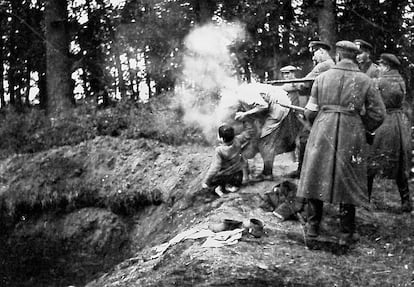
Jurisprudence also makes it very difficult for the International Court of Justice to consider genocide to have occurred. Sands explains in his article that the key lies in the enormous difficulty of proving genocidal intent, but also in a condition that led to Croatia’s genocide complaint against Serbia being dismissed in 2015: “If there are two possible motives for committing a crime, it is not easy to qualify it as a crime of genocide.” In other words, proving intent is not enough: if a state is involved in a war and commits genocide, the International Court of Justice considers it not genocide. It only considers genocide to have occurred when the sole objective is genocide itself.
Beyond the court rulings and the legal conundrums, the idea Bartov put forward in his article remains valid: many experts, historians, and legal scholars who have thoroughly studied what humanity is capable of inflicting on humanity know how to recognize genocide when it occurs. “Art is an important way for people to learn about or engage with genocides,” explains Melanie O’Brien, citing the Beyond Genocide series by American artist Amy Fagin as an example. “Each piece is based on Fagin’s meticulous research into that particular genocide, but also incorporates artistic elements from the victim group, including their language. These are incredible illuminations that transcend histories and cultures.” Other experts cited Angelina Jolie’s film about the Cambodian genocide, First They Killed My Father (2017) — also reflected in The Killing Fields (1984) and Camboya, 1978 (2024) —and Franz Werfel’s The Forty Days of Musa Dagh, in which the Austrian writer thoroughly investigated the Armenian extermination and who recounts not only the horror but also the resistance to that horror. Bartov cites Claude Lanzmann’s Holocaust documentary Shoah (1985), and Raoul Peck’s HBO film Sometimes in April (2005), “because it gives a comprehensive view of the Rwandan genocide, from the run-up to its outbreak to its prosecution before the International Criminal Tribunal for Rwanda, including the inadequacy of the international response, which was decisive in bringing it about.” It is also difficult not to be stunned by the banality of the evil depicted in the film about Srebrenica, Quo Vadis, Aida? (2020).
Genocides are also a warning for the future. “Historians surely know better than anyone that history never repeats itself, and that what was will never return: we can study the past — indeed, we must study it — but we cannot change it,” writes Bartov, explaining that genocides cannot be reversed, that the traces of death, of absence, will never disappear. But it is also more important than ever to look to the past when the international order is crumbling by the week. “The system created after World War II is under attack like never before. I think there are many people in power, including populist governments, who would like to take the world back to a time when those rules of international law did not exist. Whether they succeed is another matter,” writes Sands. In these times, the word genocide, and its history, are more important than ever.
Sign up for our weekly newsletter to get more English-language news coverage from EL PAÍS USA Edition









































