
Flight instructor jumps midflight and his student manages to land the plane
The 42-year-old opened the aircraft door and jumped while accompanying a young woman on a training flight in Argentina’s Córdoba province
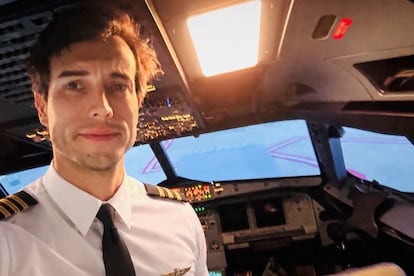
“You know what you have to do, keep going forward.” Those were the last words flight instructor Leandro Bertazzo said to his 22-year-old student, Rosario. He then removed his headset and seatbelt, set his cellphone aside, opened the aircraft door and jumped into the void from a height of 250 meters. The trainee managed to report what had happened and safely land the plane. Twenty minutes later, Bertazzo’s body was found in a rural area south of the Argentine town of Toledo, in Córdoba province.
The incident happened last Saturday at the Coronel Olmedo aerodrome, about 700 kilometers (433 miles) from Buenos Aires. According to people who worked with Bertazzo, nothing suggested the day would end this way; it began like any other. The case is being investigated by federal prosecutors in Córdoba, who will seek to establish the circumstances surrounding the incident and carry out forensic examinations.
The student already held a private pilot license but still needed additional flight hours to complete her training. From the air, she reported what had happened aboard the two-seat Cessna 150 to Eduardo Álvarez, owner of the Flying Parrot flight school.
“That day we saw Leandro as we always did. He arrived cheerful, greeting everyone with kisses as usual. The only odd thing was that, instead of arriving in his car as he normally did, he had asked a student to pick him up at the house where he lived with his parents in a neighborhood in Córdoba city. They arrived chatting happily,” Álvarez told the Argentine newspaper La Nación.
Once Rosario landed, it was Álvarez who took off again to identify the coordinates of the fall site and alert authorities, who dispatched officers from the Rural Patrol Unit and emergency personnel.
According to Álvarez, Bertazzo’s psychophysical exams were up to date, and he had been in good spirits because he was applying for a position with a major airline, a professional goal he had long pursued. Shortly before flying with his student Rosario, the instructor had gone out on another flight with a colleague for a refresher training trip. “We didn’t notice any anomaly, nothing that could have led to this outcome,” Álvarez said.
However, the family later said the pilot, who was single and had no children, was going through a “bad time” and was undergoing psychiatric treatment related to personal matters. Álvarez described him as an “excellent professional” who was “always cheerful and inspired the admiration of all his students.”
The pilot, who arrived at work on time and well-dressed on the day of the incident, had nearly a decade of continuous training and experience in aviation. According to his social media profiles, he held an Airline Transport Pilot (ATP) certificate issued by the U.S. Federal Aviation Administration (FAA), the highest level of pilot certification.
The case recalled the tragedy of Germanwings flight 9525 in the French Alps, which occurred on March 24, 2015, when co-pilot Andreas Lubitz, a man with mental health problems, took control of the aircraft and deliberately crashed it, killing 150 people. The disaster led to the introduction of procedures aimed at ensuring pilots are not left alone in command of an aircraft and to stricter mental health oversight for flight crews.
Sign up for our weekly newsletter to get more English-language news coverage from EL PAÍS USA Edition









































