
Latin American mercenaries fight with Sudan’s paramilitaries amid civil war
The first deployment of Colombians to the country, coordinated by the UAE, was in 2024, but the network has expanded and now includes contractors from countries such as El Salvador
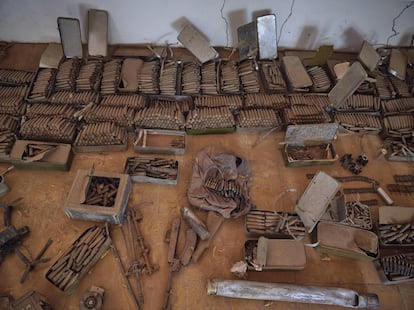

In late November 2024, the Joint Force of armed groups from Darfur, allied with Sudan’s regular army in the country’s civil war, released a video showing several of its members at a point in the desert that connects to Libya, examining a series of identification cards they had just found after ambushing an enemy convoy.
“Is this guy Sudanese?” the fighter handling the ID cards, which included the passport of a man named Christian Lombana Moncayo, asked rhetorically. “These people are not Sudanese,” he concluded. On some documents the word “Colombia” could be read, but the fighters failed to identify it and even mistook the logo of the Directorate General of Military Health (DIGSA) for the crest of the Paris Saint-Germain football club (PSG). “He’s French,” another militiaman guessed incorrectly.
In their hands they held the first evidence of the deployment of Colombian mercenaries to Sudan to assist the paramilitary Rapid Support Forces (RSF). The first soldiers had arrived only two months earlier after a stopover in the United Arab Emirates, a flight to Benghazi, Libya, and an approximately eight-day trip across the desert, according to the Colombian outlet La Silla Vacía.
Since then, however, the flow of military contractors has not only continued but expanded to other Latin American nationalities, and the network set up to sustain their deployment, training, and logistics has become more sophisticated and involved ever more countries in the region, according to press reports and recent investigations, as well as a source with direct knowledge of the operation who spoke to EL PAÍS.
At first, military contractors were recruited by the Colombian company Internacional Services Agency A4SI through vague job postings. In an advertisement on its website in September 2024 it sought, for example, drone pilots for Africa and offered a salary of $2,500 to $3,000, with accommodation, transport, and separate health insurance.
Once in the United Arab Emirates, Colombian mercenaries signed a second contract with Global Security Services Group, an Emirati company founded in 2016 by the secretary-general of the country’s presidential court, Ahmed Mohamed al-Humairi, and later transferred to his partner Mohamed Hamdan al-Zaabi, according to corporate records analyzed by the investigative organization The Sentry.
In December 2025, the U.S. Treasury Department imposed sanctions on four people and four entities in this transnational network involved in Sudan’s civil war, among them A4SI. In mid-April this year it extended them to five more people and entities, including Fénix, the company that replaced A4SI after it was sanctioned.
Those measures, however, have not halted the arrival of Latin American contractors. In Sudan, Colombian mercenaries operating under the name Desert Wolves have fought on multiple fronts, especially in Darfur, and their roles have included operating drones, artillery, and armored vehicles, as well as direct assaults, according to a 2025 complaint by Sudan’s military representative to the United Nations, Al-Harith Idriss. Contractors have also trained paramilitary fighters — including minors — coordinated propaganda campaigns, and carried out security and medical tasks.
The involvement of contractors in the war has drawn heavy criticism because the RSF has committed systematic abuses against the civilian population. Among them: executions, sexual violence, kidnappings, torture, and looting. In Darfur they have also carried out campaigns of ethnic cleansing. And in the capture of the city of El Fasher, a UN mission found indications of genocide. The conflict in Sudan has also caused the world’s largest humanitarian crisis.
The same source that spoke to EL PAÍS says, however, that the contractors are not only Colombian: there are also, albeit in smaller numbers, nationals from other Latin American countries such as El Salvador. The source adds that several Salvadorans died in the capture of El Fasher. A recording obtained by this newspaper refers to a more recent death of a Salvadoran. “I don’t know why they focus on Colombia when there are people from different countries,” the source insists.
In 2015, a few months after an international coalition led by Saudi Arabia launched a military campaign against Houthi rebels in Yemen, several outlets revealed that the United Arab Emirates, then aligned with Riyadh, had already sent hundreds of Colombian mercenaries and dozens from other Latin American countries to Yemen. Among them were Salvadorans.
The RSF mobilize mainly through tribal networks, and mercenaries from neighboring countries such as Chad and South Sudan have consistently served in their ranks, recruited through networks that often predated the current conflict. However, in the case of Latin American military contractors, the nodes that facilitate their arrival are different.
Since the deployment of Colombian mercenaries to Sudan via eastern Libya became public, their logistics have changed, relying on the network of regional allies woven by the Emirates, similar to the transfer of weapons. Still, their usual destination is Nyala, the capital of South Darfur, the RSF stronghold and the main entry and exit point for military contractors.
The EL PAÍS source highlights two main routes starting from Bogotá. The first stops in Paris and then goes to Dubai, from where contractors are moved to Abu Dhabi. The second lands in Nyala after passing through Madrid, Addis Ababa (Ethiopia), Bosaso, the capital of Puntland (Somalia), and Kufra (Libya). Another important node in this network is N’Djamena (Chad).
Before deploying to Sudan, many of the mercenaries receive training from Emirati military instructors at two bases in the emirate of Abu Dhabi — Ghiyathi and Al Wathba — Human Rights Watch (HRW) revealed at the end of May. The same source says some of these contractors also receive drone-piloting training at a base in Bosaso, and that other types of training take place in Kufra, which it declined to detail.
Once in Sudan, part of their role is to train local paramilitary fighters. “One teaches them many things,” the source says, noting that “the good thing is they are quite intelligent” and that some “learn Spanish very quickly, too.”
In addition to their military functions, some of these contractors have simultaneously taken on other tasks, including preparations to renovate at least three hospitals in areas controlled by the paramilitaries, another source familiar with the projects says. Recurrent army bombings in Nyala, however, are delaying those plans.
The RSF-appointed health minister in territories under their control, Alaa Nugoud, tells this newspaper they are working “on renovating hospitals” and that “there are proposals for [some] new ones.” And although he declined to specify nationalities, Nugoud acknowledges they are “open to hiring foreign experts to help with service provision, strategy, state-building, as other governments do.”
Despite the brutality of the war, social networks abound with Colombians willing to travel to Sudan. In a video posted in May on the TikTok platform about this recruitment, one user laments that after “retiring [from the army] it is almost impossible to get a good job,” while another asks directly “to go somewhere.” “Ready to go,” a third user assures, while another makes clear he is willing to “go anywhere.”
EL PAÍS contacted the Rapid Support Forces’ press office but had received no response at the time of publication of this article.
Sign up for our weekly newsletter to get more English-language news coverage from EL PAÍS USA Edition









































