
Lenacapavir, the revolutionary HIV drug, still hasn’t reached Latin America
Countries such as Brazil, Mexico, or Peru — which took part in Gilead’s clinical trials — have not yet received doses and are pressing for the patent to be broken
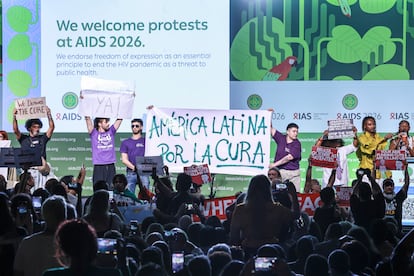
Two injections a year. That’s all it takes to protect against HIV with lenacapavir, a revolutionary drug hailed as potentially the beginning of the end of the epidemic, but its rollout has been slow. It has efficacy close to 100% and is already being distributed in small quantities in nine priority African countries. In middle-income countries such as those in Latin America it has not yet arrived, despite the fact that their residents took part in the clinical trials. The international HIV/AIDS conference held in Rio de Janeiro a few days ago was marked by protests against the pharmaceutical company that developed the drug and which, for now, holds the global monopoly: the U.S. firm Gilead Sciences.
“Tested in Brazil, denied to Brazilians,” “They use our bodies and then deny us access,” read some of the protesters’ signs on the opening day of the event. Countries such as Brazil, Mexico, Argentina, and Peru have been left out of access to the generic version of the drug, even though experts and organizations such as Doctors Without Borders (MSF) say lenacapavir could be produced for as little as $40 a year worldwide. In the United States, Gilead Sciences sells it for $28,000 per patient, including the two annual doses.
A year ago, the Global Fund and The United States President’s Emergency Plan for AIDS Relief (PEPFAR) reached an agreement with Gilead to supply this pre-exposure prophylaxis (PrEP) to two million people in low- and middle-income countries through 2028. Jared Baeten, the company’s vice president, said at a press conference at the Rio event that agreements have been signed with six generic drug manufacturers to supply 120 countries, and that 600,000 people are expected to be on treatment before the end of the year.
In April, the Global Fund announced it would expand its agreement to benefit three million people. That would allow lenacapavir introduction to be extended to 12 additional countries, including the Dominican Republic, Haiti, and Honduras. Although deployment has not yet begun, the Global Fund expects these three Latin American and Caribbean countries to receive initial batches before the end of the year and to begin distribution soon after. “We have been encouraging all countries that will receive lenacapavir to introduce it through a phased, operationally realistic approach, aligned with each country’s level of readiness, service delivery capacity, and available financing,” the organization told this newspaper by email.
However, activists and the UN say access to lenacapavir remains insufficient. “How can Latin America continue to be excluded from licenses for life-saving medicines?” Winnie Byanyima, executive director of the Joint United Nations Program on HIV/AIDS, denounced at the conference. In her view, it is entirely feasible to eliminate HIV as a global public health threat before 2030, but it all depends “on political choices.”
How can Latin America continue to be excluded from licenses for life-saving medicines?Winnie Byanyima, executive director of the Joint UN Program on HIV/AIDS
Pressure for lenacapavir to reach all of Latin America is not only an ethical issue — a moral obligation to compensate those who lent their bodies to science — but also a practical one. In Latin America, 2.6 million people live with HIV and, in 2025, there were 28,000 deaths related to the disease. While the global trend has been a decline in cases, the opposite has happened in Latin America: between 2010 and 2024 cases increased by 13%. In Brazil, the region’s most populous country, they rose by 25%, according to the Ministry of Health.
A quarter of new HIV infections occur in the countries excluded from current agreements to produce generics.
That is why, during the conference, activists stepped up pressure for Brazil to take the lead. “Gilead came here empty-handed, with empty words […] we want Brazil to lead and to be an example for everyone, to break the monopoly,” said Asia Russell, director of the organization Health GAP.
Brazil’s role right now could be pivotal, both because of its geopolitical weight and its size (more than 210 million inhabitants), and because it prides itself on having a universal public health system that, despite its shortcomings, is the largest in the world and excludes no Brazilian — nor foreigners. Brazil has a long record of success against the HIV/AIDS epidemic. In December last year, the World Health Organization certified the country for eliminating vertical transmission of HIV, from mother to child.
Health Minister Alexandre Padilha said this week that Brazil was willing to pay up to 19 times more for lenacapavir than the price offered to economically similar countries such as Indonesia or Thailand, but the company did not accept the proposal.
“Innovation without access is injustice. We look to these new injectable drug technologies with great hope […] but we demand that they be available, especially to national health systems, at reasonable, not astronomical, prices. We will not drain resources funded by taxpayers to benefit a single company,” the minister said at the start of the conference.
Innovation without access is injustice. We look to these new injectable drug technologies with great hope […] but we demand that they be available, especially to national health systems, at reasonable, not astronomical, pricesAlexandre Padilha, Brazilian Health Minister
In that context, calls are growing for Brazil to take decisive action and break the patent. Legally, the country could resort to compulsory licensing in situations deemed to be of public interest, as it did in 2007 with the antiretroviral efavirenz from the U.S. laboratory Merck. The price fell by 70%.
That option does not seem to be on the table, especially with Brazil in a more strained relationship than ever with the United States, cornered by tariffs and sanctions that last year affected the health minister himself. During the conference, the minister preferred not to speak about that more radical possibility and implied he still trusts in negotiations with Gilead. Pending arrival of the revolutionary lenacapavir, Brazil announced it will, for now, incorporate cabotegravir into public health care; it is also injectable but requires one injection every two months.
Sign up for our weekly newsletter to get more English-language news coverage from EL PAÍS USA Edition









































