
Jordan, in the unwanted crosshairs of the Middle East war
Iran has stepped up attacks against the Arab country, which hosts 4,000 U.S. military personnel, prompting a rare critique of its security alliance with Washington

On July 20, air-raid sirens suddenly sounded in Amman, the capital of Jordan. Iran had launched four missiles, which the army said were intercepted or fell in unoccupied areas. It is one of the latest examples of how the country has become — unwillingly and along with Kuwait — a primary target for Tehran’s missiles and drones in recent weeks amid a wave of attacks, threats, and dialogue sweeping across the Middle East. The situation has sparked an unusual debate about the price Jordan is paying for its close security alliance with Washington and has created the paradox that Jordan is suffering attacks that, since June, Israel — which promoted and launched the war last February in close coordination with the White House, and from where U.S. planes take off to bomb Iran — has not been facing.
Tehran has fired at least 60 missiles and drones at Jordan since July 8, when it engaged in new skirmishes with Washington, despite having agreed a ceasefire a month earlier. Proportionally, that is considerably more than the 125 attacks recorded in the previous three months.
Tehran directs its projectiles mainly at the bases that host 4,000 U.S. troops, and no Jordanian has died from Iranian strikes during the war. But Washington’s so-called security umbrella (dating from the 1950s) has had the unwanted side effects of air-raid sirens and occasional flight cancellations. That is no small matter in a kingdom that seeks to present itself as an oasis of stability in a turbulent region and that earns 18% of its revenue from tourism.
Thomas Juneau, associate researcher in the Middle East and North Africa program at the Chatham House think tank (UK) and a professor at the University of Ottawa, insists that Jordan’s “extreme vulnerability” leaves it “very few options to protect its security, both internally and externally.” “Although some have criticized it domestically, Jordan’s entire security architecture is built on its close relationship with the U.S. It made that decision long ago and has always been clear that the benefits outweigh the risks,” he told this newspaper by phone.
Washington is by far Jordan’s main ally and provided $1.65 billion in economic and military aid to the country last year. That exceeds the $1.45 billion committed over seven years in the 2022 Memorandum of Understanding. A year earlier, and without parliamentary procedure, the two countries signed a defense cooperation agreement. Aware of the criticism, Foreign Minister Ayman Safadi has insisted that Jordan does not host U.S. bases, as some other countries do; rather, they are Jordanian bases with U.S. troops stationed on them.
Juneau distinguishes two compatible factors. One is the “resentment” toward the Trump administration for having launched, over 6,000 miles away, a war that was “poorly planned and executed” and that “places Iran’s neighboring countries on the front line of the violence.” The other is that Iran’s aggressive strategy of making other countries pay the cost of their alliance with the U.S. has not prompted Jordan to question that alliance. On the contrary: “It only reinforces the idea that they have no other partners, however difficult the situation is today.”
Open letter
While the Iranian attacks reaffirm Amman’s view of the importance of its alliance with the world’s leading military power, they have also given rise to critical voices. Some 300 Jordanians, including former parliamentarians, activists, and tribal leaders (mainly from the left, pan-Arabist and Islamist currents), have signed an open letter calling for the “withdrawal of all foreign forces from Jordanian territory” because their presence “increases the likelihood that the country will be drawn into a regional conflict in which it is not a participant” and “exposes it to security, political, and economic risks that do not benefit any national interest.” “Jordan is not part of this war and its people should not suffer its consequences,” the letter says.
That is exceptional in a country where freedom of expression is constrained and where the Muslim Brotherhood was outlawed last year after being accused of planning a rocket and drone attack inside the kingdom. The party linked to the Muslim Brotherhood, then called the Islamic Action Front, won the 2024 legislative elections, driven by its criticism of the kingdom’s position — which it considered too soft — on Israel’s massacre in Gaza. But the king, Abdullah II, refused to appoint its candidate, Murad Al-Adaileh, as prime minister and instead named a trusted ally, Jafar Hassan.
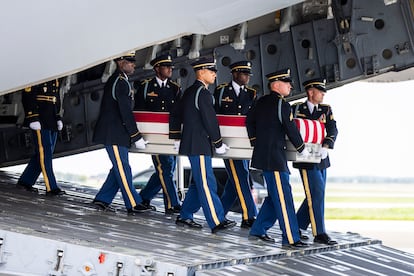
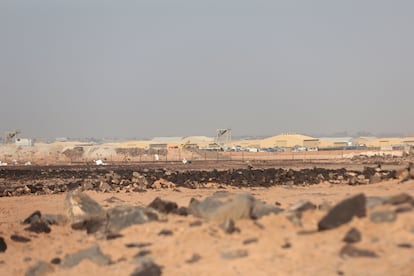
In an example of self-censorship, Jordanian media ignored the letter. Iran seized the opportunity to rub salt into the wound. The Islamic Revolutionary Guard Corps issued a statement thanking “the noble Jordanian people” for their “sincere solidarity” and — in an addition that is particularly worrying to the authorities — for the “precise information” they received from inside Jordan that allowed them to kill “dozens” of U.S. soldiers. That figure appears to be based in propaganda, but an Iranian missile and drone strike on the Muwaffaq Salti Air Base in the Azraq area killed three U.S. soldiers on July 17. To make matters worse, Donald Trump later leveled a rebuke at his loyal ally: “They did slip something through in Jordan, and if we had other operators, you know, would have not happened, unfortunately […] we let other people do the job, and sometimes it doesn’t work out so well.”
Polarization
Saud Al-Sharafat, a former brigadier-general in Jordan’s General Intelligence Directorate and founder and president of the Shorufat Center for the Study of Globalization and Terrorism, based in Amman, attributes the recent rise in attacks against his country to “an effort by Iran to raise the costs for the U.S.’s regional partners as military pressure on Iran itself intensified,” he told this newspaper by email. “It should be understood primarily as a strategic and political message” aimed at “increasing internal political polarization by presenting the government as acting on behalf of Israel or the United States” while undermining support for a strategic partnership that extends to intelligence cooperation against terrorism, border security, and military training and modernization, among other areas, and which “remains fundamental to long-term national security.”
Tehran has for years accused Amman of acting like a Western puppet in defense of Israel, with which it signed a peace treaty in 1994 and which it has helped intercept missiles aimed at its territory since June 2024, in the first direct confrontation between Israel and Iran. The risk to Jordan’s population, in fact, is not limited to attacks targeted at Jordan: before the ceasefire, most of the country’s casualties resulted from missile debris (or interceptors) falling on Jordanian soil that were intended for Israel.
And that is where Tehran has been stepping up pressure. Its defense minister, Majid Ebn-e-Reza, said last week that the current war had shown that the “countries of the Middle East themselves” must guarantee regional security, because “the presence of foreign forces increases distrust, uncertainty and insecurity.” That same Saturday, the commander of Iran’s armed forces, Ali Abdulahi, urged Muslim countries to “reconsider their cooperation and alliance” with the U.S., warning that they would “burn in the fire of war” if they acted as its “shield.”
Amman is not the only capital facing the dilemma over the benefits of embracing Washington. But unlike the Gulf states, it is particularly vulnerable without its umbrella. Created by the British in 1921 as Transjordan, it lacks natural resources, imports 95% of its oil and has large swaths of desert. Among its roughly 11 million inhabitants there is a delicate balance between Bedouin tribes and Palestinians, who are more sensitive to the actions of Israel and the U.S. in the Middle East.
To its north lies Syria, emerging from almost 14 years of civil war, with sporadic violence and smuggling networks. To the northeast, Iraq hosts militias loyal to Tehran. To its west are Israel (with relations at a low point, though not likely to rupture completely) and the West Bank, from which Israel’s far-right dreams of expelling the entire population to — precisely — Jordan.
Sign up for our weekly newsletter to get more English-language news coverage from EL PAÍS USA Edition









































