
Trump finds his own ‘forever war’ in Iran
The return to direct confrontation with Tehran underscores the difficulty the United States faces in securing a peace agreement and confronts the president with the kind of seemingly intractable conflict he once promised to leave behind forever

The hope of securing a more or less presentable agreement and moving on has vanished. On July 8, U.S. President Donald Trump declared the fragile ceasefire with Iran effectively over. “I don’t want to deal with them any more, they’re scum,” he said of the very same people he had described only days earlier as “very rational,” “strong,” and “smart.” Friday night was the first calm one after 13 consecutive days of attacks, after the White House considered raising the level of retaliation.
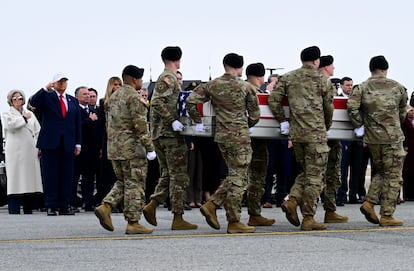
The conflict is once again spreading across the Middle East, with Yemen’s Houthi movement intervening by attacking Saudi oil tankers, while the global economy trembles as oil prices hover around $100 a barrel. Images of young U.S. service members killed in action have returned to U.S. television screens. The situation increasingly resembles a dead end, recalling the kind of endless wars in distant countries that Trump so often criticized and promised he would never start.
The examples are countless. Although the Republican leader recently claimed in an interview that he had never promised to keep the United States out of war, the record tells a different story. At a campaign rally in Pennsylvania in September 2024, two months before winning the election, he declared: “I will expel the warmonger from our national security state and carry out a much-needed clean up of the military-industrial complex to stop the war profiteering and to always put America first. We put America first. We’re going to end these endless wars.”
Those were the days when he portrayed his Democratic rival, Kamala Harris, as a hawk who would endanger world peace if she reached the White House. Or when, two months later, immediately after winning the election, he said he would not start any wars. If anything, he promised, he would end them.
All of that now seems a thing of the past. Israeli Prime Minister Benjamin Netanyahu is scheduled to visit Washington this week for the first time since February, when he convinced Trump of the need to attack Iran. Netanyahu had previously tried to persuade Democratic presidents such as Joe Biden and Barack Obama, as well as Republican President George W. Bush, but only the man who said he deserved the Nobel Peace Prize ultimately said yes.
Operation Epic Fury was supposed to last only a few days, then a few weeks. Instead, it has now dragged on for five months. Trump has claimed more than 30 times that it was on the verge of ending, but reality has repeatedly proved otherwise. “There are days when I feel as an American like a passenger in a plane being piloted by a 6-year-old,” David Axelrod, a former Obama adviser, wrote on X. “All you can do is hope and pray that it lands safely.”
At this point, it is impossible to know how long the situation will continue or whether it will escalate into a regional conflagration or remain contained as a low-intensity conflict. What is clear, however, is that no one sees an immediate way out.
“The war will continue because both Iran and the United States want things they cannot achieve either by agreement or on the battlefield,” Jennifer Kavanagh, director of Military Analysis at the think tank Defense Priorities, writes in an email. Contrary to theories suggesting that Israeli and U.S. attacks would spur citizens to rise up against a deeply unpopular regime, the Islamic Republic has not only endured but believes its position has been strengthened compared with the period before the bombing campaign began, when it was under severe pressure following the crackdown on the January protests.
The military analyst argues that Iran can continue its current battlefield strategy because its operations are relatively inexpensive. The United States, by contrast, has few viable military options. A ground invasion would entail enormous risks and obvious political costs, while limited strikes against selected targets are not enough to achieve Trump’s objectives. “As a result, the war has reached a stalemate. Both sides can continue as they are now, but that will only prolong the conflict,” Kavanagh concludes.
Brett Bruen, president of Global Situation Room and a former U.S. diplomat, holds a similar view. “Iran knows that Trump is vulnerable right now. Because of the economy, the midterm elections, and the low approval ratings of both the president and the war. The regime will exploit that weakness to raise its demands,” he says in a telephone interview.
18 dead and $37.5 billion
Meanwhile, the costs to the Republican administration continue to mount, on human, economic, and political levels. The number of service members killed since the start of the war has risen to 18.
In a puzzling maneuver, the military casualty database suddenly revised the death toll this week from 18 to 14. U.S. media later reported that the names of four soldiers killed the previous weekend, three in Jordan and one in Iraq, had been removed on the grounds that they died after Trump had declared a ceasefire in April.
Clearly uncomfortable with comparisons between this conflict and earlier wars that drained U.S. resources and lives, Trump posted a message on his social media platform, Truth Social, intended to show that he had not repeated the mistakes of previous presidents. On one side, he listed past conflicts such as the wars in Afghanistan, Iraq, Vietnam, and Korea, all of which lasted for years and resulted in thousands or tens of thousands of deaths. On the other, he cited the conflicts he had initiated, arguing that the Venezuela operation lasted a single day without casualties, while the Iran conflict had resulted in 18 American deaths over four months.

After months of offering little explanation about the course of the war, preferring instead to focus on issues such as the need for his troops to display greater masculinity, Defense Secretary Pete Hegseth appeared before the Senate on Tuesday to discuss Iran. There, he said the war had so far cost about $37.5 billion and requested tens of billions more to meet military funding needs.
Those estimates, however, may prove conservative. In June, Moody’s Analytics calculated that, once all the costs borne by U.S. taxpayers and consumers are taken into account, including military spending, higher energy and commodity prices, and interest-rate effects, the total economic impact could reach $132 billion.
Hegseth faced sharp criticism during the hearing. “You, sir, are the failure. Not the men and women who are on that front line,” Democratic Senator Gary Peters told him. “But if there’s a lack of a winning strategy, they’re in harm’s way. Their leaders have failed them.”
It is hard to imagine this unfolding at a worse moment for Republicans. Midterm elections are just over three months away, and Democrats appear well positioned. If they regain control of the House of Representatives, the Senate, or both, they could severely constrain the second half of Trump’s term. Meanwhile, polls show declining support for both the president and the war. According to a survey by The Washington Post and Ipsos, 33% of Americans support the operation, while 59% oppose it. More strikingly, only 28% believe the war has been worth the cost.
Those figures are lower than support levels recorded during the most unpopular periods of the wars in Afghanistan and Iraq. “All this is ramping up tensions within the MAGA world, and I think those divisions will become even more evident after the November elections ahead of the 2028 presidential race,” says Bruen.
Hormuz and Bab el Mandeb
The news is bleak both at home and abroad. On Thursday, the conflict took another step toward the feared regional escalation, as the Iran-backed Houthi movement bombed two Saudi oil tankers in the Red Sea. It marked the first time the Yemeni rebel group had acted on its announced naval blockade of Saudi Arabia.
The move raises the prospect that disruptions to global trade could extend beyond the Strait of Hormuz, through which about 20% of the world’s oil supply flowed before the war, and spread to the Red Sea and the adjacent Bab el Mandeb Strait, a route that accounts for roughly 10% of global crude oil shipments. After Brent crude reached $100 a barrel last week, some analysts warned that the latest turbulence could drive prices as high as $120.
At this crossroads, what is now the least bad option? Analyst Jennifer Kavanagh sees two possible paths. One would be to accept a settlement that acknowledges a shift in the balance of power in Iran’s favor and at the expense of the United States. That could involve conceding Tehran a degree of influence over the Strait of Hormuz or compensating it through sanctions relief in exchange for relinquishing such leverage. The alternative would be for Washington to withdraw and leave the international community to deal with the consequences of the war.
“But he [Trump] will not want any agreement that reflects the new balance of power because he would have to admit he has lost this war,” the expert concludes.
With Netanyahu due at the White House this week, Trump will have an opportunity to reassess the situation and decide whether to escalate with large-scale attacks on civilian infrastructure or begin preparing some form of exit from Iran, however politically humiliating that might be. Few now speak of the original objective of toppling the regime, whose leadership in Tehran appears even more radicalized than before.
In the meantime, Trump may look back nostalgically to January 2024, when he argued that his return to the White House would bring an end to “stupid endless wars.”
Sign up for our weekly newsletter to get more English-language news coverage from EL PAÍS USA Edition









































