
Enriched uranium, the latent threat at the center of the dispute between the US and Iran
Work by inspectors from the UN atomic agency on the ground was interrupted by the 2025 bombings. No one has a verifiable answer about the whereabouts of Iran’s 440kg of nuclear fuel

Satellite images released in March show a flatbed truck carrying several suspicious blue barrels in a desert area. It is escorted by three security vehicles to the entrance of the underground tunnel complex in Isfahan, the bunkers that are part of Iran’s nuclear facilities. “Not time to get excited? Transfer of large load precious high enriched uranium in daylight?” Olli Heinonen, the former head of the Safeguards Department at the International Atomic Energy Agency (IAEA), quipped on social media after the French newspaper Le Monde published the photographs.
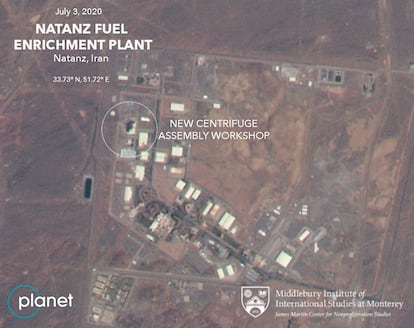
Since the U.S. and Israeli strikes against Iran’s nuclear and military facilities in June 2025, inspectors from the UN nuclear agency have only set foot in Iran to monitor sites that were not targeted. And since February of this year, after the start of the full-scale war, not even that. The IAEA has lost the physical access that for decades underpinned verification of Iran’s nuclear program. “Although analysis of satellite imagery of the nuclear sites around Natanz, Fordow and Isfahan is important,” Heinonen explains from New York, “supply chains for equipment and materials are geographically dispersed. Much of the actual research and experimental work is being carried out elsewhere, including at unknown locations.”
Heinonen is known in U.S. Department of Energy laboratories as the “Sherlock Holmes of nuclear detection.” He worked for 27 years at the IAEA in Vienna and personally inspected nuclear facilities in Iran. Although he led the agency’s efforts to implement analytical models to complement traditional verification activities, he speaks with the caution expected of someone trained as a safeguards inspector. “Satellite imagery has its limitations. It is not a continuous monitoring system that can determine, for example, a vehicle’s origin or the contents of packages. When we look at the Isfahan nuclear center, we see it houses many other activities, such as production of zirconium tubes, hafnium, etc. Additional information is needed to reach a credible, professional conclusion about the possible material those containers hold.”
U.S. President Donald Trump claimed the June 2025 bombings had caused “the total destruction” of Iran’s nuclear program. Contradicting his own boast, eight months later, on February 28, 2026, he launched Operation Epic Fury, telling the world that “Iran will never have a nuclear weapon.” The White House embarked on a large-scale war that was supposed to last a few weeks but stretched into months — with the current uncertainty over a ceasefire agreement hanging in the balance; it began with the bombing of a school in Minab that killed nearly 200 people, mostly girls, and has caused more than 7,000 deaths and 37,000 injuries in Iran and Lebanon; it has brought the Middle East to a boil, and has given Iranian leaders a new superweapon they did not know they possessed: control of the Strait of Hormuz, a key route for oil transport.
The UN agency responsible for safety and nonproliferation sees more nuclear risk in Iran today than before the war. Three days after the start of the bombings, Rafael Grossi, director general of the IAEA, said: “While there has been no evidence of Iran building a nuclear bomb, its large stockpile of near-weapons grade enriched uranium and refusal to grant my inspectors full access are cause for serious concern.” “For these reasons,” he added, “the Agency will not be in a position to provide assurance that Iran’s nuclear program is exclusively peaceful.”
Grossi is in the midst of a campaign to be appointed the new UN secretary-general. He balances leadership of the IAEA with publishing articles in U.S. international affairs journals that set out his proposal to save the organization from “irrelevance,” as he stated in a column for Foreign Affairs. The veto power of one of the five permanent members of the UN Security Council could block his candidacy. Among them is the country that attacked Iran, the United States.
Robert Kelley, former chief inspector for the IAEA in Iraq, South Africa, Libya and Syria, with extensive experience in technical analysis of Iran’s nuclear program, distinguishes between the Agency’s ability to measure nuclear material — which he says remains excellent — and its capacity to judge whether that material points to a weapons program, something he considers politicized.
“Its inspectors verify declared nuclear material,” Kelley tells this newspaper from Klosterneuburg, near Vienna. “They are the only ones, outside Iran, who can do that, and they have done an excellent job. We would be blind without the IAEA’s routine inspections.” However, the expert cautions, “making superficial judgments about ‘peaceful’ intent is a slippery slope that [Grossi] may regret taking. He himself is technically rather weak, as are his advisers, when it comes to a [nuclear] program and its content.”
The fate of Iran’s uranium
The 440 kilograms of uranium, enriched to 60%, whose exact whereabouts no one can confirm today, would fit “in 50 barrels the size of scuba tanks. That’s it,” says the U.S. nuclear engineer who, before becoming IAEA director, worked on defense nuclear programs at the Los Alamos National Laboratory — the origin of the Manhattan Project that built the first atomic bomb during World War II — and the Lawrence Livermore National Laboratory.
Hence Heinonen’s disdain for speculation about the blue drums in the satellite images, and the warning about the risks of physical inspection being replaced by remote monitoring. “The enriched uranium has not disappeared,” Kelley reminds us. “Iranian leaders know exactly where it is, and the ambiguity keeps them laughing all night.” That is, the Revolutionary Guard retains its value as a bargaining chip and latent threat. Meanwhile, Iran’s ambassador to the IAEA, Reza Najafi, denies that his country resumed enriching uranium after the Israeli and U.S. bombings of its nuclear facilities in 2025.
Kelley proposes an unconventional negotiated solution, not just a diagnosis of the crisis: that Iran give up all its 60% uranium in exchange for being allowed to continue enriching to 20%, a level for civilian use that is currently scarce on the international market, and export it as fuel. In this way, it would preserve its centrifuge program and gain a real industrial niche, while the IAEA maintains verification. A swap inspired by the “Megatons to Megawatts” precedent, which under U.S. supervision turned Soviet weapons-grade uranium into civilian fuel for two decades. “Why bomb Iran?” Kelley asks. “Just buy the material and remove it, like in Operation Sapphire in Kazakhstan.”
Days after the Memorandum of Understanding signed by the presidents of Iran and the United States on June 17, 2026, Grossi spoke at the Fukushima Daiichi nuclear plant in Japan. “The agreement explicitly states nuclear activities that are going to be carried out with regards to nuclear material facilities will be supervised by the IAEA.” He added: “Obviously, to do that, we will have to inspect. Whether this happens today, after tomorrow, or in one week, or in 10 days, it’s important but not essential. This is going to happen.” As yet, no date has been set.
Sign up for our weekly newsletter to get more English-language news coverage from EL PAÍS USA Edition









































