
David Albright, nuclear expert: ‘The only way to stop a nuclear weapons program is for the country itself to decide to do so’
An IAEA inspector in 1990s Iraq, the analyst believes Iran’s plans have suffered a serious setback from the war but have not been eliminated altogether
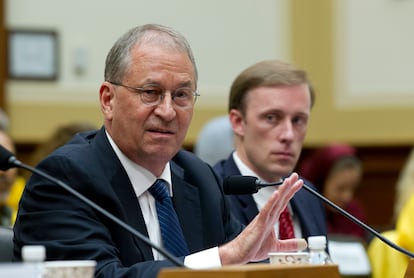

When the fog is thick — and these days it is — that is when it is most useful to listen to the people who really know. David Albright, 74, is among them: trained as a physicist, he was an inspector for the International Atomic Energy Agency (IAEA), a United Nations body, in 1990s Iraq, and he knows the Iran case in great detail. Today he leads the Institute for Science and International Security, based in Washington and which he founded more than three decades ago; he spends long periods in Münster, Germany, from where he spoke to EL PAÍS by videoconference.
Question. What practical implications does the memorandum of understanding between Washington and Tehran have for Iran’s nuclear program?
Answer. I can’t help but think of all the different memoranda of understanding that existed between the IAEA and Iran over the last 15 or 20 years. They were focused on inspections and they always ended badly. The pattern was that Iran just was not willing to provide adequate access to sites and people. Perhaps this new memorandum of understanding can finally settle the remaining issues, but there’s nothing in it that says that Iran has to come into compliance with its obligations under Nuclear Non-Proliferation Treaty. The United States will have to push hard to ensure Iran does so.
Q. Could the memorandum prevent Iran from building an atomic bomb?
A. Not by itself. It’s clear that the program to build nuclear weapons is severely damaged. That has to do first with the enriched uranium, as there’s a belief that Iran does not have any operating centrifuges to enrich it up to weapon-grade. Moreover, its facilities to make the nuclear weapon itself are heavily damaged [by the bombings]. They would likely need over a year to rebuild their capabilities.
Q. Will we see U.N. inspectors on the ground?
A. That is absolutely crucial, but I am skeptical that Iran will agree. It’s critical to discuss that right at the beginning: find out what Iran is willing to admit about its past and possibly ongoing nuclear weapons activities. The second effort would be aimed at determining if they would allow access to military sites, people involved in the nuclear weapons program. If Iran provides a complete nuclear declaration and cooperates, the inspection process could proceed quickly. Nonetheless, we should learn if Iran intends to comply right away.
Q. How close is Iran to the nuclear bomb?
A. Before the [U.S. and Israeli] strike in June, it was only months away from having enough weapons‑grade uranium for a bomb, or even for about 10.
Q. How many months?
A. Up to six months to finish all the steps. After the damage caused by the war, Iran will need much more time: a year or more to build a nuclear weapon. Before June 2025, they had confidence that the weapon would work. Now, they would have far less confidence. To make a nuclear weapon, Iran would need to create a small plant to enrich up to 90%. Theoretically it could reach 60%, but it would then have to design a new weapon adapted to that level, and that would add time. Overall, I now think it would take them a year to accomplish all the steps needed to make the nuclear weapon. Moreover, they have lost a lot of skilled people.
Q. After last June’s strike, Donald Trump said Iran’s nuclear program had been severely damaged. Why another war?
A. We are not involved in all the decisions made by the Trump administration. From a nuclear weapons point of view, what emerged was that Iran was re-establishing a nuclear weapons capability at a new site north of Tehran. Satellite imagery after the June war showed they were also carrying out many recovery operations at the sites associated with nuclear militarization. Tehran was trying to rebuild that capability. Was it complete or merely conceptual? I don’t know. I also don’t know how comprehensive it was. They were also clearing entrances to the tunnel complex in Isfahan, where much of the enriched uranium is believed to be stored. The general sense was that Iran was doing things to reconstitute its program.
Q. Where do we stand now?
A. The only way to stop a nuclear weapons program is for the country itself to decide to do so. We saw that in Iraq in the 1990s, in South Africa in the late 1980s, and also in Belarus, Kazakhstan and Ukraine, which gave up the nuclear weapons they had inherited from the Soviet Union. With military strikes, all you can do is set the program back. This set of bombings is definitely the most destructive I have ever seen against a nuclear program. If Iran wants to rebuild it to get a bomb, it will take them a long time. In that sense, there is an opportunity to try to settle this and convince Iran that nuclear weapons are not a good future.
Q. So the attacks delay the process, but by no means solve the underlying problem.
A. Absolutely. In the end, it is an engineering process. Israel went after the people with hands‑on experience, but knowledge cannot be killed: it is in the books. [What we have seen these months] is a grand experiment of how far back you can set a nuclear weapons program through military means, including assassinations of key people. My impression is that the Iranian [nuclear] program was pretty seriously set back but that the wars didn’t knock it out completely. However, in the end, the only way to stop a nuclear weapons program is to persuade the government.
Q. Are there precedents?
A. I don’t think Iran will be like South Africa. There is no Nelson Mandela there who will appear and say: we want to live at peace with the world. It will remain a rival of the United States and much of the world. The regime has changed, but not in the way the White House had expected. And, you know, Trump is the guy who wants to take Greenland, who has created a big mess in Europe... Can he really negotiate a good deal with Iran? The result could end up being unpleasant for both sides.
Q. Trump says this war has ensured Iran will never have a nuclear bomb, that he is “sure” it will not get one. Do you agree?
A. No, no, no. I guess it’s a 50-50 chance they’ll start again. The leadership will continue to be interested in building nuclear weapons for obvious reasons. That said, they may be more hesitant to try because they are not sure they can obtain a bomb within a [sufficiently short] timeframe without being detected.
Sign up for our weekly newsletter to get more English-language news coverage from EL PAÍS USA Edition









































