
Andalusia’s rivers are being destroyed by tourism: ‘You don’t see anything, it’s all dead’
Tourist overcrowding is putting the fauna and flora of many river sites at risk, with channels destroyed and trash piling up
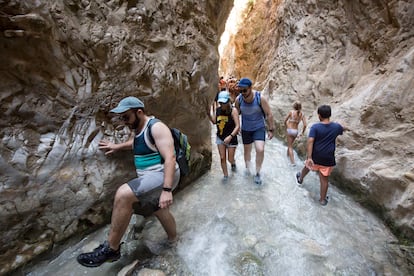

Refreshing, clear, clean water. Narrow gorges, waterfalls and pools amid dense vegetation. The Chíllar River, in Nerja (Málaga province, population 22,187), offers almost everything a summer visitor could want, including easy parking and little technical difficulty. That is why up to 3,000 people a day trampled through it. It became a fairground. For that reason Nerja Town Hall banned entry in August 2023 and, although visiting is still not permitted, the regional government of Andalusia is already planning to reopen it, with some limits. Two companies are bidding to manage the area amid widespread criticism over the major impact renewed human presence will have on biodiversity. “Tourist activity destroys its life,” sums up Rafael Yus, spokesperson for the NGO Ecologists in Action, who warns that the same risk threatens many other rivers across the region because of tourism pressure.
Today the area around the Chíllar is calm. The crowds are gone, but some people still access the route due to lack of awareness and scarce enforcement, which is shared between Nerja’s local police force and the handful of national park rangers — 18 officers for a protected area of 40,600 hectares. Beyond the ecological issues, the authorities decided to close access after warnings from the Environment Prosecutor’s Office and the Wildfire Prevention Plan, which flagged the risk to people in case of a fire. Among other issues, the only escape route would be via the river, making it impossible to know if someone had become trapped by the flames. Since then, the authorities’ idea has been to reduce river capacity through private management. Two companies, Travelnatura and Sando, have already put in bids and envisage a maximum of 500 visitors a day, although the regional government’s original proposal was almost half that: 300. The first bid offers tickets at €10 ($11.70) and the second at €4.90. Both promise constant channel maintenance and emergency protocols. During the last major cleanup, in 2017, 450 kilos of waste and thousands of pairs of shoes hanging from local wiring were removed.
The process to decide which company will get the contract is expected to be long, between one and two years. Those who know the area hope that time will be used to reconsider the project for a river designated a Fluvial Natural Reserve. “Trampling the riverbed and banks, because there is no other place to walk, kills everything. And nothing would happen if it stayed closed longer: since 2023 no one has protested,” says Yus, who stresses that Ecologists in Action has submitted objections to the reopening, arguing for protection based on the existing biodiversity sanctuary. “It is one of the few streams in the area that has water year-round and its ecosystem is very interesting. It should have the highest protection,” confirms Andrés Vicente Pérez Latorre, associate professor in the Department of Botany and Plant Physiology at the University of Málaga, who believes allowing 500 people a day “is destructive.” “Perhaps five visitors a day with naturalist roles, never tourists, should be allowed,” he recommends.
Baltasar Cabezudo is also a botanist who has worked across Andalusia. He knows the territory well and says the Chíllar’s surroundings are “singular.” He thinks the management options proposed are “a scam” with no purpose other than tourism exploitation. “There are about 50 species that are very fragile to trampling, pollution, and people’s urine, because it should be remembered that there are no toilets there,” he warns.
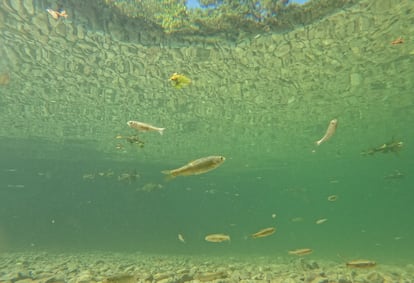
“There used to be herons in the upper course, lots of fish, crayfish, dragonflies… Now you put an underwater camera in and you don’t see larvae, you don’t see anything, it’s all dead,” says a source well-versed in the matter who prefers not to give their name for fear of reprisals. “They killed the Chíllar River and they won’t stop: the same will happen to many others that have become fashionable now,” they add.
From the Río Verde to the Cebollón
They are, indeed, not small in number. It is easy to find hundreds of Instagram posts about pools, ponds, and rivers set in postcard paradises across Andalusia. And behind those images come thousands of people, as happens at Río Verde, near Otívar (Granada), at the eastern end of the Sierras de Tejeda, Almijara and Alhama Natural Park. The huge number of visitors in recent years has forced the Andalusian government to limit access to 100 vehicles a day. Regulation is enforced by the Sociedad Cooperativa de Cázulas, owner of the land crossed by the track that leads to the riverbed. It charges €5 per person and €5 per car. In summer it fills almost daily on weekdays; on Saturdays and Sundays the limit is reached before 11.00 a.m. The route is usually taken along the river bank, but beyond the turquoise pools many visitors also walk inside the channel — like canyoning groups led by active tourism companies — affecting the ecosystem. Injuries are also common. Civil Guard figures for Granada this summer recorded the rescue of up to 12 people who could not continue the route due to injuries.
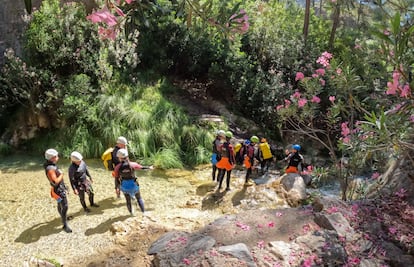
In the same province, the Dúrcal River is also suffering, as Ecologists in Action likewise denounced. “No natural area can withstand these mass visits for such a prolonged time,” the organization stressed in a strong statement then, which also pointed to species and habitat loss in the Castril and Lanjarón rivers in the Sierra Nevada. Further south, near Fornes, walking inside the channel of the Cebollón River is already prohibited, although the bank can be traversed and swimming is allowed at the dam waterfall, according to the Andalusian authority. There are also restrictions at others such as Río de la Miel, Majaceite and Bocaleones (all in Cádiz). At the latter, in the heart of the Sierra de Grazalema Natural Park, ecologists also lament more than 50 people a day — the quota imposed by the administration — and music, shouting, or dogs that turn the spot “into a theme park.” Despite all these complaints, there is no specific plan from the regional government for managing these rivers.
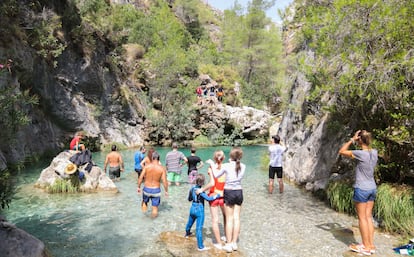
Back in Málaga, the situation is similar at rivers such as Patalamara (Cómpeta), Cástor and Padrón (Estepona), Higuerón (Frigiliana) or the pool at the Cueva del Gato (Benaoján), where families bring inflatable mattresses and leave lots of trash. Also the Genal, where dams are built without permits to create pools that affect wildlife. More serious is the situation of the Guadalmina (Benahavís), just a step from Marbella and saturated all summer. Further inland, in the Sierra de las Nieves National Park, the Turón River also offers a trail with several pools, which the regional government has banned vehicle access to, so now they can only be reached on foot. “It is a filter that has greatly improved the situation,” says Helios Muñoz, biologist and technician for the regional municipal association.
“No choice but to regulate”
Even so, the problems persist. “There are families with children who catch fish in containers, there are unleashed dogs, there are people who leave trash everywhere. When I go I am fighting with visitors all the time and, because of that, I’ve decided not to return until after the summer,” says Mariló Narváez, mayor of El Burgo (population 1,761). She also criticizes those who choose to walk in the channel itself, because of the damage it causes the ecosystem. “In the end we ask for nothing more than awareness. You can come for a swim, spend the day, but always respecting the surroundings,” she says, warning that more and more people are choosing to go upstream beyond the dams, something no one used to do. The practice puts the upper Turón at risk; it has been declared a Fluvial Natural Reserve due to limited human intervention, which favors the presence of endemic fish such as the Málaga chub, as well as crayfish and otters. A national park project has driven the installation of two cameras to monitor capacity, which may help improve management.
“There are many of us and Andalusia gets a lot of tourism. We all want to enjoy nature, which can absorb disturbances but also has its limits. There is no choice but to regulate; it is essential,” says Antonio Herrera, manager of environmental consultancy Mediodes and member of the board of the Nueva Cultura del Agua Foundation. “The effects on river ecosystems of so many people are enormous. From trash to sunscreens and many other pollutants. You just have to regulate and also raise awareness, educate, explain clearly why those measures are taken,” Herrera urges the administrations. He proposes initiatives such as prior — free — permits that the regional government requires for routes like the pinsapar in Grazalema or the Río Bailón trail, in the Sierras Subbéticas Natural Park, which serve precisely to control visitor numbers.
Sign up for our weekly newsletter to get more English-language news coverage from EL PAÍS USA Edition









































