
Spain, a country of 50 million people with infrastructure for 40 million: ‘The cracks are starting to show’
A population boom due to immigration, plus the 100 million tourists who arrive each year, underscore the need to increase spending in numerous sectors for the country to function properly
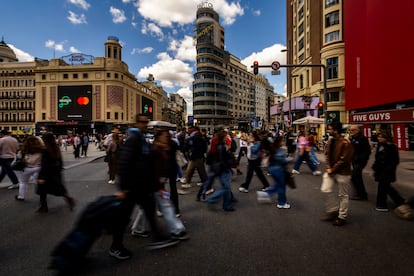

At the rate at which Spain’s population has grown in recent years, a country of 50 million inhabitants could soon become a reality. The National Institute of Statistics (INE) is expected to reveal this month, in its 2026-2076 population projections, when it believes this milestone will be reached. According to the 2025 census, Spain surpassed 49.1 million inhabitants last year, but data from the Continuous Population Statistics—which combines census data with quarterly estimates—indicate that Spain already had 49,687,120 inhabitants in April.
This population increase has been entirely due to immigration, because the birth rate is at historic lows—the second lowest in all of Europe—and since 2015, deaths have far exceeded births to resident mothers, a trend known as negative natural growth. If the population growth rate of recent years continues — with an annual increase of around half a million people since 2022 — the 50 million mark could be reached by the end of this year or the beginning of 2027.
In addition to Spain’s resident population, there is the considerable number of tourists who visit the country each year. According to the INE, 96.8 million international travelers visited Spain in 2025, the highest figure in recorded history and a 3.2% increase compared to 2024. The country thus consolidates its position as the second most visited destination in the world, second only to France and ahead of major tourist destinations like the United States, according to data from the World Tourism Organization for 2025. Initial results this year suggested that the 100 million tourist mark would be surpassed in 2026. However, the conflict in Iran has led to a resurgence of inflationary pressure, which threatens a tightening of monetary policy, and risks to the availability of aviation kerosene are beginning to impact air routes and ticket prices, potentially dampening some of that optimism.
Sooner rather than later, Spain will face a scenario of 50 million inhabitants and 100 million tourists, which, incidentally, are the very foundation of the exceptional growth Spain has experienced in recent years. This is a statistical milestone and an economic and social success. “People go where they see opportunities,” emphasizes Rafael Doménech, Head of Economic Analysis at BBVA Research and an economics professor at the University of Valencia. But at the same time, it represents an enormous challenge for the country, because the population increase has occurred in a very short time, services and infrastructure have not kept pace, and the current model shows signs of structural fatigue. The Director General of Traffic, Pere Navarro, expressed this very graphically at a meeting in Madrid last July. “[Spain] is a country of 50 million people with infrastructure and many policies designed for a country of 40 million, and this has its consequences,” he noted. “The cracks are starting to show. It’s a problem of success, a reality we have to manage.”
Public investment soared, then sank
Experts agree that effective management requires improved planning and a return of investment, the Achilles’ heel of the Spanish economy in recent years. Before the 2010 debt crisis, public investment in Spain was above the European average, at around 4.5% of GDP and in some years even close to 5.5%, fostering competitiveness and growth, but also generating an overcapacity of underutilized assets. There was a huge infrastructure deficit, and Spain was committed to modernizing and reducing its gap with Europe, which at that time was investing an average of around 3.5% of GDP, according to Doménech. With the financial crisis came a fiscal adjustment, and public investment plummeted to record lows, not only below the EU average, but almost at the bottom of the European rankings, “and for several years net investment has been close to zero, even below capital depreciation,” argues the chief economist of BBVA.
This behavior has affected not only new projects but also the maintenance and renewal of existing infrastructure, despite record levels of tax revenue. A simple look at GDP growth and expenditure components since the financial crisis reveals that current spending and pensions have been prioritized over investment, which will negatively impact productivity in the medium term.
The arrival of Next Generation EU funds—Spain has been one of the biggest beneficiaries—has partially reversed this trend, but is still far from the European average: 2.9% compared to 3.8% in 2025. These funds account for between 10% and 14% of Spain’s GDP growth in the 2021-2025 period, that is, between 1.4 and 2.1 percentage points of GDP, according to a study by Funcas and Analistas Financieros Internacionales (AFI).
A significant portion of the investment effort has been directed towards projects linked to the Recovery, Transformation and Resilience Plan, focusing on energy efficiency, sustainable mobility, and digitalization. However, its driving effect on private investment has been less intense than expected: at the end of 2025, business investment was still 3.3 percentage points below pre-pandemic levels in real terms. This is largely because a substitution effect has occurred rather than a pull effect, due to the way the plans were designed and to the structure of Spanish businesses themselves, which are predominantly small. Overall, the relative contribution of investment to growth has decreased considerably: between 2021 and 2025, it accounted for 21.3% of average annual GDP growth, compared to 35% during the previous expansionary cycle (2014-2019), according to an analysis by Sergio Díaz at CaixaBank Research.
This shift in public investment patterns, initially conceived as a temporary adjustment, has become structural, with infrastructure bearing the brunt of this deferred investment. This is now reflected in obsolescence, breakdowns, and a loss of efficiency in transportation infrastructure, water networks, and energy assets, as Ginés de Rus and Carlos Ocaña explain in their book La economía de las infraestructuras (The Economics of Infrastructure) published by Funcas. The lack of a national budget for several years is particularly noticeable in these types of allocations.
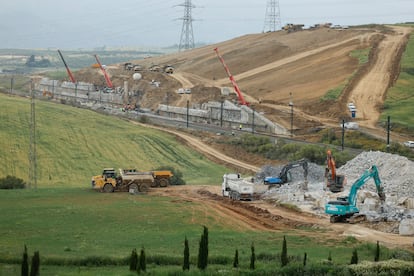
The combination of a rapidly growing population and years of underinvestment has finally reached a breaking point. The nationwide blackout a year ago, the severe human and material damage caused by the 2024 Valencia floods, and the Adamuz railway accident early this year have sounded the alarm about the state of Spain’s infrastructure. The figures from construction companies leave little room for doubt. According to data from Seopan, the investment required amounts to approximately €407 billion over the next decade. Of that figure, around €127 billion should be allocated to conservation and maintenance, and another €280 billion to new developments and the adaptation of existing infrastructure.
The list is long, but water and rail infrastructure require the greatest investment: €44 billion and €31 billion, respectively, over the next 10 years, according to construction companies. Diego Rodríguez, a researcher at Fedea and professor of applied economics at the Complutense University of Madrid, confirms the urgency. Climate change and the intensification of extreme weather events, with more severe and prolonged droughts and a greater likelihood of torrential rains and severe weather, are compounded by intensive consumption and outdated infrastructure, placing the country in a situation of recurring water stress.
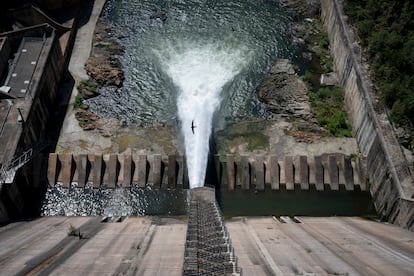
Tourism adds pressure to this situation, as a tourist consumes an average of between 400 and 800 liters of water per day, according to a report by Aigües de Barcelona, compared to 127 liters for a resident. This ultimately leads to restrictive measures such as reduced flow in distribution networks and even supply cuts. The aging of water infrastructure means that between 15% and 25% of treated water in Spain is lost to leaks, a percentage that a report by S&P raises to 40% in some regions. And the Association of Roads, Canals, and Ports has long warned about the poor condition of the network of hydraulic dams, with an average age of around 60 years. “We are almost talking about a safety issue,” warns Rodríguez.
In the case of rail, for decades the bulk of investment has been concentrated in the high-speed network, making it the second most extensive in the world, second only to China. The liberalization of the sector in 2021 lowered ticket prices and multiplied the number of passengers, increasing the pressure on the network without a corresponding increase in track maintenance. According to a report by the Institute of Economic Studies (IEE), while the volume of high-speed rail users grew by 100.8% between 2015 and 2024, maintenance spending per passenger fell by 27.5% during the same period.
Meanwhile, the commuter rail service is suffering a structural collapse due to years of underinvestment, which has increased disruptions in major urban centers. The Independent Authority for Fiscal Responsibility (AIReF) revealed a few years ago that between 1990 and 2018, approximately €3.65 billion was invested in commuter lines, which account for 90% of rail users, compared to over €55 billion invested in high-speed rail. The Ministry of Transportation has already announced a plan to invest more than €20 billion in the rail network over the next five years, half of which is earmarked for the conventional and commuter rail networks.
The goal of the Spanish government and the European Union is to continue expanding the rail network within the broader context of decarbonizing the economy. However, experts point out that in advanced economies, the benefits derived from transportation infrastructure depend less on extensive network expansions than on the system’s operational efficiency, making maintenance crucial—almost as crucial as energy security. Following the April 2025 blackout, concerns about the network’s capacity have skyrocketed, particularly in the context of economic digitalization, which entails enormous energy consumption, accelerated by artificial intelligence, data centers, and cloud services.
A network on the edge
Electricity demand in Spain grew by 2.8% in 2025, a significantly higher increase than the average of the member countries of the European transmission network, which was 0.5%. Behind this sharp increase is the electrification of domestic consumption, data centers, and, once again, tourism demand. The electricity grid is at its limit, but not because of a lack of generation: Spain produces more clean electricity than ever before, exports electricity to its European neighbors, and is a leader in installed renewable capacity. “But we continue to consume more oil than ever,” points out the Fedea researcher. Despite this, 83% of the grid connection points are saturated, which limits both the connection of new renewable generation and that of large industrial consumers. Housing developments are already stalled due to a lack of energy infrastructure; only 12% of the projects that applied to connect to the grid in 2025 received authorization, and 66% could not be served due to insufficient capacity. Saturation has become a bottleneck for industrial growth, urban development, and the energy transition itself. The blackout served as a mirror to the complexity of the current moment: it reflects a system that is no longer what it once was, but which has not yet become what the Spanish economic reality demands. “Once again, the key lies in planning,” Diego Rodríguez reiterates.
In the debate on infrastructure and the demographic challenge, there’s a temptation to reduce everything to a single figure or percentage—an important element for reversing the trend of recent years, but clearly insufficient to address such a complex issue. As Rafael Doménech summarizes, “how that investment is made is just as important as how much needs to be invested.” That is, designing a long-term strategy, conducting a rigorous evaluation of projects, and assessing their execution and efficiency both before and after implementation. Investment in the maintenance of this infrastructure must be conceived as a long-term strategy to improve the long-term growth potential of the Spanish economy and boost activity and employment in the short term. This is essential so that Spain is prepared to be a country of 50 million inhabitants and 100 million tourists.
Unprecedented transformation
Whether we like it or not, demographics will significantly influence the future performance of the Spanish economy. Spain is facing an unprecedented demographic transformation, marked, like the rest of Europe, by a structurally low birth rate, rapid aging, and a growing dependence on immigration to sustain the labor market. In fact, 80% of newly employed individuals were not born in Spain, and despite the strong population growth in recent years, the unemployment rate has maintained a clear downward trend during this time. Spain has already reached 10 million foreign-born inhabitants (20% of the population), and Social Security affiliation for this group has reached a record 3.25 million, 14.7% of the total. Forecasts indicate that in ten years, the combined population of foreign origin and descendants of foreigners born in Spain could exceed 34%, meaning that a third of the population will be linked—in the first or second generation—to immigration. A demographic challenge full of opportunities and challenges that demands coordinated action from public administrations beyond merely electoral horizons.
“An upward economic cycle allows for the integration of all newcomers, but if there is a change in the cycle and employment is affected, integration problems can arise,” warns Miguel Ángel García, a collaborator with Fedea and professor of applied economics at Rey Juan Carlos University in Madrid. García insists on the need to address these changes through planning. “If immigrants are needed, complementary measures must be taken to ensure their proper integration so that social services do not deteriorate, guaranteeing access to education, healthcare and housing, and thus preventing xenophobic incidents against newcomers,” he explains. The consequences of failing to do so are well known.
The Barcelona Society for Economic and Social Studies (SBEES) has published a report called “Spain with 50 Million Inhabitants,” which calls for a social pact to anticipate the changes brought about by this new reality. The problem of access to housing is perhaps one of the most pressing and where the current system shows the greatest weakness. The Bank of Spain estimates the housing deficit at around 700,000 units; CaixaBank Research puts the figure at 765,000. According to BBVA Research, new housing starts only cover half of the households created each year, generating a structural deficit that puts upward pressure on both rental and purchase prices and makes the real estate market inaccessible to a growing segment of the population. Funcas even warns of the risk that immigration will begin to decline in the coming years due to the difficulties in accessing housing, and without alternatives for young people to enter the real estate market, it will be difficult to imagine a recovery in the birth rate.
The report also suggests that tourism should be considered another demographic challenge and that policy design in areas of high tourist concentration should incorporate the floating population as an additional factor.









































