
Questions and answers in Spain’s train accident investigation: from the broken track to the ‘abandoned’ undercarriage
The transportation minister admits that vibrations reported on that route before the crash ‘are not normal.’ A new report suggests the right rail was fractured before the train that derailed passed over it
Spain’s transportation minister, Óscar Puente, admitted on Wednesday the “undeniable possibility” that the cause of the train crash that claimed 43 lives in Adamuz (Córdoba) might lie in a faulty section of track, based on the “bite marks” detected on the running gear of one of the two trains involved in the accident, as well as on other trains that had previously traveled along the same stretch.
However, he insisted that, with the exception of human error, no hypothesis has been ruled out for now. Puente reiterated his view that this was an extremely complex accident, unprecedented in its kind, and denied any ties to an increase in railroad travel following the liberalization of the sector or to a lack of investment and maintenance.
On Friday, the first official report from investigators was released suggesting that the right rail “was fractured” before the Iryo train passed over it. This initial official report from the Railway Accident Investigation Commission (CIAF) explains that when a rail is broken, the weight of the train causes the section before the break to drop, and the wheel ends up hitting the step that has formed in front. The front wheels of the undercarriages of cars 2, 3, and 4 of the Iryo show marks consistent with this.
How significant are the vibrations that had been previously reported?
The minister admitted that the vibrations detected earlier—which a train drivers’ union had already reported on that particular route and on others—and which some passengers had even recorded on video are neither “normal” nor “acceptable.” Experts and railroad drivers consulted by this newspaper described them as “absolutely abnormal” and indicated that they should have prompted a more thorough analysis of the track. However, none of them went so far as to directly link them to the accident. In any case, Puente ruled out a general audit of Spain’s railroad system: “We believe that our network has been thoroughly reviewed in accordance with European regulations.”
What do the breaks detected in the track indicate?
Regarding the damage observed on the tracks, the minister indicated that authorities still don’t know for sure if it’s “the cause, the effect, or partly cause and partly effect” of the accident because “many more” sections of track had been found “broken or twisted” in addition to the stretch where the train is believed to have derailed.
Why did no representative from Iryo participate in the news conference?
Puente appeared before the press alongside José Alfonso Gálvez, director of operations for the state-owned company Renfe (which operates the Alvia train that collided against the Iryo train), as well as Ángel García de la Bandera, head of traffic for Adif, a state agency that oversees Spain’s railway infrastructure. Asked why the presidents of both organizations were not present, the minister noted that sometimes presidents “aren’t the best spokespeople.” As for the absence of any representative from Iryo, the Italian company that owns the train that derailed, Puente said they had considered that possibility but ultimately decided against it.
What inspections were carried out on the track? What type of maintenance is the safest?
Both the minister and the Adif representative defended the prior inspections carried out on the track. Between October and November of last year, the infrastructure operator conducted three inspections of the section where the accident occurred and its safety components, including an inspection on foot by technicians from the public company. More recently, on January 7, a complete inspection of the switches at Adamuz was carried out. “No faults were detected that could be related to the accident,” concluded Adif’s traffic director. Experts consulted by this newspaper point to improved maintenance of the ballast layer to increase safety and reduce “track deformation, which results in jumps, vibrations, and tear and wear” that force “the yaw dampers to operate continuously.” But that, they add, costs more money.
Why didn’t the command center know that several train cars had fallen down an embankment when they spoke to the driver?
The three speakers detailed a sequence of events, down to the hour, minute, and second, in which one striking fact emerges: the command center was unaware that several cars from one of the two trains involved in the accident had fallen down an embankment. At the news conference, the officials explained that, in addition to being in contact with the train drivers—which wasn’t possible in the case of the Alvia driver because he had already died—they knew which section of the line each train was on, although it took time to learn “the condition of each train.” The three confirmed, in response to journalists’ questions, that when the Iryo train driver contacted the control center, the Alvia train that collided with the last cars — the ones that had derailed — had already passed by without him noticing. This is normal, the drivers explained, because it was nighttime, the driver was attending to other tasks, and the trains on that line travel at high speed.
Why were the train drivers both traveling at a speed much lower than the maximum allowed limit?
Puente completely ruled out human error, a reference to the drivers, who were both traveling, for reasons that have not yet been clarified, at speeds below the limit for this section of track (250 km/h or 155 mph) – one was going at 200 km/h and the other at 204 km/h. “Given that the derailment occurred at the rear of the train and on a straight stretch of track,” Puente emphasized, “it was unavoidable” on the part of the drivers. “All other factors,” he added, “remain under investigation,” but not human error.
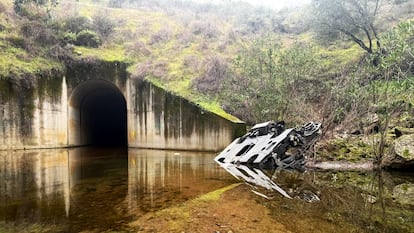
Why did a train undercarriage show up in a stream without being cordoned off by police?
The discovery of one of the bogies (the structure that connects the axles and wheels of the train) from the wrecked Iryo train in a stream about 900 feet from the point of collision dominated many of the questions during the press conference. Puente indicated that the undercarriage most likely belonged to car number eight of the Iryo train, and denied that it was not being adequately guarded. “Neither the New York Times nor Reuters [the media outlets that broke the story] discovered it. A drone was requested, and the Civil Guard captain explained to me that they had seen something resembling train wheels. Several people came down, confirmed that they were bogies, and both the Civil Guard and the CIAF (Railway Accident Investigation Commission) photographed and documented it. No one is going to take it away because it weighs ten tons and is in an extremely difficult-to-access area.”
Sign up for our weekly newsletter to get more English-language news coverage from EL PAÍS USA Edition









































