
Africa becomes the global epicenter of hunger for the first time
The number of undernourished people worldwide fell for the third consecutive year in 2025, but the continent now exceeds Asia in absolute numbers and will concentrate more than half of those affected by 2030
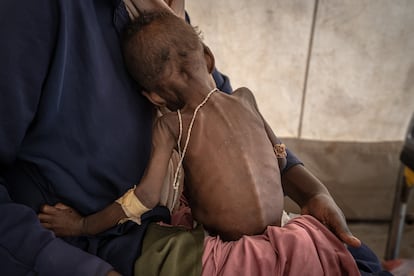

Africa has become, for the first time, the continent with the largest number of people suffering from hunger, even though the share of its population affected fell slightly in 2025. Rapid population growth in Africa pushed the continent past Asia in absolute numbers, although the prevalence of hunger in Africa fell from 20.3% to 20%, according to the findings of The State of Food Security and Nutrition in the World 2026 (SOFI) report, published Tuesday and produced by the United Nations Food and Agriculture Organization (FAO), the International Fund for Agricultural Development (IFAD), the World Food Programme (WFP), UNICEF, and the World Health Organization (WHO).
Worldwide, the number of undernourished people fell for the third consecutive year, to a range between 608 million and 696 million (between 7.4% and 8.5% of the global population), about 14 million fewer than in 2024. However, the global improvement coexists with several warning signs: more than 500 million people will still lack sufficient food in 2030, far from the target of eradicating hunger by that date, while the effects of cuts to development aid and the crisis in the Middle East are not yet fully reflected in current data.
“We are continuing to improve, but the trajectory is not moving as fast as we would like,” warns Álvaro Lario, president of IFAD, in a videoconference interview. The agency head also urges caution in interpreting the figures because the report reflects the situation in 2025, before some of the threats currently worrying international agencies could be fully seen. “What we do not yet see in these data are the consequences of the Middle East conflict,” he says, referring to the effects on energy and food markets of the U.S. war with Iran and the closure of the Strait of Hormuz.
What we do not yet see in these data are the consequences of the Middle East conflictÁlvaro Lario, president of IFAD
The most striking finding in the report is the geographic shift in the epicenter of hunger. Africa now hosts 309 million undernourished people, compared with 292 million in Asia. “Africa has shown a [percentage] decline, not very large, but a decline,” Máximo Torero, FAO chief economist, tells this newspaper. However, he adds, the continent ended up surpassing Asia because “its prevalence rate fell, but Africa’s population growth, especially in sub-Saharan Africa, is much higher.”
The trend will continue in the coming years. According to SOFI projections, between 510 million and 520 million people will still be suffering from hunger in 2030. “Fifty-six percent of them will live in Africa; that is about 285 million people,” Lario warns.
Despite these projections, the agencies believe the continent is beginning to show some shifts in trend. Torero points out that several African countries are improving thanks to a combination of social protection and investments in the food system. “This is the case of Tanzania, Senegal, Zambia, and partly Ethiopia,” he says.
Improvements in Asia and Latin America
Africa’s evolution contrasts with that of Asia and Latin America, the two regions that have contributed most to worldwide improvement. “Globally, this improvement has been driven largely by Latin America, especially South America, and by Asia, specifically India,” Torero explains. Asia went from 372 million hungry people in 2021 to 292 million in 2025, while Latin America and the Caribbean reduced hunger prevalence from 6.1% in 2020 to 4.8% last year. Still, 32 million people remain undernourished in the region.
The reduction in development aid adds an unknown. 2025 data show that global hunger decreased despite a very sharp drop in official assistance in some regions and countries. “What we know is that [hunger] has been reduced despite these cuts,” Torero says, admitting that it is unclear what would have happened without the collapse of that funding.
Globally, this improvement has been driven largely by Latin America, especially South America, and by Asia, specifically IndiaMáximo Torero, FAO chief economist
The other big question is the impact of the Middle East crisis and the closure of the Strait of Hormuz. “It affects the main inputs that agriculture requires,” Torero explains, referring to fertilizers. “Countries that are net food importers will have to pay more, and they cannot do that because they have debt problems,” warns the FAO chief economist.
To prevent the crisis from becoming a new food emergency, Torero calls for keeping trade routes open and “avoiding export restrictions” on fertilizers and other inputs. He also says it is necessary to strengthen social protection and improve logistics in response to higher oil prices and the blockade of some routes. “Moving a grain of wheat from the Strait of Hormuz to Afghanistan,” Torero explains, “can turn a 1,200-kilometer trip into a 4,000-kilometer one. That generates a cost.”
The report also poses a challenge that goes beyond reducing hunger: ensuring people can afford a healthy diet. In 2025, 2.69 billion people — one-third of the world’s population — could not afford to eat a balanced diet. The average cost of a healthy diet reached $4.28 per day in purchasing power parity (PPP), a measure that allows comparison of purchasing power between countries, and stood above the international extreme poverty line, set at $3 per day. In Africa, the share of the population that could not afford such a diet reached 66.6%. “If healthy foods are expensive, people with less purchasing power end up choosing ultra-processed products,” Lario explains.
“We must not only focus on price, but also on the structure of the system,” Torero explains, advocating for improved infrastructure and value chains, especially cold chains, to reduce the cost of fruits and other nutritious foods. He also calls for public policies to be reoriented: “Support given to cereals through subsidies must be changed and redirected to other high-value products,” such as fruits and vegetables.
Sign up for our weekly newsletter to get more English-language news coverage from EL PAÍS USA Edition









































