
The migration routes of pollution: How ozone, Saharan dust and wildfire smoke cross borders
For the first time, the EU’s Copernicus system has mapped the transboundary pollution that travels thousands of miles and is fueled by emissions and heat. The study places Spain in the most problematic zone within Europe
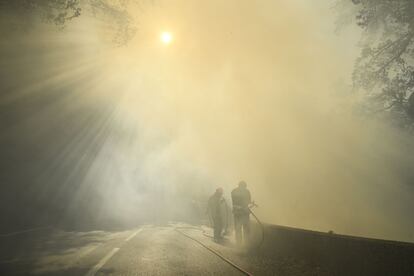
Pollution crosses any border. Residents of Seville saw this in August when the huge Niebla wildfire in Huelva province collapsed air quality levels in the Andalusian capital. Madrid residents experienced it days earlier when the regional government asked them to stay indoors because smoke was arriving from out-of-control fires in the Sierra Oeste and Ávila province. This pollution, laden with harmful particles, travels tens or hundreds of miles, and sometimes crosses countries and oceans. “Air quality in our cities, towns or countries is not only influenced by local activities but can be affected by pollution from neighboring or quite distant nations,” explains Ian Marnane, head of the Environment and Health Unit at the European Environment Agency (EEA).
The Copernicus Atmosphere Monitoring Service (CAMS) published a new study on September 30 focused on that transboundary pollution, giving particular prominence to tropospheric ozone — the ozone we breathe. According to the analysis, titled Atmosphere Watch, 40% of the world’s population was exposed to extremely high ozone levels in 2026.
The study provides a comprehensive picture of what took place in the first eight months of the year and draws on millions of data points from satellite observations, ground networks, and aircraft within CAMS’ global air-pollution forecasting system. This year the planet has been marked by above-normal heat due to climate change and, since June, amplified by an El Niño event that is registering record levels. That has also affected ozone pollution and fire-related pollution.
“Ground-level ozone exposure during the first eight months of 2026 was extremely high and persistent across Asia, while several days of very high exposure were observed in Europe and North America amid frequent summer heatwaves,” the study summarizes. “Oceania was the least affected continent.”
Sixty percent of Asia’s population was exposed to extremely high ozone levels over the eight months analyzed. Moreover, “these ozone levels were accompanied by significant pollution from particles, nitrogen dioxide, and sulfur dioxide in industrialized, densely populated regions,” the authors warn. In Europe, “successive heatwaves from June to August” also raised ozone levels. As a result, “50% of the European population was exposed” to poor, very poor or extremely poor ozone levels this year, the report notes.
Italy — particularly in the north — Spain — notably the Mediterranean coast and the Guadalquivir valley — and Greece stand out as the most affected European countries. Laurence Rouil, director of CAMS, points to a clear north–south difference: “That is not surprising. Southern, Mediterranean countries are more exposed to high ozone concentrations because of sunlight and high temperatures.”
Tropospheric ozone pollution arises when several factors combine: on one hand, the heat — which is rising with climate change — and sunlight. But chemical precursors are also needed, such as “nitrogen dioxide” emitted by traffic and fossil fuels and other “volatile organic compounds emitted by industry, solvents, some household products and vegetation,” Rouil explains.
“Tropospheric ozone responds to a complex combination of factors,” the CAMS director summarizes. That is why it is much harder to combat. In fact, since 2005, Europe has seen a clear decline in emissions of the chemical precursors that lead to tropospheric ozone generation. However, this type of pollution has not decreased. Rouil calls it “the ozone paradox,” a transboundary pollution problem. The chemical precursors that trigger it can travel thousands of miles on the wind. In addition, ozone itself, which remains active for days, can also move across borders. Rouil insists it is necessary “to reduce emissions of the precursors,” but notes that “response in concentration terms is not always proportional.”
This is not a problem limited to Europe. In fact, “only 5% of the world’s population was exposed to good long-term ozone levels and 15% to reasonable levels during 2026,” the study states. However, in the Southern Hemisphere there are far fewer episodes because it has fewer precursor emissions and the ocean-covered area is much larger than in the north.
Fires and dust
Another transboundary pollution phenomenon analyzed in Atmosphere Watch is wildfires, which “release a wide range of pollutants, including fine particles, nitrogen oxides, and many volatile organic compounds and greenhouse gases.” “Although global biomass-burning emissions have declined in recent decades, global exposure to wildfire smoke is increasing due to more extreme fires near populated areas,” the study says. Again, once emitted into the atmosphere, “these pollutants can be transported far from the fires, turning a local emergency into a regional or continental air-quality episode.” That pollution can cross thousands of miles and even entire oceans, as happens recurrently between North America and Europe.
CAMS’ analysis highlights 2026 in Europe with the cases of France, Spain and Belgium because of the “mega-fires” they suffered. “On July 22, large wildfires occurred in the Gironde and Landes regions in France. Almost simultaneously in Spain, another large fire started in Ávila province. The fire in France burned nearly 50,000 hectares, forcing the evacuation of 40,000 people — one of the largest evacuations in France since World War II — and caused significant air-quality impacts hundreds of kilometers away. In Spain, the Ávila fire joined another in Madrid that burned more than 50,000 hectares, leading to 56,000 evacuations and nearly 30,000 people confined indoors to avoid harmful smoke emissions.” It adds: “Both Madrid and Ávila recorded the highest carbon emissions from wildfires since at least 2003.”
If fires increase concentrations of harmful fine particles, desert-dust episodes push up the coarser particles known as PM10, which also cause major health problems. Atmosphere Watch explains that each year “around 2 billion tons of sand and dust enter the atmosphere.” There is a kind of “global dust belt” that includes some of the planet’s largest deserts — from China and the Gobi Desert in Mongolia, across the Arabian Peninsula to the Sahara — that play a key role. The Sahara stands out among them, its dust “often transported across the Mediterranean to Europe or across the North Atlantic to the Caribbean.” The study points to several major transport events of these particles in February that particularly affected Spain.
The report includes a list of European cities with populations of over 250,000 that registered the greatest number of dust alerts so far in 2026. Of the 20 cities, 12 are Spanish. Leading the list are Las Palmas and Santa Cruz de Tenerife with 20 and 18 days respectively. Also on the list are Córdoba (17 days), Palma de Mallorca (15), Seville (15), Málaga (14), Murcia (14), Granada (11), Alicante (11), Valladolid (10), Valencia (10) and Vigo (10).
Sign up for our weekly newsletter to get more English-language news coverage from EL PAÍS USA Edition









































