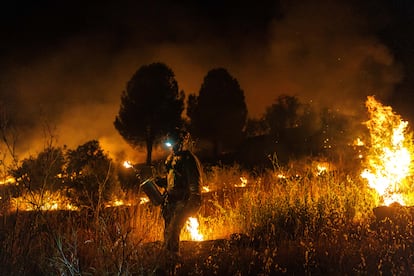
Firefighters facing a major crisis: ‘I’ve never seen a fire burn with such intensity’
Crews underline the force and anarchy of the Ávila fire and insist on improving response systems

The “largest and most complex” fire in a firefighter’s 20-year career is beginning to die down. But the south of Ávila is still smoldering, and sudden flames are flaring up where calm was expected — not least because nothing but bad omens are falling on a summer in which wave after wave of heat is forecast. Firefighters have battled an unpredictable blaze, with gales shifting its direction, sweeping across mountain ranges and dry forests, feeding on unmanaged vegetation, and overwhelming human firefighting capabilities. The situation has improved slightly: “It seems the monster has fallen asleep,” sums up another firefighter, exhausted after five days of chasing the beast as it comes and goes, rising and falling. But everyone remains on alert.
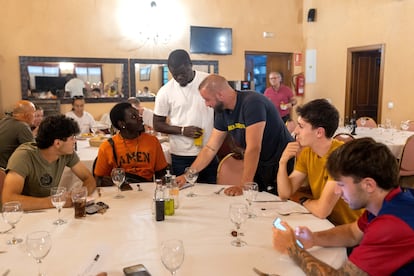
Talking with members of the operation during these critical days requires matching their pace: either walking briskly beside them while they deploy hoses or prepare drip torches, or respecting their rest in sports centers, sitting on sidewalks, or in the shade of a tree. The message is uniform: no one had ever faced anything like this. Never in one person’s two decades on the job, not in a youngster’s two summers, not in another’s seven. The same response regardless of origin. The deployment involves every kind of uniform, patches on clothing, truck colors and accents: local Ávila crews have been joined by reinforcements from the Ministry for Ecological Transition and the Demographic Challenge (Miteco), with two Forest Fire Reinforcement Brigades from Ávila and one each from Soria, Cuenca, Madrid, and La Palma, plus colleagues from town halls, provincial councils and other regions. All working together against the hotspots even if coordination sometimes falters.
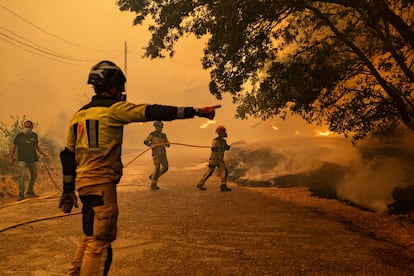
On Saturday afternoon in Casavieja (Ávila), one of the hot spots, a firefighter carrying a chainsaw tried to join a group that did not know him; they sent him elsewhere but he insisted he came from there and was sent to them. A technician complained that some urban firefighters left, letting a flank grow that is now swallowing them, the flank they were going to tackle at a campsite, but a convoy and its retreating sirens show they were defeated. Another firefighter who lived through the devastating 2022 fires in the Sierra de la Culebra (Zamora) and the 2025 fires in León and Zamora puts it this way: “Total chaos.” His team had to “run a couple of times” because a fire tongue rushed toward them along national highway 501, at the ill-fated stretch between Mijares and Casavieja. A firefighter from Ávila adds that “we didn’t stop” during one of the most complicated nights: “Incredible, everything burning, wind, but satisfied — we put out fires and saved several spots.” He and his team finish their shift. They want to continue even though they know they are needed, refreshed, clear-headed: “I’m off today, unfortunately; tomorrow I’ll come back, eager to push.”
The firefighter, who is beginning to notice the monster’s decline, develops the idea — even though his “head is on fire” — that little by little “it has been running out of fuel” after devouring such a vast area, and is finally surrounded by hoses and retardant-laying helicopters. They expect no other help from the sky — if anything, just more heat to come. It’s time to pause, catch their breath, and reflect on what they’ve been through. A firefighter from Segovia vents: “This is by far my worst fire — the force with which it raged, there was no way anyone could have put it out.”
The physical toll of so many hours sweating in heavy gear batters the body, but sometimes the mental strain is even more taxing: “In fires with such bad conditions things go wrong and it’s super frustrating because you never feel effective; mentally what weighs on me most is the frustration of seeing everything get more complicated.” A fire gives few certainties, and high turnover in the trade in Castilla y León due to temporary contracts, poor conditions, and limited training doesn’t help: “In Casavieja we saw people who were very poorly prepared, workers with little training in the hazards they face, making direct attacks without the flameproof hood and without goggles, which are mandatory.” Amid so much drama, there is room for a joke in their jargon: a crew resting in El Tiemblo playing pool and reviewing paperwork refers to the northwest wind, NW in English, as norwhisky.
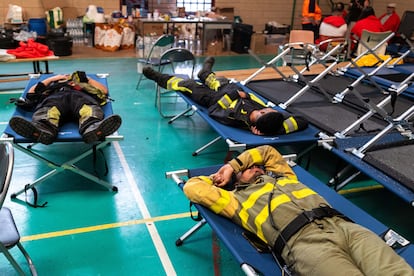
A crew from Castilla y León spends the night at the Castrejón hotel in Cebreros, another town hit by the flames. The technician takes stock: he is surprised that given the scale there have been hardly any scares or serious accidents, beyond some entrapments, and amid “surreal” episodes: in the Iruelas valley, the front overtook both his strike team and another foreman’s crew as they tried to control it. Unheard-of in 11 years on the job. The firefighter’s hair stands on end when he mentions the “50 volunteers” who helped on Saturday between Burgohondo and Mijares, “tough” places. Locals carried walkie-talkies, members of Civil Protection… “Pfff,” he exhales, grateful, and adds that volunteers are welcome if they are well organized, but there should be more training in villages so people know how many people or cars are where, in case backfires are set, and to keep people “in flip-flops or shorts” away from the flames. Another battle. Now he trusts the fire will subside and prays that no flames break out in his home region, given the lack of personnel. Many stations don’t even have working washing machines or showers, so firefighters end up taking their ash-covered clothes home with them.
Some see a glimmer of optimism amid the tragedy. The voice comes from León, fed up with fires where there has been virtually no progress in prevention or response, with no professional recognition or permanent contracts, among other shortcomings: “Let’s see if now that the fires have reached Madrid, we start to come to our senses a little bit on a national level and things change.”