An empty airport, shuttered storefronts and abandoned hotels: The tourism decline in Tulum is worsening
Flight cancellations make it harder for visitors to return to the jewel of the Riviera Maya, which has lost its shine because of factors such as high prices and the arrival of sargassum

On Tulum airport’s runway there is only one plane: a Viva Aerobus Airbus A320. For several hours that is the only aircraft that will remain at the air terminal inaugurated in 2023. The aerodrome is nearly empty after Aeroméxico, Volaris, and American Airlines announced the cancellation of most of their routes to this destination on the Mexican Caribbean. The loneliness in the terminal is unsettling and, in the distance, all that can be heard is the echo of children playing. The crisis caused by the collapse in tourism, in what was once the jewel of the Riviera Maya, has deepened over the past year and has begun to touch various sectors that had set their sights on the booming future of this municipality in the state of Quintana Roo.
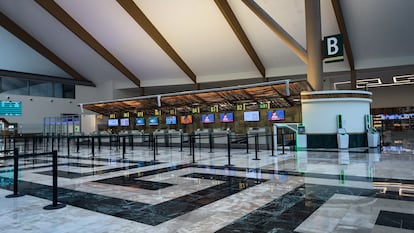
A year ago hoteliers sounded the alarm after noting a 10% drop in room occupancy. The next warning has come from the airlines, which cannot find a way to make flights to the heart of the jungle profitable. Passenger traffic has fallen 33% since 2025. Tulum airport was one of the flagship projects of the government of Andrés Manuel López Obrador (2018–2024), intended to relieve Cancún airport and provide more direct access to a region that surged after the Covid-19 pandemic in 2021. The bet on tourism beyond Cancún mainly attracted international visitors, which pushed up prices for services above other points in the region, such as Playa del Carmen. However, the enthusiasm did not hold and Tulum has already seen a rise in businesses that have shuttered their doors.
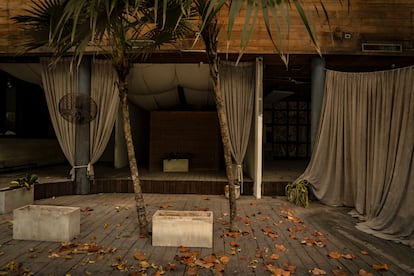
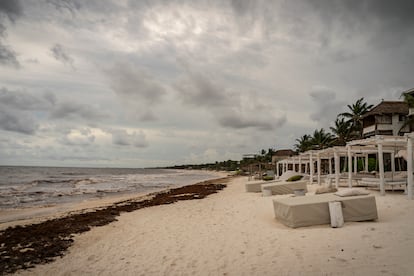
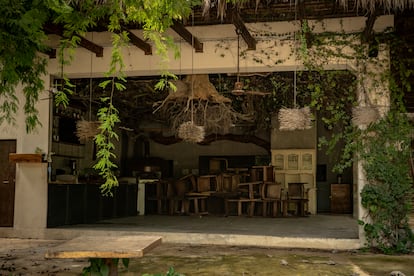
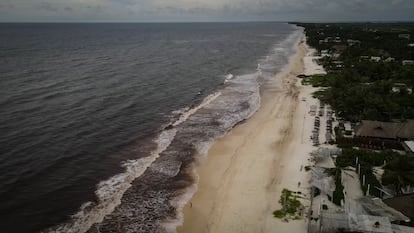
In the hotel zone, for example, is the Maya Tulum hotel: a modest seaside complex that offered a restaurant, cabins, and a beach club. The facility had only a few guests in October 2025, who used the loungers to sunbathe. Now the hotel is empty and the sunbeds, tables, and chairs lie abandoned, as if everyone at the property had fled in an instant. Along almost a kilometer of beach, sargassum has already claimed the area that no one has bothered to clear in front of the hotel. With outstanding bills to pay and few guests, some hotels are already struggling to balance their books. Blanca Ramírez says her husband works at one of them and that the owners have begun to shorten work schedules: in a two-week pay period her partner now works only 10 days. “He came here from Chiapas six years ago. With what they are paying now it’s no longer enough to cover expenses, so we supplement the income by renting a few rooms and with carpentry work he knows how to do,” she says. The rooms for rent, she adds, are not as in demand either: of four available, only two are occupied.
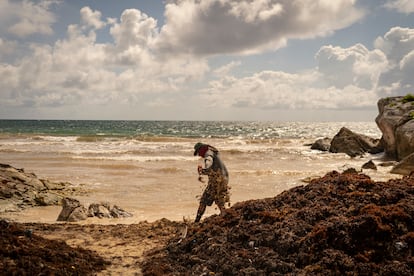
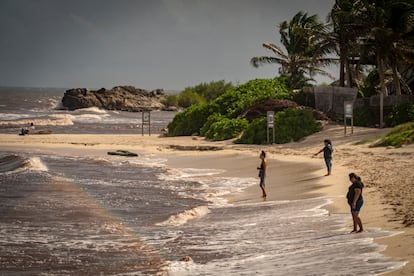
Ramírez is sitting on one of Tulum’s public beaches, where about five other families are gathered, but she — like most — avoids going into the sea. It is the end of the sargassum season, which began in April, but the water is far from turquoise. A reddish-brown hue mixes with the white foam of the waves: 2026 has seen the highest concentration of the algae in the Caribbean, according to NASA satellite data. “Decomposing sargassum releases hydrogen sulfide, a gas with the smell of rotten eggs that poses a potential problem for both ecosystems and tourism,” the scientific agency warns. The Mexican government has deployed some brigades from the Environment Secretariat along the coast to collect the seaweed with rakes, and in some spots has installed barriers to stop sargassum from reaching the shore. However, these measures have not covered the entire Tulum coastline and most of the hotel zone is suffering the effects of its arrival.

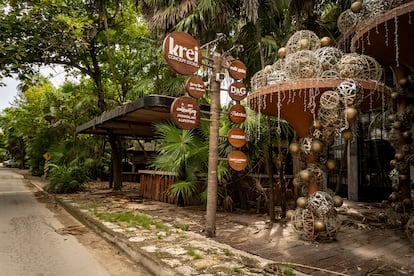
Even though streets and businesses look empty, there is still optimism that tourist flows will recover for the upcoming high season at Christmas. “There’s sargassum and some places are a bit expensive, especially along the coast where the hotels are, but overall it’s a great place — the beaches are gorgeous,” says Jaimie, an Australian musician who lives in Tulum seasonally and has seen the town at its height. A large share of customers at local businesses are foreigners who stay in the most touristic areas, while everyday life in Tulum happens in the town center. One clear sign of the drop in commerce has been the closure of one of the municipality’s two Starbucks branches. A couple of workers are packing up the furniture at the U.S. coffee chain’s outlet, which still has marks from its Halloween campaign — Snoopy and the great pumpkin — on the windows.
One of the places that has suffered most from tourism’s ups and downs in recent years is the Tulum archaeological zone, crowned by the 11th-century Mayan Castle. In September 2024 it received up to 74,385 visitors, according to the National Institute of Anthropology and History (INAH), but in the same month in 2026 it barely drew 22,100 people. The controversy over construction of the Jaguar Park around the archaeological site was settled this year with the removal of charges of up to 515 pesos (about $28). Many tourists access the beach free of charge by bike or on foot, and only pay if they want to visit the Mayan ruins. Tickets cost 80 pesos ($4) for Mexicans and 265 pesos ($14) for foreigners.
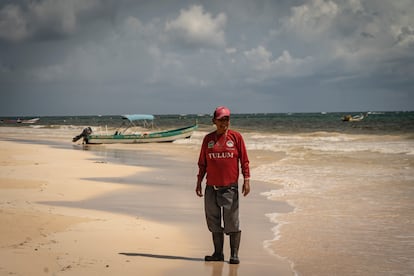
“Tulum is a magnet,” says Tito Juárez, a provider of water-based services for tourists. His boat is moored as he explains that this year Easter Week was more generous for tourism than the summer, but that it is by no means a recovery. “Mexican tourists are hurt by everything that’s been said about Tulum, that the coffee is very expensive or that it costs $80 to enter Jaguar Park. The government stopped charging, but the National Guard has also stopped conducting patrols and monitoring,” he says. It is true that government attention is focused closer to the Jaguar Park area, while the rest of the municipality still has significant problems with public lighting and potholes. Mayor Diego Castañón announced this month a campaign to resurface the main roads in the municipality.
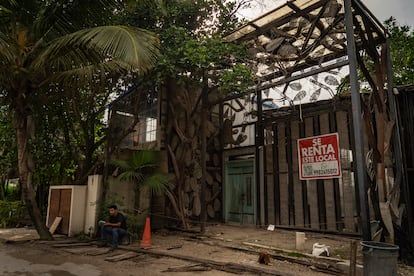
The government has launched a campaign called Tulum Renace (Tulum Reborn) that emphasizes free access to the beaches — where entry had previously been charged or conditioned on purchases at businesses — and sargassum cleanup operations. Quintana Roo governor Mara Lezama announced last week the opening of air routes from Canada — Montreal and Toronto — as a bet on foreign tourism to boost the jungle airport. Federal Civil Aviation Agency (AFAC) data show that in the first year of Tulum International Airport’s operation, in 2024, there were 1,117 operations, and that a year later they fell to almost half, with 689. “They will recover,” predicted Mexican President Claudia Sheinbaum when the closures of the air routes became known. Reclaiming Tulum as one of Mexico’s flagship tourist destinations appears to be an uphill battle that grows more complex by the day.
Sign up for our weekly newsletter to get more English-language news coverage from EL PAÍS USA Edition