
On the trail of Maya vanilla: The regenerative project reviving a fragile species in the Mexican jungle
Mestiza de Indias, in the country’s southeast, protects 200 hectares of rainforest where rare plants also thrive. The project is part of an effort to push back against mass tourism
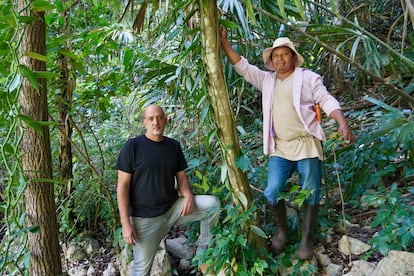
His father had recently passed away, and Gonzalo Samaranch, still young, left Barcelona to seek refuge in the only place even slightly deeper than his grief: the Brazilian Amazon. He spent eight months immersed in the jungle, spending his nights, alert and still, on platforms built in the treetops, waiting to hunt the animals he would eat in the morning. One day, he had a vision. “I saw myself in the future, in a jungle, growing food, married to an Indigenous woman, and in a place with an underground river. That’s exactly what I’m doing today,” says Samaranch, now 50 years old.
He is the founder of Mestiza de Indias, a regenerative agriculture initiative he launched with his Mayan wife, Martha Elena Chan Tuz, which is based deep in the jungle of Mexico’s Yucatán peninsula. There, on a beautiful aguada, they stumbled upon something extraordinarily rare: a kind of wild vanilla with a level of genetic diversity no longer seen in this climate‑threatened plant — and of which they have become the guardians.
Through the project, the couple protects 200 hectares of jungle and has restored five of them, where hundreds of fruit trees and high‑quality organic vegetables now grow. Their products are sold to hotels and restaurants in the region, but only to those willing to go against the grain of the mass‑tourism industry.
Samaranch’s life has been a series of twists and turns. At 18, he was doing fashion photography in Paris and taking portraits of people with autism. He spent eight months in the Amazon and then returned to Barcelona to study journalism. After graduating, he edited Le Cool, an underground travel guide, and later became an art dealer to make a living. Then he had an existential crisis: he recognized his own privilege and decided he wanted to contribute to a better world. He sold everything and set off in search of inspiring projects, eventually arriving at Las Cañadas, a leading agroecology center in Mexico, where he trained in order to replicate the model.
In 2013, he moved to Tulum with the idea of practicing permaculture. He observed the tourism boom on Mexico’s Caribbean coast and the growing dependence on imported food. Youth migration had led to the abandonment of the milpa (polyculture plot where Indigenous farmers grow several complementary crops) — once a source of healthy, local food — and young people were returning with money earned in tourism only to spend it on junk food. Samaranch concluded that an organic regenerative‑agriculture project could help address those problems.
With his savings, he bought 200 hectares in Espita, between Cancún and Mérida: far from tourist hubs and pollution, yet close to communities in need of jobs. “I was interested in this plot because I didn’t have to cut down jungle — it had already been degraded by poor cattle‑ranching practices. We cleared it, installed an irrigation system, started planting, and began offering our products to restaurants in the region,” he explains.
Agriculture, he adds, is generous: radishes grow in 20 days, tomatoes in three months, and with good planning, staggered production can begin within just a few weeks.
It was in Espita that Samaranch also met his now‑wife, Chan, a community‑project leader, former municipal tourism secretary, who is now fully involved in the project. To reach Mestiza de Indias, you pass through San Pedro Chenchelá, a tiny settlement in Espita. Once you cross the property gate, you see a wide stretch of land and, straight ahead, an apiary.
Samaranch immediately clarifies that these are Melipona beecheii, an endemic stingless bee — but not the only species. “Meliponas are trendy, but they’re just one of many varieties. The beecheii are popular because they’re the most productive,” he says. “It’s the same story again: always chasing maximum yield. And in the process, the other endangered varieties have been forgotten.”
The project, he explains, also keeps the Nannotrigona perilampoides bee species and, thanks to guidance from the organization Miel Nativa Kaban, will soon incorporate others.
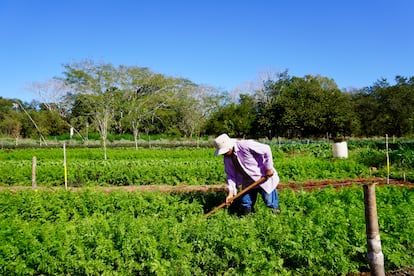
At the far end of the property lies the milpa, where they practice regenerative agriculture — rebuilding soil organic matter and biodiversity to create sustainable crops through methods such as crop rotation, keeping the ground covered with plant material to prevent erosion, and minimizing soil disturbance.
Samaranch walks through the milpa, pulling from the earth whatever he sees that can be tasted. Purple basil, asparagus, garlic blossoms, white eggplant. Then a crisp spinach leaf, yellow beet, another basil that tastes like cinnamon, sweet carrot, edible flowers, and okra — the caviar of vegetables. The seeds come from Las Cañadas. Planting is continuous and free of agrochemicals, and the result is high‑quality produce. “When you buy food, you’re not just deciding what you’re going to eat — you’re also choosing a landscape: 20 hectares of agro‑industry, or what you see here,” Samaranch says.
At first, he sold wherever he could. But he later chose to work only with established venues. Among his allies is Andoni Luis Aduriz, the award‑winning, Michelin‑starred chef now leading XAL on the Mexican Caribbean. “It’s a privilege to have access to people so committed and so good at what they do. He’s a close interlocutor,” Aduriz says. “Their production isn’t massive. I don’t find their products expensive — especially considering they open the door to the heaven of flavor and to the culture in which they’re grown.”
Mayan vanilla
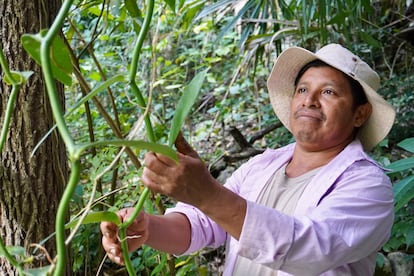
“And here is the crown jewel,” Samaranch announces after walking deeper into the jungle and descending about 50 meters toward a beautiful wetland. He points to the smooth, fleshy leaves of the Maya vanilla.
To convey the significance of the find, Samaranch turns to biologist David Moreno Martínez, founder of the organization Orquídea, Ciencia y Tecnología and an expert on vanilla. Moreno explains that there are more than 25,000 orchid species: around 125 are vanillas, and only three have economic importance because of their aroma and flavor.
The best‑known species is planifolia, native to Mesoamerica and widely used as a flavoring. But it is now endangered because it is propagated through cuttings: a piece is planted and replanted endlessly, allowing it to flower in three years instead of the eight required when grown from seed. This cloning reduces genetic diversity and makes the plant more vulnerable to climate change.
That is why the wild vanilla Samaranch points to is so important: it is not a clone and may be genetically distinct from those in Veracruz or Chiapas, according to Moreno. Samples have already been sent to the University of Florida for genetic analysis. To protect and study this and other species, Samaranch founded the nonprofit Na’at Lab Salud Planetaria.
A space to breathe
Four workers from nearby villages are employed by the project, among them Teresa de Jesús Cen Requena and Reyes Baltazar Cohou. Her son and his brother struggle with methamphetamine addiction — a drug that has reached even the smallest Indigenous communities. Mestiza de Indias has become a workplace where they earn more than the minimum wage and better pay than anywhere else nearby, and they regularly take home baskets of the produce they grow themselves. “It’s a space surrounded by nature that helps me take a breath and forget everything,” says Jesús Cen Requena.
This, Samaranch believes, is why the project matters: to care for nature, but also to offer people a dignified alternative.
Sign up for our weekly newsletter to get more English-language news coverage from EL PAÍS USA Edition









































