
Climate change fuels record-breaking fires in Spain’s hottest July on record
The extreme weather conditions that feed wildfires were 20 times more likely due to global warming, study finds

July in Spain has been “extremely hot,” according to the State Meteorological Agency (Aemet). In fact, along with 2022, it is the hottest since official records began in the middle of the last century. The agency’s data, shared with EL PAÍS, indicates that the average daily temperature in July in mainland Spain was 25.7ºC. This is 2.6ºC hotter than what is considered normal, taking the period between 1991 and 2020 as a reference. During the whole of July, aside from a couple of days toward the end of the month, temperatures have soared above normal, with three separate heat waves.

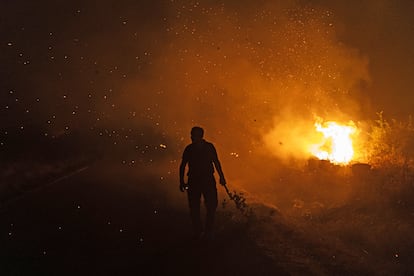
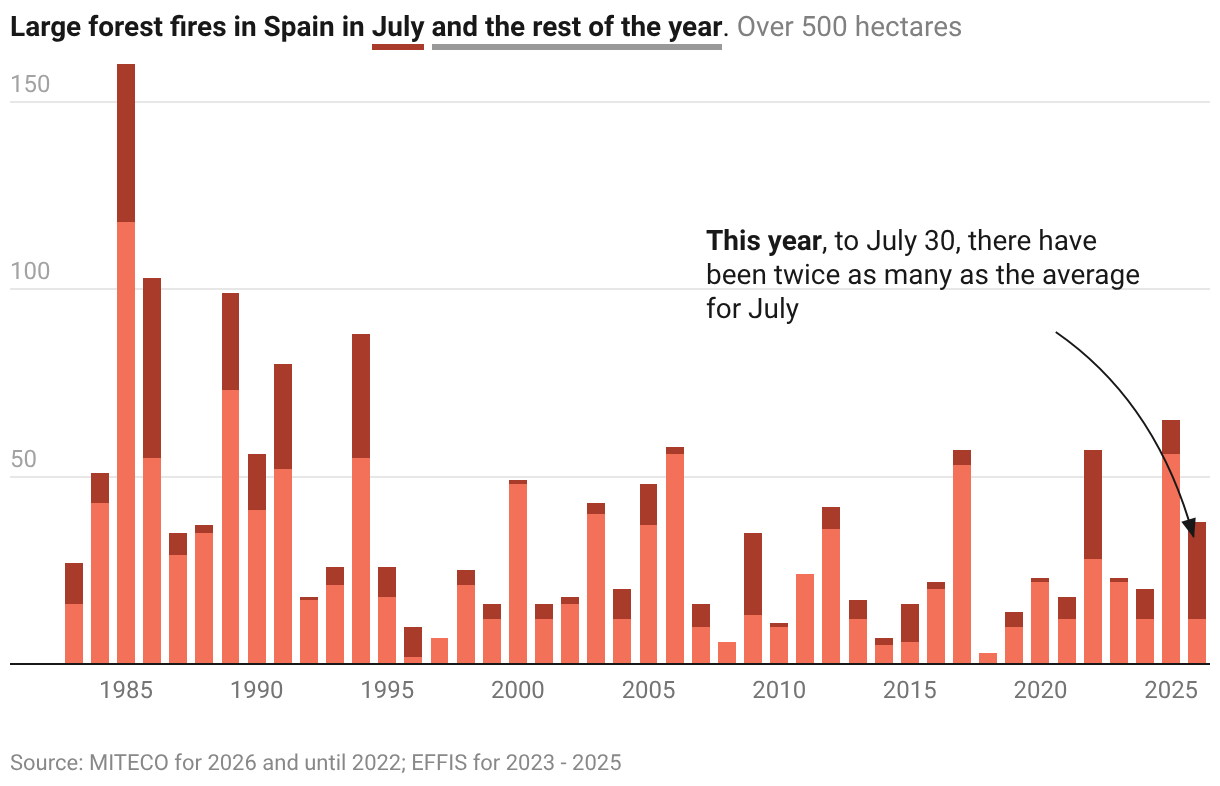
The extreme heat has been largely responsible for a disastrous spate of forest fires, with 26 wildfires affecting around 150,000 hectares. They include the deadly fire in Los Gallardos in Almería in the Andalusia region and the gigantic fires in Guadalajara and Toledo, Castilla-La Mancha, as well as the most recent ones in Ávila (Castilla y Leon) and Madrid, which triggered a national emergency in Spain — the first time ever for a natural catastrophe of this nature.
A study by a group of scientists from the World Weather Attribution (WWA) confirms the impact of climate change on these fires in Spain, and also on the wildfires in France. The experts have analyzed the heat, dry conditions, and wind that are used in the so-called Daily Severity Assessment (DSR) index, which measures the difficulty of extinguishing a fire once started. They conclude that climate change has made those conditions at least twice as likely in southwestern France and at least 20 times more likely in central Spain. They also argue that in the current climate, “An event of this intensity is expected about once every 20 years in southwest France, compared with about once every 6 years in central Spain.”
WWA researchers explain that “the wet-winter to dry-spring transition is an increasingly important driver of wildfire risk in western Europe.” This was the case last summer when there were a record number of fires and affected hectares in Spain. This summer’s heat has been preceded by intense and persistent rains. This set of conditions, the WWA explains in its report, contributes to the growth of vegetation, which subsequently dries out and becomes fuel for fires.
The extreme heat of this July followed an extraordinarily hot June. In fact, it was the second-hottest June in mainland Spain since at least 1961. And you don’t have to go back very far to find the warmest June prior to this one: it was in 2025.
The records are confirmation of climate change caused by human beings, fundamentally due to the burning of fossil fuels. This global warming translates into an increase in average temperatures. It also generates an increase in the intensity and number of extreme episodes, such as heat waves.
The data points to a clear uptick in the intensity, number and duration of these heatwaves in Spain, which in turn help generate the most unfavorable conditions for forest fires when they occur. According to the Californian organization Berkeley Earth, although warming does not cause fires, higher temperatures and changes in precipitation increase the chances of a serious event once a fire breaks out. It adds that the hotter and drier conditions make the fires that occur much more serious and that it is no coincidence that 2023, the warmest summer in Canada’s modern history, also set the record for the largest area burned.
The worst years this century in Spain in terms of area affected by fires were 2022 and 2025, though that is not taking 2026 into account. In both cases, these summers had heat waves and record temperatures.
Brutal consequences
“The climate alarm is blaring from every direction,” said UN Climate Change Executive Simon Stiell in a statement released July 29. “Around the world, climate-driven disasters are reaching nightmare proportions, as the costs of humanity’s addiction to burning coal, oil and gas keep spiraling upwards. These record-breaking wildfires tearing through France, Spain and other parts of Europe, forcing mass evacuations and hammering regional and national economies, follow brutal heatwaves that have dried out landscapes,” he added.
“These spiraling disasters are now the lived reality for billions in a world getting rapidly hotter, as humanity moves too slowly from fossil fuels to clean energy and to protect forests,” Stiell said.
In the same vein, Friederike Otto, from Imperial College London and leader of the WWA, explained: “Europe’s climate is shifting faster than governments are adapting. Our research showed how climate change is worsening drought across the continent. Now we’re seeing yet another disaster fueled by the same driver: the burning of fossil fuels.”
Sign up for our weekly newsletter to get more English-language news coverage from EL PAÍS USA Edition









































