
Inside Mattel, where the world’s most famous toys come to life: How the ‘Toy Story’ action figures are designed
At the toy company’s design and product development center in El Segundo, California, the last two years have been spent creating the new product line, inspired by the fifth film in the famous Disney-Pixar saga
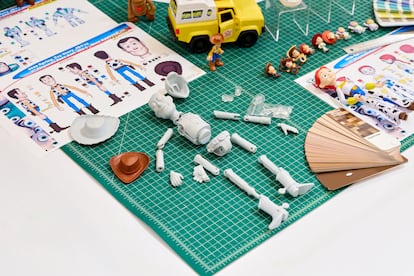

What do toys do when we leave the room? Do they move? Do they talk to each other? Do they have their own adventures? These are questions that we all asked ourselves as children. And they’re also the basis of Toy Story, one of Disney-Pixar’s most successful franchises, which was created three decades ago.
Today, these questions have inspired the stars of the new toy line designed by Mattel, to coincide with the theatrical release of the fifth Toy Story film, which hit U.S. theaters last June 19. The company has pulled out all the stops to make the world’s most famous toys seem like they actually come to life. For instance, the Buzz Lightyear and Woody action figures blink, turn their necks when they speak and move their mouths when they utter one of their 73 phrases. They even recognize and interact with each other.
On a poster at the entrance of the Handler Team Center (HTC), there’s a poster with a quote: “The heart of Mattel is design and development.” The phrase is attributed to Ruth and Elliot Handler, the American couple who founded the toy giant back in 1945. A tour of Mattel’s main product design and development center — located in the city of El Segundo, south of Los Angeles County — confirms this message.
The Toy Story characters are so iconic that Kristen Sanzari and Baxter Crane designed the new toys without even seeing the fifth film (which Disney kept under wraps more tightly than a sealed police investigation). They say they read the scripts, but barely saw 10 seconds of footage. The two women studied animation together and reunited about two years ago, when they found themselves working side-by-side at Mattel. Sanzari manages a team that’s made up of Crane and two other designers, who have spent the last two years working on new products for the franchise.
“We have decades of experience with Toy Story, so we know the fundamentals of the characters. For specific films, Disney involves us early on, while they’re developing the story. And, as they make changes, we make ours. For Toy Story, they give us the film’s message. The fifth film is basically about technology, about the digital and analog worlds. So, we understood the importance of how to represent the new character,” Nick Karamanos explains. He’s Mattel’s senior vice president for action figures, preschool, and entertainment partnerships.
The new character, and villain, of the story is LilyPad, a frog-shaped smart tablet that Bonnie — the protagonist — receives. The device puts the entire animated gang in jeopardy. “LilyPad was the most difficult toy to design, because she’s an iPad, but also a character with her own personality. And that’s what children are going to focus on. We’re not going to design an iPad the way Apple does,” Crane clarifies.
“Another issue is making sure that we stay true to Buzz and Woody’s story. Now we’re bringing them to life, in real life. There’s always a balance between [specifically addressing the] new story and bringing more innovation to the characters that already exist,” Karamanos notes. He’s been with the company for 22 years and has worked in its five major departments (dolls, vehicles, games, action figures, and preschool). “It’s art and science. You can have the best idea on paper, but if you can’t manufacture it, it doesn’t matter. Or if you can manufacture something that’s okay, but not great, it’s not worth it either,” he adds.
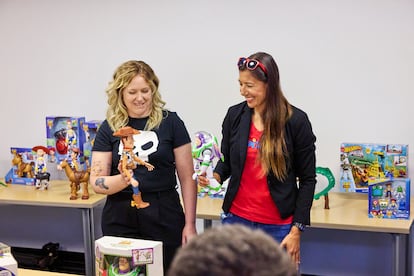
Today, technology has come to their aid. Sanzari explains that the idea of bringing Buzz and Woody to life as animatronic toys first arose in 2014… but it wasn’t feasible at the time. Two motors per toy were needed: the final product didn’t work well and the result was very expensive. “Over time, the technology has become cheaper. And that helps, even though it makes things more complex. We had to align the blinking of [the action figures’] eyes with their mouths; they couldn’t blink too much or too little. And we had to synchronize this for each of the 73 phrases they say, as well as for the other languages,” she recalls, describing one of the fundamental parts of the design process.
“The idea of animatronic toys has been around for a while. They built a prototype very early on, but they’ve arrived at the perfect time. The technology [that Mattel] has been able to incorporate now has been done almost magically. And it’s also been perfectly timed, because of the technology being incorporated into the fifth film,” confirms Tracy Thurman, vice president of product design at Disney.
The relationship between Disney and Mattel — the companies that created Mickey Mouse and Barbie respectively — dates back to 1955. Thurman clarifies that the latest chapter in the story “isn’t anti-technology” and hinted there’ll be a new character in the upcoming film… something that (once again) was confidential information before its release.
For the Ultimate Action Buzz and Woody figures — each standing just over six inches tall and on sale for around $89 — infrared technology has been incorporated. And now, each action figure has only one motor.
“I wanted them to communicate like friends having a conversation,” Crane explains. In fact, the action figures don’t have the same tone of voice when children play with them like a normal toy (“toy mode”) as compared to when they talk to each other (“alive mode”). “The challenge is ensuring that most of your ideas make it into the final product. And maybe not all of them will, but then they’re saved for the next one.”
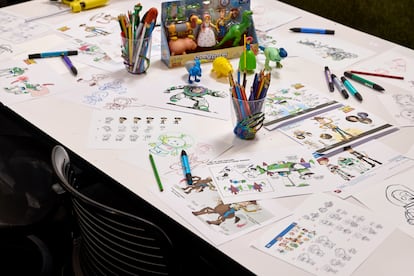
“I think children have such vivid imaginations that they can create stories with a toy that doesn’t have any technology. Technology can bring an extra element [to playtime], but what inspires us is what we remember from our own childhood toys. A lot of our design [process involves] thinking about what can inspire a child’s creativity and imagination. And if that’s just a simple mechanical feature, like Buzz doing a karate move, then that’s what it will be,” Sanzari says. She hasn’t forgotten that one of the things that bothered her nephew the most was that his Mattel Jurassic World dinosaurs couldn’t stand up on their own. Now, as she designs new products, she keeps that in mind.
For the new Toy Story movie, her team has created around 200 products, including plush toys, mini action figures, accessible sets for children, a new Uno game, as well as two Hot Wheels cars featuring Buzz Lightyear (Uno and Hot Wheels being two other Mattel franchises). And after the film was released, they can continue launching products… until they have to focus on the next movie.
Crane would love to design an Ultimate Action figure of Jessie. Karamanos suggests exploring Pizza Planet as a potential setting, as well as taking a look at the use of the claw machine from the first movie. But getting there involves a whole process: it starts with sketches — just like in movie-making — then moves on to modeling and printing. The team can go from a sketch to a first print in just a few hours.
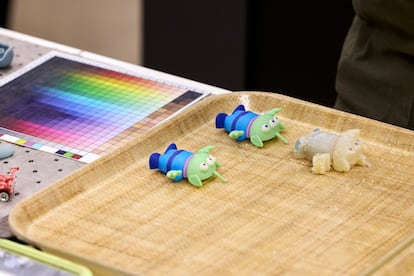
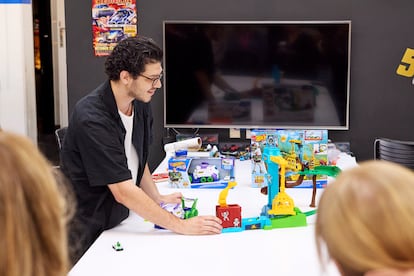
“What’s wonderful about Mattel and its people is that we all remember our childhoods and can continue to do so in our work,” Karamanos says. He has a Toy Story lamp in his office that he originally bought for his son’s room (his son no longer wanted it upon reaching adolescence). At the entrance to the Handler Team Center, there’s a ramp on the wall with a loop for launching Hot Wheels cars. And that already hints at what you’ll find inside: rooms and workspaces overflowing with toys. They have an area dedicated to Barbie (with six sewing machines for adding hair), another area dedicated to vehicle design, their own hardware store, a chemistry lab (Mattel created Slime in 1976), a room with 14 3D printers (prototypes no longer take seven days; the process has been reduced to two), a metal printing room (designed to be explosion-proof), a recording studio, the packaging area… and so on and so forth.
On the walls, you can see the company timeline: a year-by-year summary with information about earnings, employees, organizational charts, product launches, the competition, as well as global events.
“Our number one rule is that we have to be true to [each] brand. We make sure that we have a quality product — that the packaging, details and features are right — and we launch it at a price people can afford,” Karamanos summarizes. Potential customers also play a role, with focus groups of children and adults (the collectors’ market is a booming business these days) put together to test the prototypes. The designers’ own young children also try out their ideas. “You know that you’ve done a good job when everyone in the room is fighting over the prototypes,” Crane says, laughing about the latest creations.
And today, the buyer is also involved in the entire process. “Many years ago, we communicated with consumers through advertisements; now it’s much more of a two-way conversation, which gives us a lot of information. It started with Amazon reviews: [through these comments], you could suddenly get a better understanding of what parents thought about a product they bought for their child,” Karamanos recalls. “This has changed the way we put out our message and receive a response. Before, [the process] was done through letters and focus groups; nowadays, it’s so interactive that it allows us to change and adjust things much faster.”
It may seem that this company — which transports its employees from the Handler Team Center to the nearby offices in a small Barbie-themed bus — doesn’t encourage taking things too seriously. But at Mattel, that’s also the key to getting things right.
Sign up for our weekly newsletter to get more English-language news coverage from EL PAÍS USA Edition









































