
Luis Har, former Israeli hostage in Gaza: ‘If it had been only up to our government, we would still be there’
The Argentine-Israeli, rescued by the IDF after 129 days in captivity, admits ‘resentment’ that it took Benjamin Netanyahu so long to seal the ceasefire that brought back the last captives
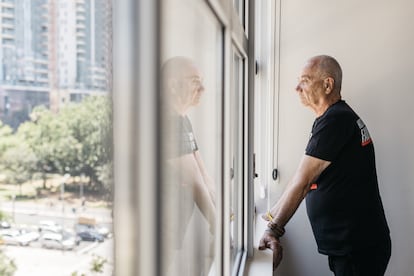

Luis Har (Buenos Aires, 73) squeezes in a break during his vacation at a hotel in Eilat, a tourist city on the shores of the Red Sea at Israel’s southernmost tip. It is the clearest evidence of the upheaval — from anonymous citizen to a public figure who travels constantly — his life has undergone since October 7, 2023, when Hamas took him hostage in its massive surprise attack, along with his partner, Clara Marman, and three of her relatives, at a kibbutz near Gaza, Nir Yitshak. All five held dual Argentine and Israeli nationality.
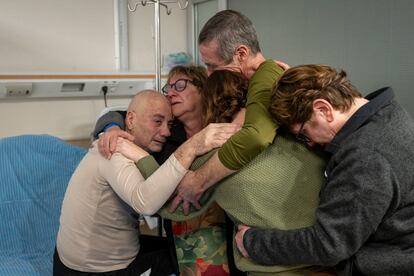
The other date that changed his life is February 12, 2025. Four months earlier, Hamas had released the three women in a first exchange with Israel, so only he and Fernando Marman, his partner’s brother, remained captive in an apartment in Rafah. Suddenly they heard intense aerial bombardment. It was diversionary fire —which killed dozens of Palestinians, mostly civilians — so elite Israeli soldiers could reach their location, inform them “we are here to take you home” and report back to command: “We have the diamonds.”
It was one of the very few successful military rescues among the more than 250 people the Palestinian militias seized that day, and he recounts it in a recent book titled Hostage. Dozens more died in captivity (from Israeli fire or at the hands of their captors, especially when rescue attempts were suspected). The vast majority returned through negotiated deals under various ceasefires. Prime Minister Benjamin Netanyahu could have signed the latest agreement — which Donald Trump imposed on him in October 2025 — “a year earlier,” Nitzan Alon, one of his top negotiators, admitted this week.
A few days before Israel marks the first anniversary of October 7 with no remaining hostages, and with the first elections since the Hamas-led attacks scheduled to take place on October 27, Har admits to “resentment” over the delay in the agreement. Sometimes he answers questions by saying he does not want to speak about politics, and then he ends up doing so. And he switches from Spanish to Hebrew (the language he’s used to speaking in such situations) to say two words: “Investigative committee,” because he wants a probe into the security fiasco that led to his kidnapping. It’s a demand championed by the opposition in Israel and one that Netanyahu has been blocking for three years.
Question. The third anniversary of October 7 is approaching. How are you, after everything that has happened since that day?
Answer. We’ve been through hell, but we’ve come out the other side, and we can’t keep thinking like this. We have to move forward and focus on the good things. I have a new appreciation for life.
Q. What are those good things?
A. I lived on a kibbutz in southern Israel, had my job and used to pick up my grandchildren from kindergarten. I lived an ordinary life. Suddenly, I find myself with ambassadors or kings. I have to dress in suits, wear a tie... See the world, hear different opinions and stick to my truth. What being in there gave me is the confidence to speak up and face things the previous Luis would not have done.
Q. Does that in some way change how you are experiencing this third anniversary, the first without hostages?
A. Last year we still did not believe they would all come out. It’s a dream, a reality thanks to Trump. We never dreamed they would all come out.
Q. Why?
A. Because it seemed impossible to us. Because if it had been only up to our government, we would still be there. That’s why I thank Trump.
Q. It was surprising that they found all the bodies. It was assumed some would never be able to return.
A. It means they also knew where they were and knew they could come back and it could have been done much earlier.
Q. Your case is different because you were freed in a military operation, but you’re angry that the others did not come out sooner.
A. I feel resentment. But I’m not angry. I want there to be a commission of inquiry so we can find out exactly what happened on October 7 and why. I’m not looking to assign blame; I want to understand so we can be prepared in case it happens again. I’m certain it could happen again. After the Holocaust, we used to say, “Never again” — it won’t happen. And now I say it can happen anywhere and in any form. And we have to be prepared for that.
Q. How does it affect you to hear that other countries issued warnings before October 7?
A. Let’s start with that story that our prime minister was sleeping and no one woke him up, poor thing… That alone is enough for me. And I said I would not talk about politics, especially now before the elections. But you feel that everything could have been handled differently.
Q. On a more personal level, does returning to the kibbutz or being here on the border [Eilat almost touches Egypt and Jordan] give you a different feeling after having been captured?
A. I returned to live in Urim [the kibbutz where he settled after emigrating from Argentina in 1971] and Clara returned to Nir Yitshak [where they were kidnapped]. We think it is our home and where we must be. If we all decided we couldn’t be there and left, what would remain? It is very important for me to have returned and to feel at home. Sometimes I am bothered by hearing Arabic a little. Right here in the hotel, most of the workers are Arabs and speak Arabic. It does not bother me enough to leave, but it makes me jump, let’s say.
Q. The last time we saw each other, in Hostages Square [in Tel Aviv], before the release of the last 20 living hostages [in October 2025], you spoke about how they would go through a physical and psychological recovery. How has that process been for you?
A. While there were people who hadn’t returned, I felt inside that I wasn’t whole, even though I was happy that I had been freed in such an extraordinary way, and I am grateful to those soldiers who gave their lives for me.
Q. You said earlier that you think differently. Did being kidnapped change you politically? How do you see the world now?
A. I try not to get involved in politics, to focus on the positive. But I’ve changed my outlook. I used to think we could live in harmony. Today, I’ve distanced myself from that idea. These days, we want peace, but we don’t have a partner to make peace with. Unless they [the Palestinians] change their way of thinking and their hatred… Hatred can be replaced with love, and children can be brought into the world to live a good life, not to become martyrs. When they change that, there may be peace. There are also right-wing extremists in our country, who are just as terrible as those on the left. Both extremes are terrible, and I accept neither.
Q. You just said you believe it could happen again… As a former hostage, how do you feel about Hamas still being in power in Gaza?
A. It’s out of my hands. I have to accept reality, and what I’m saying is that we have to be prepared for anything at any time. That’s why I need to know exactly how what happened on October 7 came to pass.
Q. What is your day-to-day like now?
A. To this day, I still don’t sleep well. They want to give me pills. I have them with me, but I take one every now and then. The doctor has told me I have to take at least one a week because my body needs to rest. The thing is, I can’t just sit around doing nothing. If you look at my diary... I can’t just switch off. I can’t stay home watching TV, because every time I’m home even for a little while, it all starts coming back. I start feeling bad, and this and that starts hurting. That’s not the Luis I want to be, so I avoid it.
I also go to conferences around the country. Fernando [Marman, with whom he shared captivity] is here, but he does not give interviews, nor is he willing to be photographed. He speaks only within the army, as a way to say “thank you.” Wherever I go, people know me, shake my hand, greet me.
I like this life. I feel more comfortable, more important, more appreciated. It’s a pity it’s because of what happened. But it happened. I was in hell and now we must get the best out of this. I would not want to go back to who I was before.
Q. Some former hostages have spoken about the documentary NAZA. They did not receive it well. What’s your opinion?
A. What is shown to the world can do a great deal of harm to the State of Israel. I don’t know why the information coming out of Israel is never understood as it should be, nor does it yield the results one would expect. When I speak, people see me differently. Many tell me, “We’d never heard the story from this perspective before.” Antisemitism has increased so much, and people see only horrors that are often not even true. They use the press, movies, and everything else to show only the bad. We’re not perfect, [but] our army is an army. To the world, we’re murderers, but this is a war, and in a war, things happen that shouldn’t happen — especially when those attacking us are 12- or 14-year-old kids.
A movie like the one that came out… What was the purpose behind it? It’s to turn people against us, to give the world a little more ammunition so they’ll turn against us. And, really, people like that shouldn’t be living here. Because, what’s the point? They don’t like it here; they’re against the country: Go somewhere else and see if you can live better there.
Sign up for our weekly newsletter to get more English-language news coverage from EL PAÍS USA Edition









































