
Sylvester Stallone: ‘I don’t know what the new masculinities are. It’s in a man’s nature to conquer’
The actor recalls a violent childhood devoid of parental love in his memoir and blames himself for failing to build the career he envisioned after the success of ‘Rocky’
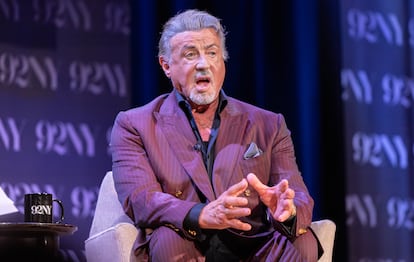

It is Sylvester Stallone’s fourth interview of the day. Is he tired of talking yet? “No, because this is the first one about my memoirs,” he replies from a hotel room in New York, his hometown, overlooking Central Park, where he is meeting with EL PAÍS.
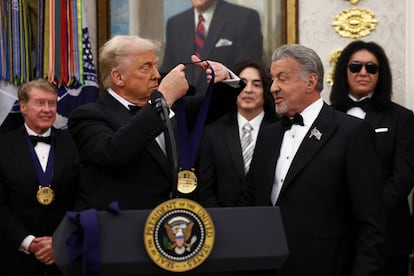
The conversation that follows confirms the impression that he has come eager to talk. For more than 40 minutes, the actor expands on subjects ranging from his frustration with a career that never took off as much as he would have liked, to his hatred and subsequent friendship with Arnold Schwarzenegger, and his change of attitude toward Donald Trump. Stallone introduced the U.S. president at an event in Mar-a-Lago in November 2024, shortly after his election victory, describing him as “a mythical character” and “a second George Washington.” Now, however, Stallone criticizes him for leading the United States into the hornet’s nest of Iran.
“Don’t get me involved in politics. I just said I hate war,” he says as the interview draws to a close.
He does not shy away from any question, not even the most painful ones about the death of his 36-year-old son in 2012 or the trauma of a brutally difficult childhood with parents who, he says, never loved him. Even at 80, it is something that still hurts.
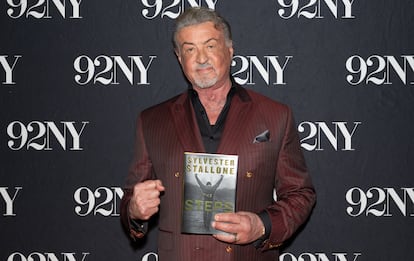
The reason for the interview is The Steps, a surprisingly candid memoir in which the tough guy opens up like never before. It is not a conventional autobiography. Instead, it focuses on five pivotal moments in his life and reveals that, contrary to what his parents always told him, he is no fool.
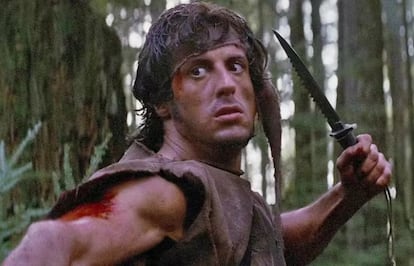
Stallone peppers the conversation with sound effects, gestures such as clenching his fist to convey anger or the urge to hit someone, and impersonates the voices of people in his stories as he recounts anecdotes. He constantly compares himself to animals. All of this is delivered with the characteristic half-smile caused by a difficult birth that left part of his mouth paralyzed, a defect that did not stop him from becoming a global superstar with franchises such as Rocky and Rambo. Watching him now reflect on the 1980s and 1990s, when he was one of the most famous actors in the world, is a show in itself.
Question. In your book, Rocky is the only film shoot you discuss. Do you feel that the rest of your career failed to live up to what you expected after that extraordinary success in 1976?
Answer. Absolutely. I was not happy with my career. It all happened because I didn’t understand the rules of the game. The character Rocky and I were inseparable. And when people saw me acting like an arrogant, angry and spiteful person, they began to hate me — deservedly. My whole life everyone said, “You’re stupid, you’re a loser.” And when I finally proved them wrong, I overreacted. That was my mistake. I reacted like a child.
Q. When did things start to go wrong?
A. After Rocky, I shot F.I.S.T., a very good film with a very good director. But people hated it. They wrote my funeral. And what did I do? I fought back. I said: “Why don’t you say that to my face? We’ll fight.” It was just like I was still on the street, like an animal. I hadn’t learned humility. I didn’t realize a damned miracle had happened: I was the luckiest man in the damned world [with the success of Rocky], but I didn’t act that way. And it carried over into my life, my marriage and my children. It was a bad stretch that lasted many years.
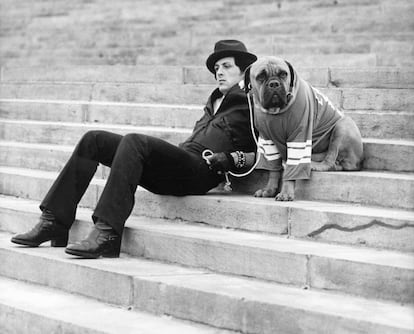
Q. Rocky won three Oscars, including Best Picture and Best Director. But you were nominated for Best Actor and didn’t win. How did you react?
A. It hurt because I felt I had lost it because of my words. I realized I had made enemies at the Academy. I thought we were going to win. How did we lose the Oscar for best score?
Q. Does it still hurt today, 50 years later?
A. Of course it does. I understand I did it. It was my fault.
Q. In your memoir, you write that when you finished the Rocky screenplay, you had just $80 in the bank, had spent nights sleeping in shelters and on park benches, and your wife was pregnant with your first child. Yet you turned down an offer of $360,000, more than $2 million in today’s money, because the deal required you to give up the lead role.. How were you so convinced you would succeed? Have you always had that much confidence in yourself?
A. No. I grew up with a tremendous inferiority complex. I wasn’t muscular. I had a mother and father who said non-stop: “You weren’t born with any brains, so build up your muscles; there’s nothing here” [he points to his head]. But something told me: do not sell it. I swear to God, I knew in my heart that this was the moment: either I landed a good acting part, or I would never be a star. At the first screening, people kept leaving the theater. Even my mother walked. I went home thinking: “I’m going to fucking kill myself. I’m going to be a broken, horrible man. I won’t recover. I have no skill. I have no work. I have nothing.”
Q. Your book carries a message about perseverance and never giving up. But isn’t there a flaw in the idea that people who don’t succeed simply didn’t try hard enough?
A. The only way to know whether you will succeed or fail is complete dedication and sacrifice. If it doesn’t work out, you can say you did everything you could, and it still didn’t work. That’s my philosophy.
Q. You also write that all your efforts were driven by a desire to be loved by your parents. Has that search defined your life?
A. It still does today. It’s such a sadness and regret! Why couldn’t you just love me? How about a kiss? Why do you fucking hate me so much? The more I got successful, the more they hated me. Because I reminded them that they didn’t have such things. They didn’t have talent. But they wouldn’t accept that.
Q. Did you make peace with them?
A. With my father, yes. With my mother, no. My father was physical; she was emotional. No one can hurt you more than your mother. You are part of her.
Q. How did growing up in a violent home affect your approach to parenting?
A. I was very physical. I knew I was strong, although I never used that strength against my children — only on the street. If someone looked at me… I felt like it was my father challenging me. I had a terrible temper. That temper also made me work hard. Even to this day, I’m competitive. I see guys in their fifties, and I say: “I can do that.” It’s weird. And I don’t like it. But it’s part of the animal. It’s like a Doberman; it’s built to be competitive.
Q. You went through one of the worst experiences possible: losing a child. Can anyone ever recover from something like that?
A. No. Even if you did nothing wrong, you have a horrible sense of failure. I still feel it today. I can’t even look at a photo; I don’t have any pictures of him at home. It’s too horrible. He was making movies. He was different; he wasn’t an action person but rather intellectual — he liked horror movies and strange foreign films. I know it was hard for him to be my son.
Q. Rocky V is based on your relationship with him.
A. Yes, it’s very autobiographical. A man my mother had just married called me and said: “Sly, you don’t know me. I just married your mother. I have bad news. He’s gone.” I asked who he meant, and he said: “Your son.” “What the fuck are you talking about?” I said. “Yeah, he died. I’m sorry,” he replied. Then he hung up. It was too fucking much; I couldn’t even breathe. I kept it inside. Two weeks later, I exploded. I fell apart. Like an animal.
Q. There has been a lot of talk about your rivalry with Arnold Schwarzenegger. How real was it?
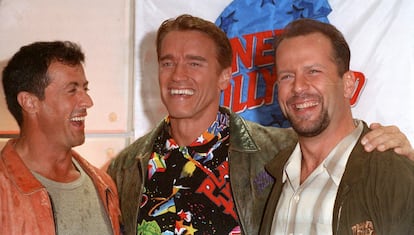
A. We hated each other. It was deep. The hatred came more from me. The press pitted us against each other. He was smarter than me and would say: “Sylvester will make a good movie someday.” And I thought: “Fuck.” He was very political. He’s my favorite actor. I like him.
Q. But now you are friends.
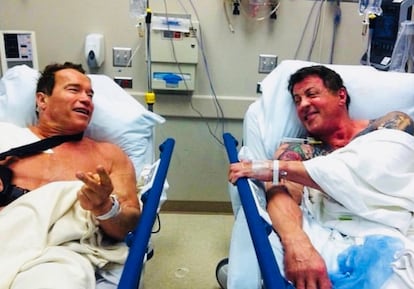
A. Yes, because he’s special. We’re in contact. We even crossed paths about 10 years ago in a hospital. I couldn’t believe it. I was going in for shoulder surgery and there he was, coming out of the same operation, also for a shoulder. I’ll show you a picture. Isn’t that wild?
Q. President Donald Trump appointed you ambassador to Hollywood. What does that role mean?
A. When I was made ambassador, I didn’t even know. I was watching CNN, and they announced it. I called the White House to say I didn’t want the job. Ambassador? As if Hollywood were a foreign country! It seemed ridiculous. They also named Mel Gibson; I called him and asked: “Mel, are you an ambassador?” “I don’t even know what you’re talking about,” he answered.
Q. You have defended Trump. What do you think your country saw in him?
A. Sometimes you say things you probably shouldn’t. I’ve changed a lot when it comes to politics. He appeals to many people, but things are changing. War is horrible. I hate it! The only people who get rich are the military-industrial complex, with the blood and bones of those poor people who make no money. I hate the idea of being in Iran. When I did Rambo, I was talking about the Vietnam War. Since Korea, we’ve been going to countries for no fucking reason. War is only justified if you’re attacked. Why do we go there? I feel so bad for the soldiers. Their entire lives are wrecked, and yet they keep defending the flag.
Q. You shaped the idea of masculinity in the 1980s. How do you view today’s obsession with fitness and gym culture?
A. It’s very important, because men need to conquer something to prove their masculinity. It’s part of their nature. That’s why they go to war. Only men do crazy things, like jump out of windows or throw themselves off motorcycles. I never see women doing those things. Every man needs to challenge himself to see if he’s brave.
Q. And what do you think of the new masculinities?
A. I don’t even know. What is that? A real man is physical. That’s what he’s put on this planet for. That’s what he was and always has been.
Q. How does someone who came to embody masculine strength and vigor come to terms with aging?
A. It’s an adjustment. The gym is the church of the soul. I go just to be in that environment. I can no longer lift 300 pounds. That’s over. But there are other ways to feel strong and masculine. Otherwise I would die. Everything would fall apart if I stayed home watching TV. I would get depressed. I feel pretty good. Dying is easy. Living is hard.
Q. What do you think about the woke movement?
A. It’s kind of boring. I like outrageousness. I like people to say outrageous things and do outrageous things. That’s what I loved about the 1980s, with Andy Warhol and people like that… just crazy. But it’s coming back. It’s all a cycle.
Sign up for our weekly newsletter to get more English-language news coverage from EL PAÍS USA Edition









































