
Expiry of the last nuclear treaty between the US and Russia opens the door to rearmament
The New START treaty, which limits the number of strategic warheads deployed by the parties to 1,550, ends on January 5 with no negotiations on the horizon. Washington also wants China to commit to a reduction, but Beijing refuses
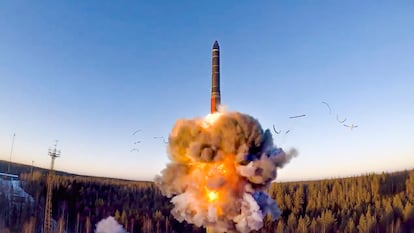

Five months after signing a crucial nuclear arms treaty to quell fears of impending catastrophe, Soviet leader Mikhail Gorbachev telephoned his counterpart in the United States, George H. W. Bush. It was Christmas Day, 1991. The tone was warm. Gorbachev called to tell his “dear friend” that he was going to resign. “Our responsibilities may change, but I assure you that what we have achieved will not,” Gorbachev said. “I am convinced that what you have done will go down in history,” Bush replied.
On January 5, more than three decades later, that security architecture sealed in the final stages of the Cold War has lost its last pillar with the end of the New Strategic Arms Reduction Treaty (New START), which limited to 1,550 the number of nuclear warheads deployed by the two major powers, mounted on both missiles and bombers.
The United States and the Russian Federation, the successor to the Soviet Union that was dissolving as Gorbachev resigned, have allowed the only remaining nuclear arms control agreement to expire without any sign of negotiations in the short term. Other pacts, such as the Anti-Ballistic Missile (ABM) Treaty and the Intermediate-Range Nuclear Forces (INF) Treaty, also perished before it. Gorbachev and Bush laid the foundation for this system of limiting nuclear arsenals with the signing of the START Treaty in Moscow on July 31, 1991. The objective of that first pact was to restrict long-range weapons power, termed strategic because it was designed to attack the enemy on its own territory. This distinguished it from tactical weapons, which have a shorter range and are used on the battlefield.
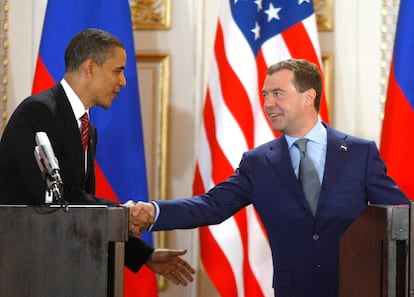
U.S. President Barack Obama and Russian President Dmitry Medvedev gave arms control a new boost with the signing of the New START treaty in Prague in 2010, which was renewed in February 2021 for another five years. “The main advantage of Cold War-era arms control talks is that they generated institutionalized knowledge in both the United States and Russia about the other side,” Paul van Hooft of the U.S. think tank Rand noted in an email.
On paper, along with the cap of 1,550 warheads and bombs, the treaty established a limit of 800 launchers for this type of weapon (deployed and undeployed), and 700 intercontinental ballistic missiles (ICBMs), submarine-launched ballistic missiles (SLBMs) and heavy bombers assigned to nuclear missions.
Communication between Washington and Moscow
More importantly, the agreement allowed for up to 18 inspections of arsenals per year between the parties. This established a new line of communication between Washington and Moscow and, therefore, created a climate of some predictability, essential for de-escalation. “Without transparency, each side will assume the worst-case scenario, and that definitely won’t contribute to greater trust,” Pavel Podvig, director of the Geneva-based Russian Nuclear Forces Project, explains by phone. “Before, they had to prove they weren’t doing anything suspicious, but without this treaty, without this whole system, without the verification mechanism, they simply don’t have the tools to do so.”
The treaty has functioned for many years, not only for mutual deterrence but also to contain, to some extent, the other countries with nuclear capabilities (the United Kingdom, France, China, India, Pakistan, North Korea, and Israel). The end of New START, however, comes at a time of global rearmament. The Stockholm International Peace Research Institute (SIPRI) warned last year that “the world’s nuclear arsenals are expanding and modernizing.” According to SIPRI records, the total inventory exceeds 12,200 warheads, more than 9,600 of which are operational. Between 80% and 90% of the arsenal, stored or deployed, is in the hands of Washington and Moscow.
The Swedish research center estimates that both the United States and Russia have deployed over 1,700 warheads in total, whether mounted on a ballistic missile or ready to be launched by a bomber. This figure would not exceed the limit of the now-defunct treaty because, under the Prague agreement, each bomber, despite being able to carry between 16 and 20 of these devices, only counts as one warhead.
“It is likely that both sides will respect the treaty to a greater or lesser extent as if it were still in force, at least for now, since that would cause the least disruption,” Van Hooft continues. The climate so far this decade has been one of relative continuity. Inspections between the two countries were abruptly halted during the pandemic. In February 2023, a year after the start of the large-scale invasion of Ukraine, Moscow withdrew from New START in response to the Biden administration’s support for Kyiv. Threats of nuclear weapons use followed, many made by Medvedev himself, now a member of the Russian Security Council, but none have materialized into an attack.
Last September, Russian President Vladimir Putin suggested that the status quo could be maintained for another year. Washington has not responded to the proposal. U.S. President Donald Trump, who undoubtedly maintains some relationship with his counterpart in Moscow — a relationship that has deteriorated somewhat in recent months and is far from the rapport between the leaders of the 1990s — has warned of the risks of these weapons, but little more. “If it expires, it expires,” Trump recently said.
“Even when there appeared to be political will, it wasn’t enough to overcome the disagreement over whether bilateral arms control should also include non-nuclear systems, such as missile defense, which have an impact on nuclear deterrence,” notes SIPRI researcher Tytti Erästö. The consequence: the demise of New START increases the risk of larger arsenals, as well as the possibility of a less secure world. “The qualitative arms race has been underway for quite some time, and without regulation, a numerical arms race is also possible,” Erästö adds.
The unknown quantity is China. The United States considers the Asian giant a greater threat than Russia, so any agreement should include Beijing at the negotiating table. On December 24, the Pentagon published a report on Chinese military capabilities, warning of a “growing” and expanding nuclear arsenal. According to SIPRI data, the Chinese People’s Liberation Army possesses a total of 600 warheads, 24 of which are operational for immediate use. But beyond the overall figure, Washington is concerned about the rate of production of these nuclear warheads, the highest in the world: 100 per year since 2023.
A month before the U.S. report, Beijing published a document on arms control stating that it is the major nuclear powers that must drastically reduce their stockpiles. “When conditions are right,” the document stated, “all nuclear-weapon states should join the multilateral negotiation process on nuclear disarmament.” This three-way agreement between Washington, Moscow, and Beijing seems unlikely in the short and medium term. “Russia wants an agreement with the United States because the symbolic value of being an equal partner is important to Russia,” Podvig points out. “All of the United States’ attention is focused on China, but China is reluctant to sign any of these agreements because it doesn’t feel it needs them. A treaty between the three would be practically impossible, but perhaps we can imagine agreements between China and the United States.”
Back in 1945, Albert Einstein and J. Robert Oppenheimer, along with other scientists from the Manhattan Project, which led to the first atomic bombs, founded the Bulletin of the Atomic Scientists. This organization periodically updates what it calls the Doomsday Clock, which measures how close humanity is to catastrophe, set for midnight. According to the latest update, on January 27, the world is 85 seconds from midnight, the closest it has ever been to destruction. Among the reasons cited is undoubtedly the demise of the New START agreement between the United States and Russia.
Sign up for our weekly newsletter to get more English-language news coverage from EL PAÍS USA Edition









































