
Boris Cyrulnik, neuropsychiatrist: ‘You can’t reason with fanatics like Trump. If you don’t think like him, you’re an idiot’
After a catastrophe, there are three possible paths, says one of the pioneers of the concept of resilience: carry on as before, vote for a dictator who promises security, or evolve and be reborn
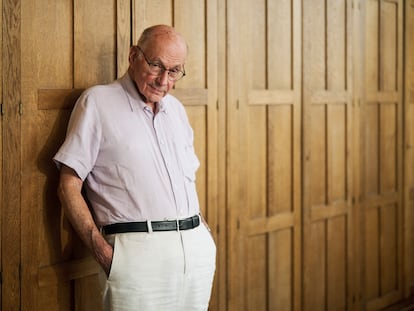

Boris Cyrulnik approaches through the door of one of the offices at the French editorial that publishes his work. He has a strange expression, and his head is bowed. It’s not his mental state, he notes. He has a stiff neck that barely allows him to lift his chin off his chest. But when he does, he smiles and jokes, and displays the same undiminished irony.
Cyrulnik, perhaps helped by that disposition to remain cheerful despite the pain, is one of the leading figures behind the concept of resilience. An ethologist and neuropsychiatrist, he has dedicated his life to explaining how people can put themselves back together after a trauma like the one he suffered the night when, at just six years old, four armed German officials arrested him for being a Jew. He spent the following years hiding from the Gestapo and managed to survive, but his parents were deported to Auschwitz and he never saw them again. “Much research, including my own, begins with personal experience,” he says once settled into an armchair.
Cyrulnik has been an adviser to French President Emmanuel Macron and led the 1,000 Days Committee created after Macron arrived at the Palais de l’Elysée. The body was tasked with understanding how that earliest stage of life shapes a child’s development in lasting ways, affecting everything from language acquisition to the ability to relate to the world. According to Cyrulnik, everything that happens during the first 1,000 days of a child’s life is essential, especially sustained contact with both mother and father in order to nurture the development of emotional bonds, a theory he explores in Quand l’amour devient attachement (When Love Becomes Attachment).
But beyond his remarkable resistance to neck pain, Cyrulnik also possesses an unusual ability to anticipate future trends by drawing on scientific data about the behavior of younger generations. And this time, he does not come bearing good news.
Question. How have you coped with this summer heatwave?
Answer. Poorly. Though at least where I live it hasn’t been quite so hot.
Q. We could invoke resilience to understand what it has taken for some French households to endure the summer heat.
A. The term was invented, precisely, to talk about what happens after a flood or a fire, when another way of life appears. Farmers used the word to describe what happens to flowers: when it’s hot, they shut themselves up to keep what little water they have from evaporating, and if that continues, they become a flower with thorns. That transformation defines resilience.
Q. It also seems to apply to humans.
A. Of course. Psychologist Emmy E. Werner applied this climatological or land-based concept to psychology to explain how traumatized children manage to live in a different way after a traumatic experience.
Q. Have we abused the term?
A. Yes, of course. All scientific words are abused. The concept of DNA, for example. When someone says, “It’s in the company’s DNA,” they are using it in a way that is completely different from what the term actually means. They don’t know the chemical formula that defines it. Or when someone calls another person an idiot, they forget that idiot was once a scientific term. The same happened with hysteria, which became famous through Freud but had to be removed from classifications of mental illness because it had turned into an insult directed at women. The same applies to resilience. But resilience is a simple concept: how to begin a new phase of development after a trauma.
Q. The term was used a great deal during the pandemic, when we said we would emerge from it as better people. Did we learn anything?
A. The evolution of living beings always follows a catastrophe. We are currently still in the midst of a catastrophe, so there are two options: either we do not evolve, or we adopt a different way of living in society. The Italian Renaissance, for example, began this way — with a plague epidemic that originated along the Silk Road. Ship crews ignored quarantine measures to make more money and would disembark at night, carrying plague bacteria. Two years later, one in every two Europeans had died, but culture had changed. That is resilience.
Q. And now, where are we?
A. After a catastrophe, there are three paths. Carry on as before, without changing a thing. Another option is to vote for a dictator who promises security and confidence — a strongman who says, “I know what needs to be done.” And a third path is rebirth. Today, unfortunately, there are more and more authoritarian countries — societies that are socially disorganized and violent, that don’t know what to do and hand over power to a dictator they elect at the polls. Look at [U.S. President Donald] Trump or what happened with [former Brazilian president Jair] Bolsonaro.
Q. In France, far-right leader Marine Le Pen is closer than ever to being elected president.
A. That is the danger. When a society is disorganized, we run the risk of looking to politicians like Le Pen or Jordan Bardella [the president of the far-right National Rally party]. They promise that they know where evil comes from and how to fight it. But traditionally, they have always managed with little more than expelling foreigners, going after Jews, or burning a few witches.
Q. Many people who speak out against anti-semitism in France don’t remember that National Rally was a party founded by antisemites, collaborationists and former members of the Nazi paramilitary organization SS, or Schutzstaffel. How is that possible?
A. [French military officer Philippe] Pétain was elected. And Lavalle [his prime minister] was a former Socialist Party official. It’s a classic. They don’t really believe in political ideals; they believe in those that are biological, psychological and cultural. Politicians turn to all of that to get to power, but not to think.
Q. The generation that was supposed to emerge so much improved by the pandemic has instead become more conservative and religious.
A. They are anxious. There are too many changes that lead to mental issues. School has become a place that instills fear. It saved me, but today it causes children anxiety. Parents place too much weight on what happens there. They tell their children that if they fail, they’re finished. And so they turn it into a source of anguish. In countries such as Japan, it has become a downright site of abuse and has contributed to many suicides. What happens if they lose a year or two? Nothing. Far worse is stressing children, filling them with anxiety, depriving them of sleep. It is that anxiety that ultimately leads people toward authoritarian political options.
Q. There is a widespread feeling that we’re becoming more intolerant, more violent, less cultured, less attentive. Is that really the case?
A. At Macron’s request, I chaired the Commission on the First 1,000 Days: 300 days in the womb, 300 days in our parents’ arms, and the rest of our lives in language. Those are the three sensory environments in which we develop, and when they are not connected, the brain malfunctions. When the environment is disrupted, especially for children, the frontal part of the brain is not properly stimulated and becomes underdeveloped. And that is the area where anticipation is formed.
Q. What does that mean?
A. If you take a picture of the neural circuit that creates certain pathways, you can see how they are obscured by the surrounding tissue. If there is a brain abnormality, the amygdala becomes hypertrophied, and that generates violent and sexual impulses that they cannot control. If you think about it, there have never been so many cases of rape or so much conflict with parents or teachers. France recently approved an extension of paternity leave. And that’s a very good thing. Because studies show that when both parents can spend more time with the child early in life, there are fewer cases of depression, and the children develop under better conditions.
Q. What are the implications of that?
A. That they no longer vote for the right [laughs]. No, seriously, it means they are not violent, and that they have confidence in themselves, in their peers and in their parents. That’s the main issue. There has never been so much sexism among teenagers, both boys and girls. There has also never been so much incest in France, and that’s a good indicator of how disorganized society has become.
Q. What would the ideal environment for those first 1,000 days look like?
A. Children need to be constantly surrounded by people and made to feel secure. Africans do this very well. They believe it takes a whole village to raise a child. And John Bowlby, my mentor and the founder of attachment theory, argued that what is needed is an extended family group of six to eight people. That no longer exists in France or the United States. Children should never be left entirely on their own, because then they can become vulnerable to predators or other dangers.
Q. Are screens part of those dangers today?
A. They are magical tools, tools of communication. But not for relationships. For adults, spending more than three hours a day in front of screens increases the risk of depression fourfold. For a preverbal child, under the age of three, it can lead to language delays similar to those seen in autistic children.
Q. Are you in favor of banning social media, as France has done for under-15s?
A. That’s what was done in Australia, and it didn’t do anything. It was a failure. They look at another person’s screen, get their parent’s phone…
Q. So what should we do?
A. Parents need to set an example and not spend all day on their phones or in front of screens. We need to nurture other relationships: theater, sports ... Screens are useful tools, but we have to fight their side effects. There is no progress without side effects. In this case, those side effects are isolation and strained relationships. Babies, for example, stop understanding certain reactions from adults when they’re looking at a screen; they lose track of the communication.
Q. You discuss attachment in your book and distinguish it from love.
A. In neuroimaging and psychology, a clear distinction is made between love and attachment. Psychologically speaking, love is like a bolt of lightning. You don’t know what that person does for a living or even their name, but they make you happy. Attachment, on the other hand, is intense, long-lasting love. And when we look at neurological images, we see that the reward system is overstimulated in those cases. Attachment is the memory system; emotional stability is necessary for a child or a partner to learn to develop it. And when that happens, it has a calming effect. And that — going back to politics — means we have no need for dictators.
Q. Why?
A. When there is uncertainty, people hand over power to a dictator. If you have a group, a family, or peers who give you security, you’ll opt for a platform—the development of ideas. That doesn’t happen here. Do you know Le Pen’s or Bardella’s platform? Today, the only thing that matters is forming alliances to gain power.
Q. Are you afraid of what might happen in the next French elections?
A. Yes, because they’re in a very strong position. You can’t argue with them because they have strong convictions. You can’t debate with religious, political, or economic fanatics, like Trump. If you don’t think like him, you’re an idiot. Look at Colombia; they just elected another extremist.
Q. The violence you’re talking about is more evident in men. Do you think there would be fewer conflicts if more women were in power?
A. No, there are many women who have been seduced by Trump and that kind of leader. And look at Margaret Thatcher, Catherine the Great and Margaret of France. When they come to power, they’re just as violent as men, but they come to power less often.
Sign up for our weekly newsletter to get more English-language news coverage from EL PAÍS USA Edition









































