
Mallorca 1820: X‑raying Europe’s last major plague epidemic
An analysis of documents from 200 years ago reveals the high fatality rate of the outbreak, which was not bubonic, and the effectiveness of quarantine measures
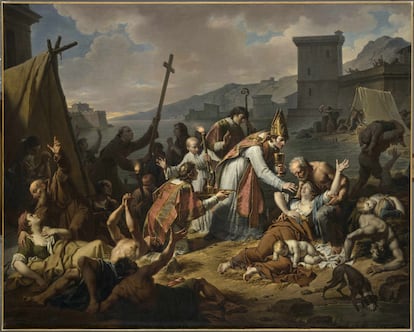

That summer must have been terrifying: between May and October, one in three residents in the area died of plague. Now a study of papers from 200 years ago recounts how Europe’s last major plague epidemic unfolded — the one that struck Mallorca in 1820. From newly discovered daily reports of the infected and the dead, researchers were able to calculate its extreme lethality and to conclude that the specific form was not bubonic, but pneumonic. The records also show how, in the absence of antibiotics to fight the disease (they would not arrive until a century later), confinement measures saved thousands of Mallorcans, confining death to the eastern tip of the island.
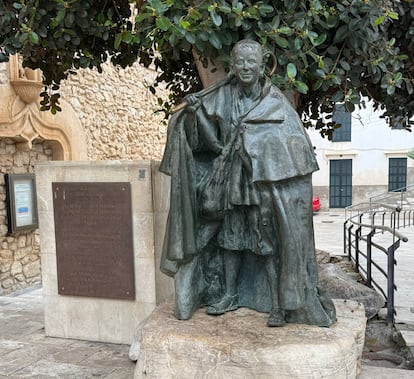
The second plague pandemic — which began with the Black Death at the end of the Middle Ages — ravaged Europe for the next four centuries with periodic outbreaks. The introduction of public health measures, mainly hygiene, ultimately expelled Yersinia pestis, the causative bacterium, from European territory in the 19th century. One of the pandemic’s last convulsions hit several islands in the Mediterranean. In Spain, it was Mallorca’s turn. Legend has it that a shepherd who picked up the blanket that served as the shroud for an infected sailor buried on the island spread the disease. The real story is now known in full detail thanks to the discovery and analysis of daily reports sent to the local health authority at the time, the Junta Superior de Sanidad. The researchers have published their results in the journal PNAS.
“It was probably smuggling,” says Joana Maria Pujadas-Mora of the Open University of Catalonia (UOC), a co‑author of the study. “There was an illegal landing on a beach near Son Servera [at the eastern tip of Mallorca], and the crew of that vessel, believed to have come from Tangier, would have been infected,” Pujadas‑Mora explains. “Then the legend of the young shepherd as patient zero followed.”
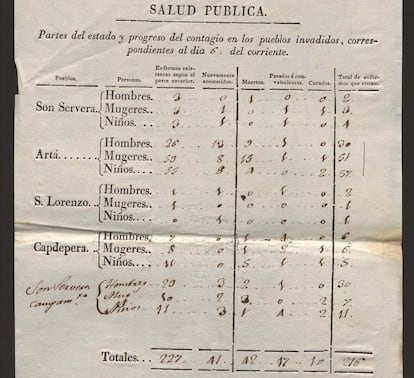
While she was already a postdoctoral researcher, her thesis supervisor, contemporary history chair Isabel Moll of the Universitat de les Illes Balears, told Pujadas‑Mora: “There are a number of deaths — you work with numbers, take a look.” She discovered a treasure: papers kept in the archive of the Royal Academy of Medicine of the Balearic Islands that turned out to be a diary of the epidemic. Almost from the start, in May 1820, affected towns had to send Palma a daily report with the number of infected and the number of deaths, broken down by sex and age, along with a situation report. Fear was such that they disinfected the pages with vinegar.
It all began, as the legend said, in Son Servera in early May, but then spread to neighboring towns. Having data on total population, number of cases, and number of deaths, and using modern epidemiological tools, the researchers estimated the mortality rate (deaths as a share of the total population) and, more importantly, the case fatality rate (deaths among the infected) and other indicators such as the basic reproduction number, known as R0 — a term that became widely known during the Covid pandemic.
“There are three transmission mechanisms for plague,” recalls Pedro Puig of the Catalan Mathematical Research Center (CRM) and the Universitat Autònoma de Barcelona, also a co‑author of the study. “One is via flea or louse bites [vectors that have bitten an infected rodent or human]. The disease develops more slowly and that is when buboes — swollen lymph nodes — appear,” he explains. The case fatality rate for that transmission route in the pre‑antibiotic era ranged from 30% to 60%. In pneumonic plague, transmission occurs through airborne particles. The third is septicemic plague [when the infection circulates in the blood], which results from contact with open wounds or handling corpses. “In those cases the fatality rate is 100% — everyone dies,” Puig adds.
On average, across the four affected towns — Son Servera, Artà, San Llorenç, and Capdepera — the case fatality rate was 78%. “Given such a high observed rate, we believe both pneumonic and septicemic forms played a relevant role,” Puig says. The researchers do not rule out bubonic plague, but that form does not kill at such high rates. There is also a historical detail: Son Servera has no port, so smugglers ferried goods to the shore in small boats from the ship — making it unlikely that infected rats reached the beach.
The blow was hardest where it began, in Son Servera: of the town’s 1,684 inhabitants, 1,340 were infected. When the epidemic was declared over in November, only 300 had recovered. Thanks to the vinegar‑stained papers, researchers estimated an R0 there of 1.3. That is not as high as the 2.5 estimated for the early stages of the Covid pandemic, but it was above 1. In nearby Capdepera, the R0 was below 1. That helps explain why in that town, which had 1,179 inhabitants in May 1820, only 146 were infected. But R0 is dynamic — it changes when measures are taken, and measures were taken in Mallorca.
“During Covid they sent us all home. In Mallorca in 1820, they created a triple cordon sanitaire,” Pujadas‑Mora recalls. Although at first they did not know what disease it was or the transmitting agent (they even killed all dogs and cats), doctors suspected plague quickly. They isolated each of the four affected towns from one another — and from the rest of the island. Within the four towns, they separated the sick from the healthy. They also imposed “a naval blockade; in fact, the area was fully militarized,” Puig notes. The first cordon isolated Son Servera on May 27. Inside it almost everyone died, but outside it was salvation.
Except for one case reported in Manacor, no further cases were detected outside the quarantined zone. In other words, the more than 40 other towns on Mallorca avoided it. That is one of the lessons the authors say should be learned: “Even though they did not know what they were fighting, they put cordons in place,” Pujadas‑Mora emphasizes. Looking at the epidemic’s dynamics, the researcher is convinced that “it would have reached the whole island and caused very high mortality — so the containment measures were truly effective.”
Sign up for our weekly newsletter to get more English-language news coverage from EL PAÍS USA Edition









































