
The great drought devours the heart of Europe: Record-low harvests, historic restrictions and a stalled economy
Millions of Europeans face unprecedented limits on water access due to lack of rain. Low flows in major rivers are slowing trade, dragging down energy production and decimating staple crops such as maize, rice, wheat, and soy


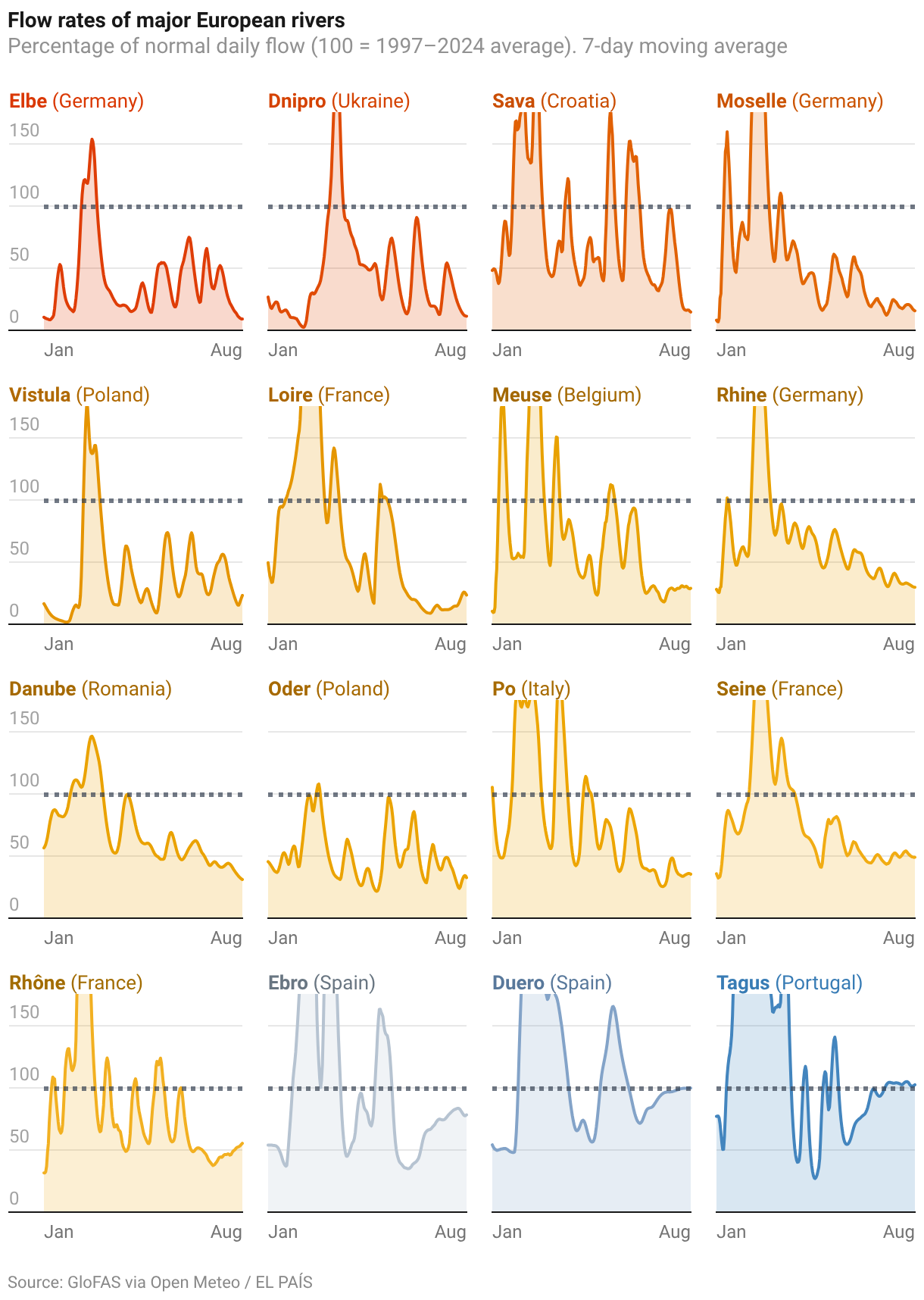
The great European drought has not only turned once-lush parks into dry wastelands. It has unleashed a complex cascade of emergencies with multiple effects that collapse like dominoes across countless sectors — from food prices to freight transport, and on to energy production and growth forecasts for major economies, with continental GDP at stake: the short-term economic hit will be at least €50 billion ($58 billion). The water shortage that is withering the heart of the continent during this summer of extreme temperatures has driven river flows and water resources down to historic lows.
Millions of people are facing water restrictions for the first time, and impacts are multiplying in countries unaccustomed to running short of water. Stifling temperatures have already killed about 25,000 Europeans so far this summer, including more than 9,500 people in Germany during the terrifying heatwave in the last week of June, and France is struggling to protect itself after registering its fifth consecutive heatwave. Cargo ships carrying essential goods to Rotterdam via the Rhine are sailing at 30% capacity to avoid running aground. One of the worst blows has hit agriculture, with output from Europe’s main breadbaskets decimated: wheat production in the EU and the United Kingdom will fall 24% this year, costing producers roughly €2 billion. That has forced France to promise aid to a highly vulnerable sector. The new British prime minister, Andy Burnham, called the situation a “powder keg”; Italy has already asked Switzerland for water to save its rice fields; and Hungary has completely shut down its only nuclear plant, which was cooled with the now-vanished waters of the Danube. While rains that could ease the crisis are awaited, the dry punch will leave a mark on Europe: this is the feared future.

France: farmers in crisis
In France, authorities are facing a fifth heatwave, with around 70% of the country suffering some form of water restriction and 40,000 people in 80 municipalities already facing supply cuts, forcing them to rely on tankers or bottled water, according to the French Ministry of Ecological Transition. Some 67 departments (out of the country’s roughly 100) are at crisis level, which means water is reserved for priority uses and activities such as filling pools, irrigating sports fields, or washing cars are prohibited.
The drought has come alongside the hottest, driest summer on record. Precipitation was 67% below average and July was the third-driest month since 1959. Almost all groundwater reserves (94%) are below normal levels and “the condition of aquifers is deteriorating,” according to the monthly bulletin of the Geological and Mining Research Office. In addition, over 1,000 watercourses experienced interruptions in flow or ran dry.
The minister for the Ecological Transition, Monique Barbut, convened the crisis cabinet last week to study measures against the “particularly intense drought and the effects of climate change, which continue to increase pressure on water resources.” The minister asked departmental prefects to issue water-restriction orders without delay when the situation requires it. “Containment should be the default response and must apply to everyone: households, agriculture, and industry,” she said. She noted that last week water supplies for 550,000 residents were under pressure. This is an extremely severe drought that occurs “once every 25 years,” she added.
The minister quantified the impact of successive heatwaves, fires and drought this summer. According to her figures, they will cost the country between €10 billion and €15 billion, representing between 0.3 and 0.5 percentage points of GDP. That is a significant impact, given that growth forecast for this year is just 1%. A study by Triodos Bank indicates the cost to the EU could be 0.5% of GDP, with dramatic cases such as Poland of up to 2.9 percentage points.
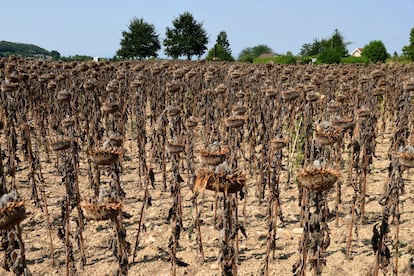
The situation is particularly grave for agriculture, and the sector anticipates a catastrophic summer with unprecedented consequences for harvests. The FNSEA, the main farm union, foresees a 40% drop in the maize harvest, which could reach 70% in some departments. They also warn of excessive mortality on poultry farms, especially after the late-June heatwave — the most intense so far this summer.
Prime Minister Sébastien Lecornu pledged emergency measures and aid for farmers as part of next year’s budget on Sunday. “We recognize the magnitude of this crisis and no farmer will be left alone to face this situation,” he said.
No hoses in the United Kingdom
British authorities have formally declared drought across 71.3% of England, after the driest July since records began in 1836. In the south of the country the situation is worse: last month was the driest in its history, with only 1% of expected rainfall. The last five years include three drought years: 2022, 2025 and 2026. Today, 45 million of the United Kingdom’s nearly 70 million inhabitants live in an area officially in drought.
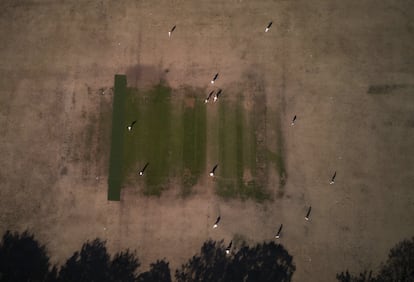
Some 27 million Britons are already subject to restrictions, such as bans on hosepipe use, but the UK government has drawn up contingencies for the “reasonable worst case,” including limits for businesses and any use deemed nonessential, such as irrigation of sports facilities and soccer pitches, car-wash businesses, window cleaning, or private pools. Last Friday, Burnham warned that the drought, together with five heatwaves since May, has turned the UK into a “powder keg.”
The lack of rain has forced weekly meetings of the National Drought Group, a platform led by the Environment Agency that also includes the Met Office, water companies, and experts. One fundamental problem for the UK is a historical lack of preparedness for a prolonged drought period.
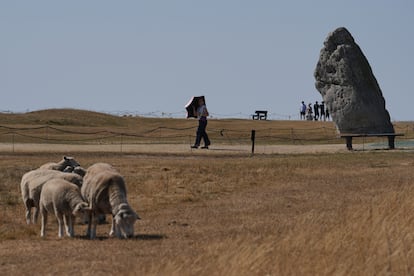
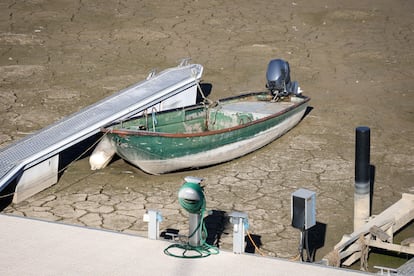
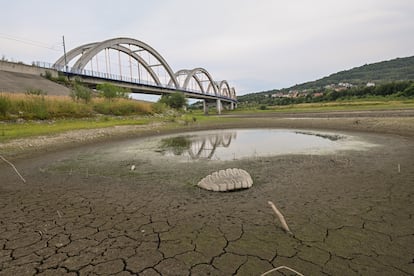
Currently, only 14% of England’s rivers show flows considered normal for this time of year, according to Environment Agency data, which reveal that 22% have “exceptionally low” flows. As a result, navigation obstacles are already possible on the Thames, the Lark, and the Ouse. Reservoir levels, meanwhile, continue to drop, with almost all in England below usual levels and five already at “exceptionally low” capacities.
Here too, agriculture is among the hardest-hit sectors. Output is significantly lower because harvests had to be brought in at the earliest point of the season in 20 years. According to the National Farmers’ Union, if the drought continues there could be shortages in the supply of some foods. The livestock sector has already had to use feed reserves planned for winter to feed animals, given the inability to grow pasture.
Price increases in Germany
In Germany, the strong impact of extreme temperatures, fires and drought stands in contrast to the government’s cautious statements, which has limited itself to saying it is “monitoring” the situation. Environmental groups and the Green Party are calling for faster adoption of heat-protection and climate measures.
Drought is also hitting crops hard. “Since mid-June around three million tons of cereals and rapeseed have been lost due to the heat,” reported the Deutscher Raiffeisenverband, which represents 1,600 cooperatives in agriculture and processing. That represents a loss of income of €600 million. Meanwhile, the German Farmers’ Association has said it expects considerable reductions in harvests that could amount to total losses. “We start from the assumption that the cereal harvest, particularly wheat and rapeseed, will be below average,” the association’s president, Joachim Rukwied, told RND. “For autumn crops, the trend points to considerable losses as well,” he added. “In the south this could mean a total loss of the harvest.” Some fear the harvests could even be worse than in the disastrous 2003 season. As a result, prices of some vegetables such as carrots, cucumbers and peppers have risen. In several southern states, the collapse of forage reserves has forced some farmers to cull animals earlier than planned.
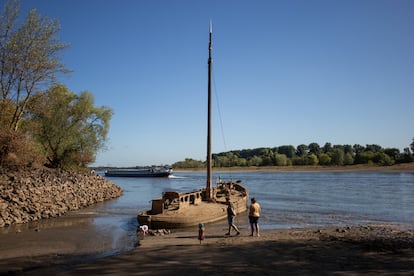
Regarding rivers, the Rhine — the country’s most important waterway — currently has flows lower than ever. Because of this, Transport Minister Steffen Bilger announced that cargo should move from inland shipping to rail and road. Federal states responded by relaxing Sunday driving bans for trucks. Rail is also expected to carry more freight. But hauliers warn that this could affect products such as gasoline, diesel, and jet fuel. Meanwhile, the German Economic Institute says the low river levels could hit already meager growth forecasts for this year.
According to the German Weather Service, “extreme water stress” is also affecting deeper soil layers regionally, which could pose a problem for some forests. Groundwater — around 70% of drinking-water supply — is currently being depleted. In parts of the Black Forest, private wells are already running dry, prompting local suppliers to activate emergency plans and use tanker trucks. In many areas, especially in Bavaria and Baden-Württemberg, lawns cannot be watered, at least during the daytime, nor can pools be filled or fields irrigated.
Italy asks Switzerland for water
In Italy, the drought has flipped the traditional map of water scarcity and impacts are especially severe in the north. In fact, the National Association of Land and Irrigation Water Management, Consortia, has described the south — where reservoirs entered the dry season unusually full this year — as the country’s “hydric safe” in contrast to the progressively reduced reserves in northern areas.
The most delicate situation is in the Po basin, the great water artery that crosses northern Italy and supplies one of the country’s most important agricultural and industrial areas. The river and several tributaries are registering exceptionally low flows, while the alpine lake reserves essential to feed irrigation systems in summer are at minimal levels.
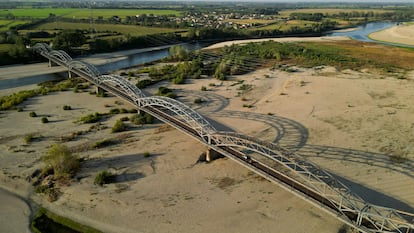
The situation is so critical that Italy and Switzerland have agreed to temporarily increase the flow of water from Lake Lugano into Lake Maggiore to ease the effects of the severe drought. The transfer will take place via the Tresa river, which naturally connects the two lakes and crosses the border between the countries, eventually draining into the Po and supplying an extensive network of irrigation canals that support important agricultural areas of Lombardy and Piedmont, including the large rice paddies of northern Italy. The decision is especially notable because Switzerland itself is also enduring a period of severe drought and it represents an unusual example of cross-border cooperation in the face of growing water scarcity.
Extreme heat, drought, hail and fires have already caused more than €3 billion in damage to Italian agriculture, according to a preliminary estimate by Coldiretti, the country’s largest farmers’ association. One of the hardest-hit sectors is rice. Italy is the European Union’s largest producer and much of its rice is concentrated between Lombardy and Piedmont. Farmers warn that in the worst-affected areas the harvest has fallen 40%. Corn, soy, fruits, vegetables and forage are also suffering from the lack of rain. Added to this are rising irrigation costs, since farmers need more energy to obtain and distribute water.
The Po faces another problem: the intrusion of Adriatic seawater at the river mouth. When flows fall too low, saltwater moves upstream and can enter irrigation canals. Currently, seawater has advanced about 20 kilometers (12.4 miles) inland. At the end of June some canals had to be closed to prevent damage to rice and maize crops. Farmers also warn that this year the phenomenon has appeared much earlier than usual.









































