
The rejection vote marks Brazil’s presidential election
Extreme polarization between supporters of the leftist President Lula and the far-right candidate Flávio Bolsonaro will lead many voters to choose whoever they feel is the lesser evil, regardless of qualifications
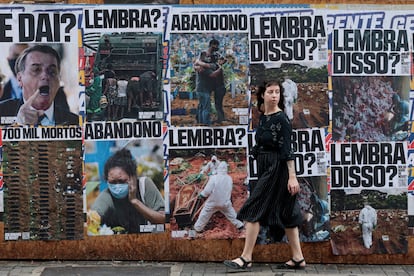

Brazil is in the final stretch of a tightly contested presidential election, but the campaign is almost absent from the streets of São Paulo, the country’s most populous city. On Paulista Avenue, only a few small banners with candidates’ photos remind people of this Sunday’s ballot, to which nearly 159 million Brazilians are summoned. Framed by towering office blocks, Paulistanos walk among street vendors, offices, shopping and cultural centers and show an enthusiasm for the spring day that vanishes when the conversation turns to the vote. Fewer people passionately defend their own candidate’s platform than those who want to stop the one they despise from winning.
President Luiz Inácio Lula da Silva and his main rival, Flávio Bolsonaro, have more negative than positive ratings, yet they still top the polls in a country split in two. Attempts by other candidates to grow within the huge gap between them have failed: their combined share of voting intention is around 10%.
“Lula can’t continue in power, enough already,” says João Costa, a 28-year-old driver. Part of Brazilian society’s weariness with a president about to finish his third term and, at 80, fighting for a fourth, is one of the cards most often played against the Workers’ Party (PT) leader. Costa says his parents voted for him in 2003 because they believed the country needed change, but now they will turn their backs on him because he represents the opposite. “Although they don’t like Flávio either,” he clarifies. Why not vote for another candidate? “Only Flávio has a chance [of beating Lula]. He’s the lesser evil,” he answers, shrugging in resignation.
Costa has made up his mind, but he will spend Sunday behind the wheel of his car, working. Although voting is compulsory in Brazil, absenteeism can be justified if someone is away from their registered voting location; in his case, Minas Gerais, more than 310 miles (500 km) from São Paulo. In 2022, abstention was 21% and experts believe this year’s figure will be the same or higher.
María and Marcia, 21 and 22, admit that the hope with which they voted for Lula four years ago has faded. “There is a lot to improve in Brazil; I would have liked Lula to do more and I don’t see proposals that inspire me,” María says outside the communications firm where she works with Marcia, their first job. Although both complain about low pay and the high cost of living, their vote aims to block the eldest son of former president Jair Bolsonaro from coming to power. “Flávio Bolsonaro is a danger to democracy, to the Amazon, to minorities, to women’s rights…,” María lists.
Political scientists note that the economy, public security and services are among Brazilians’ major concerns, but there are other factors that matter when deciding how to vote. “The phenomenon of polarization has produced a vote of rejection that can prevail over everything else,” says public opinion specialist Esther Solano, a professor at the Federal University of São Paulo.
Solano says the determination to vote against a candidate is clearer among right-wing and far-right voters: “Among those who were convinced voters of Jair, some think his son lacks credibility, that he has no experience, that he’s a spoiled child, but they will vote for him anyway because it means voting against Lula.”
Brazil enters the election with unemployment at a historic low of 5.3%, inflation under control (4.22% year-on-year) and years of moderate economic growth, albeit higher than expected. Like Maria and Marcia, some Brazilians do not feel those improvements in their daily lives but believe that if Bolsonaro wins he will push for public spending cuts to curb the deficit, worsening their situation.
For others, however, that cut is inevitable and they criticize measures Lula has enacted in recent weeks in the opposite direction, that is, to put more money into the pockets of the poorest. Among those measures, issued by decree, is a 15% increase in Bolsa Família, an anti-poverty benefit received by nearly 20 million families, and a ban on online gambling.
“I’m very grateful to Lula”
The president is trying to persuade the few undecided voters — around 3%, but crucial in such a close race — and to mobilize low-income voters, Lula’s most loyal base and the group with the highest abstention rates.
“I would vote for Lula, I’m very grateful to him, my children were able to study thanks to him,” replies Imani, a 49-year-old Afro-descendant. “I don’t know if I’ll vote because I’m caring for my grandchildren and my daughter’s house is far from the polling place,” she adds before boarding the first bus that will take her to the city’s outskirts, almost two hours away.
“Lula subsidizes the poor more and more. When will this end? He hands out money without caring that he’s creating a deficit that will eventually explode,” warns Antonio de Assis, owner of a tourist business who says he is deeply opposed to Lula and the Workers’ Party he leads. “I would like [Javier] Milei to govern us,” the man says, referring to Argentina’s president, who has become known worldwide for the chainsaw symbol aimed at cutting public spending.
De Assis, 65, admits he initially considered voting for Renan Santos, an ultra-liberal candidate, but in the end chose Bolsonaro’s son. “I don’t care if he’s the most capable one or not, I’ll vote for whoever can beat Lula.” He accuses the Brazilian president of being “a thief” and “a corrupt man” — even though his court conviction was annulled — and extends his accusations to Supreme Court justice Alexandre de Moraes, suspected of protecting a banker accused of fraud in the corruption case known as caso Master. De Assis pulls out his cellphone to show a video that demonizes De Moraes, another example of how social media and information shared by phone have helped polarize the campaign to levels never seen before in Brazil.
Sign up for our weekly newsletter to get more English-language news coverage from EL PAÍS USA Edition









































