
Mount Athos, the Greek stronghold that bans women from entering
This enclave, considered by Orthodox Christians to be the Garden of the Virgin Mary, houses about twenty monasteries and maintains a special legal regime known as ‘ávaton’ that admits only men
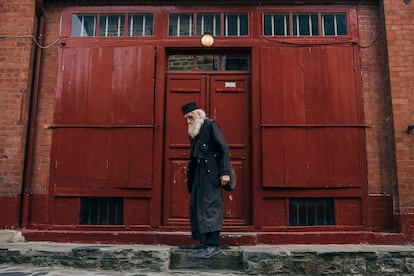
Orthodox monks rise to pray at 4.00 am at the Monastery of Saint Gregory, located on Mount Athos, considered by Orthodox Christians to be the Garden of the Virgin Mary. Not even at that hour do the lap of the Aegean Sea and the birdsong prevail over the hum of the electric generators. Hours later, the roar of an infrastructure project funded by the Greek government and the European Union will join the soundscape. Modernity marches on by way of EU funds at this location that is home to 20 monasteries, where some monks drive up the slopes in all-terrain vehicles. Maybe in a few years electric cars will be seen on the streets, or maybe drones will carry food to the most inaccessible spots. What will probably not be anywhere in sight, however, are women.
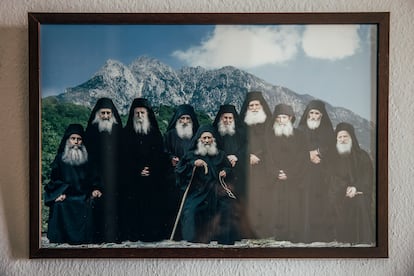
On Mount Athos, which covers an area three times the size of the city of Barcelona and similar to that of Malta, access is allowed only to men. In this part of the Chalkidiki peninsula the ávaton has applied for 1,000 years — a Greek term meaning “inaccessible” that bans entry to women and female animals, except in rare cases such as female cats. That peculiarity, which Greek society does not question, is enshrined in Article 105 of the Greek Constitution and was acknowledged by the other EU member states when Greece joined the EU in 1981.
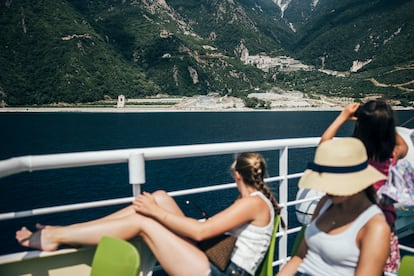
Therefore, only men can enjoy one of the world’s largest collections of Greek manuscripts, imposing frescoes, thousands of icons and masterpieces of Byzantine painting from the 12th to the 15th centuries, among other treasures. Women can only view the sacred mountain from cruise ships that must keep at least 500 meters from the shore.
Greek journalist Stavros Tzimas, one of the leading experts on Athos, is also one of the few Greeks who publicly opposes the ban. “But the believers,” he adds, “argue that one of the reasons Athos retains its appeal for the outside world is precisely the ávaton.”
Is that ban compatible with the gender equality and non-discrimination values promoted by the European Union?
The values of the European Union
Lina Gálvez, a member of the European Union for Spain’s Socialist Party (PSOE) and chair of the European Parliament’s Committee on Women’s Rights and Gender Equality, says in a WhatsApp conversation: “Obviously, it is not compatible. [The prohibition] amounts to assuming that all women are impure. But it is also true that it is very difficult to do anything from the European Union [to change it], since that exception was already established when Greece joined.”
Ana Miranda, another Spanish member of the EU Parliament, also argues by email that the ávaton is incompatible with Europe’s commitment to gender equality, “enshrined in the Charter of Fundamental Rights of the EU.” Miranda believes representatives in EU institutions have a responsibility to denounce “gender apartheid” and “open a debate to end prohibitions” that affect “half of the EU’s population.”
Sakis Arnaoutoglou, a member of the Greek the socialist party PASOK who has visited the mountain twice, says by email that the question of compatibility with European values admits no easy answers. “It is not only a matter of equality. It is also a matter of history, faith, culture and the way Europe approaches unique historical realities that have existed for centuries.” Arnaoutoglou points out that Athos is part of a historical reality that “long predates the European Union itself.” He adds that Europe is built not only on common rules but also on respect for diversity.
Although in 2024 Greece became the first predominantly Orthodox country to legalize same-sex marriage, the Church still has considerable political influence over national affairs. Legalization has not eliminated the weight of traditionally conservative social structures. Greece ranks among the EU member states with the worst outcomes on equality, according to the European Institute for Gender Equality (EIGE). The country is 22nd out of the 27 EU member states, with a score of 57 out of 100, well below the EU average (63.4).
Mount Athos sits on a peninsula about 50 kilometers long by seven wide, with no road access enabled. Travel is by sea and the gateway to the peninsula is the municipality of Ouranoupoli, home to about 800 residents in winter and several thousand in summer. That is where the permit to enter the mountain is obtained: €25 for Orthodox pilgrims and €30 for others.
“An aberration”
A Spanish mother and daughter visited Ouranoupoli last July. The daughter works in Brussels for a company associated with European institutions. Both prefer not to give their names. The mother calls the ávaton “an aberration.” The daughter, however, supports keeping the ban, although she regrets not having access to the marvels kept in the monasteries. “There are inconsistencies everywhere,” she says, “and a place like this makes me think of the past. I don’t see it as that serious.”
One of the most impressive monasteries is Simonos Petra, standing majestic atop a mountain above the sea. Photography is not allowed inside its church. A monk shows visitors the relics it houses. For women who want to see the icons or relics, the monks have found a solution: they board tourist boats that circle the mountain in small boats themselves. There they sell holy cards, blessed wine and oil, perfumes and other souvenirs of the place.
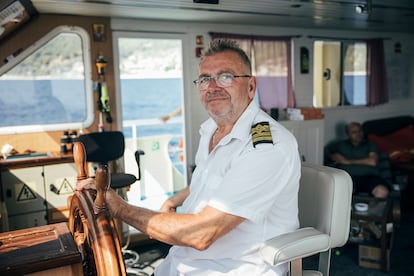
The Kapetan Fotis is one of those cruises. Its captain is Giorgos Rodokalakis. He not only agrees with the prohibition but believes the monks should be stricter. “Food should be for sustenance only, not for enjoyment. Now it seems like something for gourmets.” Smiling, the captain says without any trace of embarrassment: “Women have a tricky mind and if they entered Athos they would destroy it.” Rodokalakis sees no contradiction in the monks boarding the boat and talking with women: “That tests their faith; it’s a challenge for them.”
Aliki Peterson is a filmmaker who has bought souvenirs from the monks worth €65. She says she respects the ávaton. “If you go to someone’s home you have to respect their rules.” Nikol Konstante, 50, a teacher, musician and interior architect, admits: “As an artist I would love to see the monasteries’ icons. But I fully agree with the ávaton. Because this is the place of the Mother of God.” Theodora, 64, mother of a monk who asks that her surname be withheld, shares that view. “The Virgin Mary asked that women not come and I think that’s right.” For Cristina Pelagia, 30, the cruise is “an opportunity,” a kind of gift the Virgin Mary has given her.
There have been several breaches of the ban throughout history, such as during World War II, when monks hid people linked to the resistance against the Nazis. But the ávaton is not debated in the country. Not even left-wing politician Litsa Amanatidou challenges it. In 2008 she broke the ávaton along with five other women, but only to draw attention to a legal dispute over some land. “The monks of Vatopedi monastery,” the activist recalls, “wanted to appropriate land in exchange for water from a lake. And we made our protest visible.”
At no time was the millennial rule questioned by Greeks, then or now. “Feminism,” Amanatidou argues, “has many fronts to fight, such as the deaths of women from gender-based violence or wage discrimination. Compared with problems like those, Athos occupies a very small place. Besides,” she concludes, “if the ávaton were broken, Athos would become a place like many others on the coast, overloaded with tourists.”
Although the EU is not considering any changes, Lina Gálvez, chair of the Committee on Equality, proposes opening a debate about EU funding for Mount Athos. She suggests the EU should not subsidize spaces where fundamental Union values are contravened. For now, the ávaton continues to enjoy political, social and economic protection as solid as the monasteries’ walls.
Sign up for our weekly newsletter to get more English-language news coverage from EL PAÍS USA Edition









































