
The incredible story of the man who built a fake Roman theater in Italy and sold tickets to visit it
The fraudster, who charged up to €40 to visit a site built without permits on a hill in Vicenza and presented as a historical find, has been sent to prison
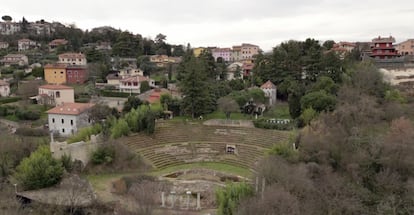

He built a fake Roman theater among the hills of Vicenza province in Italy, using modern stone blocks artificially aged to look ancient. He presented it as an archaeological discovery containing remains from Ancient Greece, Ancient Rome and even the Neolithic; organized guided tours and historical reenactments, charged up to €40 per visitor, was included in an official tourist guide and has ended up in prison, sentenced to two years and four months in a final ruling. This is the incredible story of Franco Malosso, a 69-year-old Italian who called himself Franz Von Rosenfranz in artistic circles and who pulled off one of Italy’s most astonishing archaeological hoaxes.
After a 10-year legal process and the Supreme Court’s confirmation of the sentence, the author of this colossal fraud entered Ventimiglia prison a few months ago to serve the sentence for illegal construction and forgery of works of art.
The origins of the story are uncertain; it dates back to a few years before 2016, when Malosso began erecting the fake ancient theater on the hills of Arcugnano in the province of Vicenza. On a 5,000-square-meter site he installed a series of tiered stands built with stacked and worked stones made to look old. The columns are also fake — made of cement — as are the plaster statues and an artificial pool dug beneath the seating in the arena area. The structure known as the Anfiteatro Berico, which still stands despite its name, is actually a semicircular structure inspired by a Roman theater.
In 2016, after a complaint from the City of Arcugnano, an investigation began that concluded the entire complex was modern and had been built without the required urban planning and landscape permits. That marked the start of a complex judicial process filled with defense appeals.
A review of the news archives does not make it clear whether Malosso’s intention was to reconstruct an alleged ancient theater or simply to create a fake archaeological site and pass it off as genuine. His account changed over time. At first he presented the site as a real archaeological site with remains from different historical periods. Later, when investigations began, he claimed it was a reconstruction of a supposed ancient theater that, he said, had once existed beneath the hill. That theory, however, was dismissed by the Cultural Heritage Superintendency, which determined there were no archaeological remains on the site and that all the structures were of modern construction.
Over the years Malosso’s defense has consistently argued that the forgery had been made so “clumsily” that it would have been impossible for anyone to believe it was a genuine archaeological remain, and that the deception thesis could therefore be discarded.
The conviction covers urban planning offenses and crimes against cultural heritage. Judges found that the massive installation had been presented as genuine archaeological remains and that it had generated economic gain through visits and activities organized at the site. The case continues to provoke astonishment in Italy, where people wonder over how such an elaborate fiction could have been erected and maintained over time.
Experts consulted agree that a genuine archaeological site is easily recognizable to a specialist. Jacopo Bonetto, an archaeologist and full professor in the Department of Cultural Heritage at the University of Padua, explains that identification does not depend solely on the visual appearance of a structure but also on its architectural features, the materials used, construction techniques and state of preservation. “It is completely absurd to think that an ancient building can be confused with a modern one, even if built in the same way,” he tells this newspaper.
According to the archaeologist, Roman buildings are identified by all those elements, which are impossible to reproduce faithfully in a recent construction. Added to that is the cost of a work of this nature: “Reconstructing an amphitheater [faithfully] today would entail enormous expense, hardly affordable for a private citizen,” the expert says.
Bonetto also stresses that the very location of the alleged theater should have raised suspicions. “Context is fundamental, because ancient buildings were only erected in certain places. Ancient amphitheaters were built, in 99% of cases, on the outskirts of Roman towns. An amphitheater out in the countryside, far from an ancient urban center, is naturally false,” he says. The expert highlights that episodes like this are, fortunately, extraordinarily rare.
Beyond the anecdote, Bonetto believes the case underscores the importance of scientific rigor in managing historic heritage. “Competences must be respected and that does not always happen. Too often cultural heritage is left in the hands of people without specific training. European heritage is an enormous asset that must be preserved and requires qualified specialists,” he argues. In Vicenza’s case, he adds, “one inspection by competent archaeologists was enough to understand it was a fake.”
The court ruling also orders Malosso to compensate the city for the damage caused, to demolish the theater and the other illegally built structures and to restore the hill to its original condition, though that order has not yet been carried out.
Sign up for our weekly newsletter to get more English-language news coverage from EL PAÍS USA Edition









































