
Trump’s Iran nuclear deal echoes abandoned 2018 pact with Tehran in a stronger negotiating position
The previous pact contained guarantees similar to those believed to be under discussion now, but in a political context far less conducive to agreement
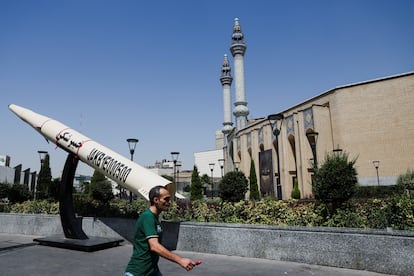

When Donald Trump unilaterally withdrew the United States from the previous Iran nuclear agreement with world powers — the Joint Comprehensive Plan of Action (JCPOA) — in 2018, he justified it with a string of epithets: “horrible,” “disastrous,” “weak” and “the worst deal ever.” Among the arguments he cited at the time was that the 150-page pact, which took two years to negotiate, allowed Tehran to keep enriching uranium and did not eliminate its missile program or its support for allied militia networks in the region. He also said it gave “billions of dollars” to a “regime of great terror” by easing international sanctions.
Eight years later, after a three-and-a-half-month war, around 7,000 people dead, the Strait of Hormuz closed and hundreds of billions of dollars in losses, the United States is preparing to sign a preliminary agreement with Iran under which, it has emerged, a new nuclear commitment — not very different from the one Trump broke — will be discussed in the coming weeks. It could even be more fragile.
The reason is a marked difference. The Islamic Republic has emerged from the war with a more radical leadership and in a stronger position, after having withstood the military onslaught by Israel and the United States and, above all, having shaken the global economy by closing maritime traffic through the Strait of Hormuz. Tehran may now be less willing to make major concessions because it knows how to strike back at Washington.
The 2015 deal
The JCPOA, signed by Iran in 2015 with the United States, France, the United Kingdom, Russia, China, Germany, and the EU, obliged Tehran not to enrich uranium above 3.67% purity — enough to generate electricity but not to make nuclear weapons. Iran agreed to dispose of 97% of its stockpiled enriched uranium and to hold no more than 200 kilograms of the material. It also accepted a stringent inspection regime by the International Atomic Energy Agency (IAEA) in exchange for the gradual lifting of international sanctions.
What is known about what will be discussed during the 60-day negotiation period between Iran and the United States that will begin on Friday, after the signing of the preliminary pact in Geneva, Switzerland, appears similar to provisions in the JCPOA. Washington wants Tehran not to enrich uranium for a 20-year period, while Iran reduces that span to five years. The Islamic Republic has not enriched the material since the 12 days of bombing by Israel and the United States against its nuclear facilities in June 2025.
Washington also seeks the handover of 440 kilograms of highly enriched uranium (at 60%, close to the roughly 90% needed for atomic weapons) that the country holds, but Tehran agrees only to dilute it to reduce its purity. The return of international inspectors to Iran is also expected.
In return, both sides will discuss sanction relief and the delivery to the Islamic Republic of an as-yet-unspecified sum — believed to include a first tranche of about $12 billion — of Iranian funds frozen abroad. That money and the lifting of some punitive measures could be a lifeline for a regime that, before the war, was in deep trouble. Not only because of the thousands killed in the repression of the January protests, but also because of the dire economic situation that initially sparked the demonstrations. Those funds would give it room to slightly improve the national economy and ease discontent, especially if they are accompanied by the multi-billion-dollar reconstruction plan Iran wants to secure.
To place its signature on the preliminary text, Tehran has also refused to accept what had been one of Trump’s main complaints about the previous pact. Iran has not even agreed to discuss renouncing its missiles or ceasing support for its non-state allies (Hezbollah, Hamas, the Shia militias in Iraq and the Houthis) in the region.
A fragile agreement
On the one hand, the supposed guarantees that the Islamic Republic will not build nuclear weapons — which the final agreement to be negotiated in the coming weeks should include — do not appear any stronger than those in the 2015 deal. On the other, the political context has changed completely.
Tehran has always maintained that its nuclear program had peaceful purposes. In 2003 its then-supreme leader, Ali Khamenei, issued a fatwa (a religious edict) banning atomic weapons. Khamenei was regarded as a brake on the hardliners in the Islamic Republic who aspired to develop such armaments, but, even so, the United States and Israel killed him in an airstrike on February 28, the day the war began. That assassination precipitated the rise of his son, Mojtaba Khamenei, to the supreme leadership.
Mojtaba is seen as an exponent of a new generation of leaders, aligned with or drawn directly from the hardline ranks of the powerful parallel army, the Revolutionary Guard. The war and the destruction caused by more than 17,000 Israeli and U.S. strikes reinforce the rhetoric of those Iranian hardliners who believe the only way to defend their country and restore deterrence is with atomic weapons. The enormous distrust the Islamic Republic showed toward the West and, especially, the United States in 2015 is now abyssal — even more so toward Trump, whom they know can abandon any pact or attack Iran again, at the whim of his capricious character.
Sign up for our weekly newsletter to get more English-language news coverage from EL PAÍS USA Edition









































