
A whirlwind week: From the threat of escalation to the imminent signing of an agreement
On Monday, the downing of a U.S. Apache helicopter precipitated the biggest exchange of fire since the truce

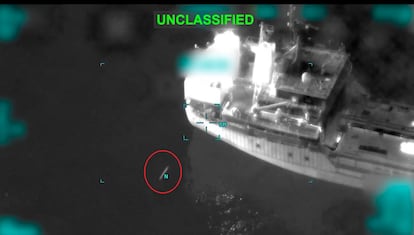
It was the downing of a U.S. helicopter by an Iranian drone over the waters of the Strait of Hormuz. It could have been any other skirmish: U.S. and Iranian forces had spent days engaged in increasingly serious encounters in the area while talks for a peace agreement dragged on. But that clash last Monday particularly upset President Donald Trump, who had just agreed a ceasefire in Lebanon. The Republican announced on Tuesday that the United States had to return the blow. A sequence of events began that seemed to push the two countries to the brink of resuming large-scale hostilities.
The helicopter incident itself was the kind of episode Trump likes: spectacular, with a happy ending, material for a Hollywood movie. “If you ever get a clip, you won’t believe the rescue, how cool it was,” the Republican told reporters on Wednesday in the Oval Office.
The Apache was patrolling the strait where Iran and the U.S. have been enforcing their own blockades and which has become the conflict’s most sensitive flashpoint, looking for possible threats to U.S. forces or to merchant ships the United States wanted to allow through. An Iranian drone intercepted it and exploded. A munition it was carrying penetrated the helicopter’s cockpit.
“That bomb was lodged in the helicopter, it didn’t explode, it was on fire, but it didn’t explode. It’s just those two guys, they knew how to fly, but they got very lucky,” Trump said. Both crew members were able to get out of the aircraft before it sank. They were eventually rescued by a maritime drone, an unmanned Corsair vessel that can reach speeds of up to 40 miles per hour and that the U.S. Fifth Fleet, based in Bahrain, began using in the Persian Gulf area in March, the Pentagon has said. The drone transported them to a prearranged point, where another helicopter picked them up and carried them to safety.
Neither adversary intended for the incident to get out of hand. Since the ceasefire took effect on April 8, pausing open hostilities, both had been careful that their skirmishes — drone launches, interceptors, attacks on drone launch sites, ship interceptions — did not cross the line. A return to active combat would have been unacceptable to many U.S. voters and would have had grave consequences for the world economy; the Iranian regime also did not want a renewal of bombing over its territory.
But Trump, who had been conciliatory in less serious incidents, ordered an escalation in the response. He himself resumed wartime rhetoric, threatening to strike bridges and Iran’s power infrastructure. Tehran in turn replied with attacks on U.S. bases in Kuwait and Bahrain. The fiercest exchange of fire during the truce occurred over two nights, last Tuesday and Wednesday. It was to continue for a third on Thursday, the U.S. president declared.
Meanwhile, negotiations mediated by Pakistan, Qatar, Egypt, and Turkey continued. Trump himself insisted last Wednesday that a document had already been agreed and only the signing remained, but the Iranians were putting up obstacles, he said: “They keep playing us for suckers.” The aim was to try to reach an agreement on the content of the memorandum of understanding that the United States had effectively announced as agreed, pending only presidential approval.
The key moment came on Wednesday. A Qatari delegation had traveled to Tehran and, although it ended its visit without apparent breakthroughs, it proposed new wording for parts of the memorandum, which was well received. Fearful of an escalation with unpredictable consequences, the mediators — and allies from other Arab countries — began calling the White House to request military restraint and to assure that this time there had been clear progress and an agreement could be reached within a very short time. According to Alex Plitsas of the Atlantic Council think tank, the big question is whether “military pressure pushed Iran to accept terms it had previously rejected.”
Turnabout
Early last Thursday, Trump announced in a post on his social network platform Truth that new strikes against Iran would take place that night. But just a few hours later he made a 180-degree turn. At the mediators’ request, he said, and facing the real possibility of finally being able to sign an agreement, he canceled the bombing order.
That same afternoon he declared not only that an agreement was close but that it was essentially done. So much so that he even envisaged a signing ceremony, probably in Europe — the location would have been Geneva — and that the United States would be represented by its vice president, J.D. Vance.
“It is obvious that Trump does not want to return to full-scale war. And he has only bad options: either a bad deal with the regime he wanted to bring down,” or “to leave things as they are, but with an opponent that feels emboldened.” “Or return to war, with dramatic economic implications,” Danny Citrinowicz, the former head for Iran at Israel’s military intelligence services, said this week in a talk organized by the Carnegie Endowment.
Iran initially played hardball. It denied that a preliminary agreement was imminent before its foreign minister, Abbas Araghchi, admitted that “an agreement is closer than ever.”
Since then the two countries have disagreed in their accounts of the agreement’s content. As a senior U.S. government official who spoke on condition of anonymity recalled, Iran (and the United States) needs to sell the agreement to its public in the most favorable way possible.
Because of these differences, the two governments also showed disagreement until the last moment about when the signing ceremony would occur. A trip to Geneva was dismissed almost immediately: Vance would not have been able to return to Washington before Trump’s departure to attend the G-7 summit in Évian, France, where he will hold a summit with Arab countries. The memorandum’s signing would take place remotely. On Saturday, Trump said it would happen on Sunday. Iran denied that, while admitting it could happen in the coming days: apparently, it did not want to give the leader of its enemy that birthday present. Finally, on Sunday, it was announced it would take place on Friday in Switzerland.
The suspense peaked at the last moment. Israel struck again in Lebanon on Sunday and Iran warned the deal could fall apart. A furious — and worried — Trump, afraid the pact might slip from his hands on the day of his 80th birthday, lashed out at Israeli Prime Minister Benjamin Netanyahu, the leader who convinced him to go to war and who has done more than anyone to obstruct the memorandum. Hours ticked by. Trump insisted it was all water under the bridge, that the agreement was going ahead. Hours later, Pakistan announced the pact. The United States confirmed it afterwards and, this time, Iran did too.
Sign up for our weekly newsletter to get more English-language news coverage from EL PAÍS USA Edition









































