
Iran denies Trump’s claims of a peace agreement to the end the war
The US president says he has called off attacks and that the final details of negotiations ‘have been brought to the highest level of Iranian leadership and approved’
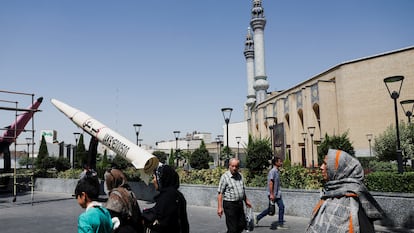

Is the war in Iran over? On Thursday, U.S. President Donald Trump made yet another of his sudden about-faces — and one of the most dramatic — regarding the war in Iran. Hours after announcing that his forces would launch a new round of attacks — the third in three consecutive nights — he proclaimed on social media that he had canceled that decision because the two adversaries had already approved a memorandum of understanding that only needed a few final touches. He later noted that the pact could be signed as early as this weekend, perhaps in Europe, with the United States represented by Vice President J.D. Vance. But Iran insists that, although most of the document is already finalized, the United States “continues to change its positions.”
This is not the first time Trump has triumphantly proclaimed that an agreement has already been reached and that only minor details remain. But what the U.S. president considers minor details have ended up being the most serious stumbling blocks in the negotiations, ranging from specifics regarding Iran’s nuclear program to the lifting of sanctions or the unfreezing of Iranian funds. State-run and semi-official media in Tehran deny that everything is as settled as the U.S. claims.
The state-run IRNA news agency quotes a Foreign Ministry spokesperson as saying that “nothing has been finalized” and that claims of an agreement are pure speculation. Despite the Iranian denial, the markets reacted with euphoria to Trump’s announcement.
According to the U.S. president, “discussions with the Islamic Republic of Iran have been brought to the highest level of Iranian leadership and approved.” As a result, “I have, as President of the United States of America, cancelled the scheduled strikes and bombings against Iran this evening,” he wrote on his social media platform, Truth. Later, at an event in the Oval Office, he indicated that Iran’s Supreme Leader Mojtaba Khamenei himself had given the green light to the memorandum of understanding: “I understand that the answer is yes,” he commented.
Trump asserts — as he has done on several occasions since the current ceasefire took effect on April 8, though his predictions have yet to materialize — that while both sides were exchanging fire, significant progress has been made behind the scenes. “Discussions and final points have been, in both concept and great detail, approved by all parties involved, including the United States, Israel, Saudi Arabia, UAE, Qatar, Turkey, Pakistan, Bahrain, Kuwait, Jordan, Egypt, and others,” he wrote.
In the Oval Office, he attributed this sudden progress to the pressure exerted by two consecutive days of airstrikes by his forces against targets in Iran. The Republican has made no secret of his desire to turn the page on a conflict that has claimed thousands of lives and has proven far more complicated than he had anticipated. His announcement came a day after official figures revealed that inflation in the United States had reached 4.2%, the highest level in three years, driven by sharp increases in energy prices.
Following his statement, the price of a barrel of oil fell below $90, the lowest level since the start of the war. Wall Street surged on Thursday, with the Nasdaq tech index rising by just over 2%.
Trump’s statement came after he had stepped up his threats against Iran, which he was trying to pressure into accepting his terms for a ceasefire. After two consecutive days of attacks in the south and west of the country — to which Tehran responded by firing missiles at military bases in Kuwait and Bahrain — he had warned on Thursday that the bombings would continue overnight. He had also stated that he was considering seizing the island of Kharg, about 18 miles off the Iranian coast and home to a major oil hub in the northern part of the Persian Gulf, and taking control of Iran’s energy sector, “as we have done in Venezuela.” When asked if he was maintaining that threat, Trump replied that it would depend on what happens with the memorandum of understanding.
Behind that aggressive rhetoric lay a shift in the Trump administration’s strategy, which maintained that the intention is not to resume the open warfare of the first two months of the conflict, but to ramp up pressure on Iran to accept U.S. conditions, sign a peace agreement, and allow the U.S. president to finally — as he ardently desires — draw a line under a conflict that has become far more complicated than he imagined. The World Bank has already lowered its global growth forecast for this year to the lowest rate since the pandemic, at 2.5%.
But what Trump wants is one thing, and reality is another. The president claims that Tehran has lost its offensive capabilities and that the latest U.S. strikes have completely destroyed its defenses. But Iranian forces continue to fire, and Monday’s downing of an Apache military helicopter in the Strait of Hormuz — which triggered the new wave of clashes — made it clear that Tehran still retains the ability to strike. The theocratic regime considers itself strengthened by the mere fact of having survived the phase of open hostilities and the assassinations of many of its leaders, and has shown no signs of wanting to back down.
Added to the deep mistrust between the two sides are vast differences in their positions. Iran demands sanctions relief and the unfreezing of funds, which Trump maintains he is unwilling to grant. And Tehran does not want to give up key aspects of its nuclear program, a condition the U.S. insists is indispensable.

Capturing the island of Kharg
Trump’s threats are also hampered by the difficulty of carrying them out. In the early months of the war, the U.S. president toyed with the idea of taking the island of Kharg. U.S. forces even attacked targets there, though they avoided destroying the oil infrastructure. But the White House ultimately ruled out the possibility of occupying it due to the complexity of the operation, as well as the risk of backlash from the American public.
Invading Kharg would be relatively straightforward, but maintaining a U.S. military presence there would be another matter entirely. Any troops deployed there would be exposed to enemy fire from the mainland and as Trump acknowledges, voters are completely opposed to a military deployment on the ground that could cost American lives.
Sign up for our weekly newsletter to get more English-language news coverage from EL PAÍS USA Edition









































