
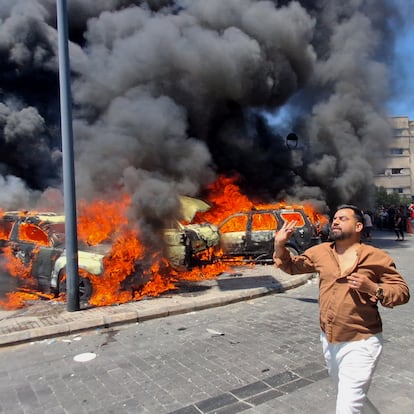
Exchange of fire between US and Iran marks beginning of a dangerous new phase in the war
Trump threatens a new round of attacks on Thursday if Tehran does not accept his terms for peace

With the latest exchanges of fire between the United States and Iran, the war in the Persian Gulf and its fragile ceasefire — marked by increasingly serious skirmishes — has entered a new phase, the most dangerous yet, raising the prospect of a return to hostilities. While the United States attacked Iranian targets for the second consecutive night, the Iranian General Staff has once again announced the complete closure of the Strait of Hormuz, and the Revolutionary Guard Corps has warned that Iranian troops will respond “decisively” to any attack by the adversary. President Donald Trump has threatened attacks may continue on Thursday if Tehran does not accept his conditions for peace.
The exchange of fire was as intense as, or more so, than the previous night, and far more serious than the clashes that have been occurring over the past couple of weeks. The Revolutionary Guard claims to have attacked 18 “important” sites linked to U.S. forces at the Ali Al Salem and Ahmed Al Jaber military bases in Kuwait, and the U.S. Fifth Fleet base in Bahrain.
Meanwhile, following an initial wave of airstrikes in southern Iran, the United States launched a second round against western Tehran. In both attacks — which took place about four hours apart — U.S. forces targeted air defense systems, communication systems, and surveillance sites, according to U.S. Central Command, which oversees U.S. military operations in the Middle East.
“U.S. Marine Corps, Air Force, and Navy assets fired precision munitions on Iranian targets that posed a threat to U.S. forces and international commercial ships transiting regional waters,” Centcom stated in a release shared on social media, describing the attacks as “self-defense.” “The strikes are in response to Iran’s unwarranted and continued aggression. U.S. forces remain vigilant, lethal, and ready.”
For his part, the commander of the Iranian Revolutionary Guard’s aerospace forces, General Majid Mousavi, has threatened to turn the entire region into “hell.” In a statement carried by the state-run IRNA news agency, the high command declared: “Do they want to make the sacred Strait of Hormuz unsafe? We will turn the entire region into a living hell. This is the response to U.S. aggression in the region.” The Iranian Joint Chiefs of Staff have announced that the closure of the Strait of Hormuz, which they have kept blocked since the start of the war, will now be complete. The United States, meanwhile, insists that ships continue to pass through the strait.
Although talks are still on the table — at least in theory — both a U.S. administration weary of negotiations and an emboldened Iranian regime that considers itself the winner of the conflict seem ready to resort to force again to resolve their differences, with the risk that any miscalculation could send the situation spiraling out of control. Israel’s offensive in Lebanon is also adding fuel to the fire.
The Trump administration states that the intention is not to return to the phase of open hostilities seen in the first two months of the conflict, but rather to pressure Iran into accepting U.S. conditions. To sign that peace agreement which the U.S. president proclaims time and again is practically a done deal. But it never quite comes out of the oven: the enormous mistrust between the two sides is compounded by vast differences in their positions. Iran demands sanctions relief and the unfreezing of funds, which Trump maintains he is unwilling to grant.
Pressure on Iran
Bored, in his own words, with negotiations that are dragging on much longer than he expected — he insists time and again that Iran is on its knees and “eager” to sign an agreement — Trump has concluded that Tehran “is playing us for suckers,” referring to the Republican administration in the negotiations, as he stated this Wednesday during an event in the Oval Office.
Under pressure himself from inflation at its highest level in three years — at 4.2% — and widespread public discontent, the U.S. president has also decided that the way to exert pressure on the theocratic regime is to intensify attacks: at that same event, he announced that the United States would strike again for the second consecutive night. He confirmed that over the past few weeks, U.S. forces have been helping merchant ships carrying 100 million barrels of oil pass through the Strait of Hormuz.
In a brief telephone interview with a Fox News correspondent in Tel Aviv, Trump assured, according to the reporter, that the United States would bomb Iran again on Thursday if it does not capitulate in the negotiations. During a visit to Central Command headquarters in Florida, Defense Secretary Pete Hegseth echoed his boss’s statements. “President Trump said we will be hitting Iran hard, and we will be,” he said. “If we need to negotiate with bombs, we’ll negotiate with bombs.”
But it is highly doubtful that new rounds of strikes will force the Islamic Republic to back down. “Attacks alone can’t coerce concessions. Trump must also convince Iran it can ‘avoid’ attack by meeting US demands. It’s called the assurance problem — and it’s been a major obstacle to any deal since Trump left the JCPOA,” — the agreement negotiated by the Obama administration in 2018 — wrote Rosemary Kelanic, director of the think tank Defense Priorities, on social media platform X on Wednesday night.
Meanwhile, efforts to make progress in the peace talks continue, though without success. A delegation from Qatar, one of the mediating countries, left Tehran on Wednesday without having made any headway.
Sign up for our weekly newsletter to get more English-language news coverage from EL PAÍS USA Edition









































