
US and Iran announce an agreement to open the Strait of Hormuz and end the war
After nearly four months of conflict, the two countries have agreed to extend the ceasefire, which they will sign on Friday in Switzerland. Pakistan says the parties have committed to an immediate cessation of hostilities on all fronts, including Lebanon

The United States and Iran reached a preliminary peace agreement on Sunday to end three and a half months of war in the Middle East, according to an announcement by Pakistan, whose prime minister said the agreement will be signed next Friday in Switzerland. Both Iran and U.S. President Donald Trump have confirmed the deal. The Republican has also announced the reopening of the Strait of Hormuz following the signing of the agreement.
If the agreement is finalized, the war between the two adversaries will be over, at least in its current form, settling a conflict that the United States and Israel began on February 28 and that has left a trail of more than 7,000 dead, shaken alliances in the region, dealt a severe blow to the global economy, and threatens the prospects of Trump and his Republican Party in the November midterm elections. All to achieve — after a long roller-coaster ride of lurches and shifts in the U.S. president’s stance — what already existed on the eve of the war: an open Strait of Hormuz and Iran’s promise that it is not seeking to develop nuclear weapons.
The markets reacted immediately and favorably. The price of Brent crude fell more than 3% to around $84 a barrel, after closing last week at its lowest level since the start of the war. The dollar also weakened against other international currencies.
The announcement came from Pakistan, the mediating country. Its prime minister, Shehbaz Sharif, stated shortly after 5:00 p.m. EDT on his X account that, “following intense talks,” “a peace agreement has been reached between the United States of America and the Islamic Republic of Iran.” “Both parties have declared an immediate and permanent cessation of military operations on all fronts, including Lebanon. The official signing ceremony will take place on Friday, June 19, in Switzerland,” Sharif wrote.
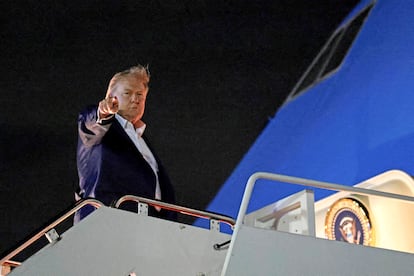
Then it was Trump’s turn. “The Deal with the Islamic Republic of Iran is now complete,” said the president, who turned 80 on Sunday, on Truth. “Congratulations to all! I hereby fully authorize the toll free opening of the Strait of Hormuz, and, simultaneously herewith, authorize the immediate removal of the United States Naval blockade. Ships of the World, start your engines. Let the oil flow!” added the Republican, who later, in another message, clarified that the reopening of the strait would take place after the agreement is signed, allowing time to clear it of mines first.
“The text of the memorandum of understanding has already been finalized,” Iran’s Deputy Foreign Minister Kazem Gharibabadi later confirmed, according to the Tasnim news agency. The official signing, the senior official also indicated, will take place on Friday in Switzerland. U.S. Vice President J.D. Vance has already expressed his intention to travel to Geneva to attend the ceremony.
Iran played hardball all day Sunday, following Israel’s attack in Lebanon. Faced with the desperation and fury of a Trump who saw the opportunity to announce a deal on his birthday slipping away, he first suggested that the incident could derail the entire process. Then he fell silent. And when it finally confirmed the deal, Tehran’s state media presented it as a major victory; they claimed they had managed to secure new last-minute concessions regarding peace in Lebanon, “guarantees on that country’s territorial integrity, and the immediate lifting of the U.S. blockade” on Iranian ports, according to the Fars news agency, which is linked to the Iranian Revolutionary Guard.
Deputy Minister Gharibabadi, for his part, assured upon confirming the agreement that the signing of the memorandum of understanding does not mean that Tehran trusts “the enemy,” and warned that if the Islamic Republic considers that the United States has violated the terms, “we will take our own measures.”
The crucial part will come during the 60-day negotiations to reach a final agreement, Gharibabadi added. According to him, those negotiations will address the lifting of sanctions on Tehran, as well as its nuclear program, mechanisms for monitoring compliance with commitments, and a reconstruction plan for Iran. These talks, in which the mediators who facilitated the preliminary agreement — primarily Pakistan, but also Qatar, Turkey, and Egypt — will also participate, will begin once the new ceasefire has taken effect, the Strait of Hormuz has been reopened, and Iranian funds abroad have been unfrozen.
The senior Iranian official also stated that starting Sunday night, the United States will begin lifting the blockade it had imposed on Iranian ports. Washington agreed: in a series of tweets, Trump announced that he is authorizing the “immediate lifting” of the U.S. naval blockade, although the Strait of Hormuz, according to him, will remain permanently open on Friday after the signing ceremony, “due to the removal of the mines” that Iran had laid to close the strategic sea passage since the start of the war.
The announcement of the agreement brings to a close a whirlwind week that began with a serious escalation of fighting between the two sides, with two consecutive days of shelling that threatened to undermine the truce — which had been in effect, in theory, since April 8, though it had been marred by repeated violations. For weeks, Trump had promised that peace was within reach, but the agreement had yet to materialize.
Both sides have argued and disagreed until the very last moment over the content of the memorandum of understanding — the provisional agreement whose text will be released on Friday — which establishes a 60-day ceasefire to negotiate the final pact during that time.
The accounts of what was negotiated that have been circulating in recent days differ depending on which of the two sides is explaining it to its audience. Iranian Foreign Minister Abbas Araghchi, quoted by his country’s state television, stated last Friday — as his deputy has now confirmed — that the provisional agreement will include reopening the Strait of Hormuz and ending conflicts on multiple fronts, including the Israeli invasion of Lebanon, something Israel has so far refused to do. The core issue — the future of Iran’s nuclear program — will not be resolved now but only at the end of another several-week negotiation period.
For now, the key is to see what both sides agree on regarding the Strait of Hormuz, the maritime corridor that is vital for the international transport of oil, gas, and fertilizers. Iran has maintained until now that its sovereignty — and that of neighboring Oman — over the strait must be recognized.
Another point of contention
Another point of contention are the Iranian funds held abroad that Tehran is claiming. The Islamic Republic expects to receive $24 billion in frozen assets, half of it before new negotiations on its nuclear program begin, and that during those talks Washington will offer a reconstruction plan worth at least $300 billion. It also maintains that the sanctions weighing on its economy will be lifted.
Washington’s version differs. According to a senior official who spoke last week on condition of anonymity in a telephone conversation with journalists, the agreement provides for the terms to be implemented gradually: Iran would receive funds currently frozen abroad but only in installments, as it fulfills its part of the pact, especially regarding its nuclear program. “They will be rewarded financially for fulfilling their obligations under the agreement. If they hand over their nuclear material, as they have promised, they will receive something. If they dismantle their nuclear facilities, they will receive something more. If they do not comply, they will receive no economic benefits,” he insisted.
Now that the deal has been sealed, it’s time to put it into practice — which may prove to be the most difficult part. Both sides harbor deep mutual distrust and do not want to give the other any opportunity to claim victory.
The Iranian regime will have to convince the Revolutionary Guard, which has been significantly strengthened as a result of this war, that the outcome is worth it. Trump does not want, under any circumstances, to be criticized for the result being similar — or worse — than the JCPOA nuclear deal negotiated by the Barack Obama administration and signed in 2015 by Iran and the Western powers, under which Tehran limited its nuclear activities in exchange for the lifting of sanctions.
The Republican withdrew the United States from the agreement in 2018, claiming that the terms were terrible, even though the International Atomic Energy Agency had certified that Tehran was fulfilling its commitments. Washington’s withdrawal undid that agreement. As a result, Iran accelerated its nuclear program.
The memorandum of understanding, and the agreement that may emerge from future negotiations “will likely allow Iran to have achieved a new normal, in which the United States no longer automatically considers that directly attacking its neighbors and effectively controlling the Strait of Hormuz constitutes a casus belli,” opined William Weschler, former Deputy Assistant Secretary of Defense for Counterterrorism and current analyst at the Atlantic Council think tank, prior to the agreement’s confirmation.
Sign up for our weekly newsletter to get more English-language news coverage from EL PAÍS USA Edition









































