
The story behind ‘Dancing on My Own’ and the irresistible power of songs that make you cry while you dance
Robyn’s song, released back in 2010, keeps appearing in movies and television shows. The epitome of catharsis, the Swedish artist’s tune is what music experts call a ‘sad banger’
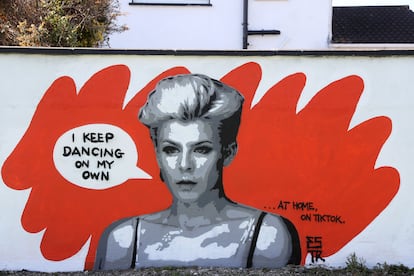
The last production that the song appeared in was the Netflix film Voicemails for Isabelle (2026). This romantic dramedy stars Jill, an aspiring chef who sends voice messages recounting her life to her sister, who passed away after a life confined to her home due to cystic fibrosis. They shared a favorite song that moves Jill every time it plays: Dancing on My Own (2010), by Robyn, the Swedish singer. But well before the film was released, over the past decade-and-a-half, the song had already appeared on the soundtracks of many movies and television shows, playing during some of the most memorable scenes in these productions.
One of the clearest examples is the series Girls (2012-2017), which features many iconic sequences, such as when Hannah (Lena Dunham) dances in her room (who hasn’t been swept away by music in the privacy of their bedroom?) to the rhythm of this song. At that moment, her roommate, Marnie (Allison Williams), appears… and the amateur dancer tells her that her ex-boyfriend is gay (in an admission that comes off as both funny and a little unhinged). Her friend then dances with her and the episode – titled All Adventurous Women Do, now a television classic – comes to a close.
This song has a connection to Dunham’s series in the same way that The Cranberries’ 1992 song Dreams serves as the anthem for Derry Girls (2018-2022). But in the case of Dancing on My Own, many viewers will easily associate it with other shows.
Robyn’s hit song appears in key episodes of Orange Is the New Black, Gossip Girl (the original) and Never Have I Ever. A symphonic version is used during a ballroom dance in Bridgerton. It also features in pivotal moments of films such as Babygirl (2024), The People We Hate at the Wedding (2022) and Teen Spirit (2018), where actress Elle Fanning performs it with great emotion. And, of course, there’s the aforementioned Voicemails for Isabelle, whose success has made the now-legendary song a trending topic on social media platforms like TikTok. In June, when the film was released, Google searches for it skyrocketed by 400% compared to the previous month.
“I don’t know what it is about that song, but it just drives me crazy. For me, it’s the feeling of being the girl [standing] in the corner, watching the guy you like with someone else. I think, when I first heard it, I [realized that I] felt like this way, way too often. It seems like a super universal feeling that not too many people can put into words,” Belén explains. She’s a Robyn fan who discovered the song thanks to Girls.
Her theory coincides with the explanation offered by cultural critic Hanif Abdurraqib in The New York Times, in a 2022 article titled The Delicious Misery of the ‘Sad Banger.’ This refers to sad songs that you can dance to and that, mysteriously, comfort your soul.
“[The sad banger] gets beyond binary emotions and unlocks a multilayered fullness that might, depending on the song, involve dancing, and crying, and longing, and stumbling out of some dive bar midtune to text or call the person you probably shouldn’t,” the critic wrote. “You can measure the success of a song by the limitlessness of emotions and impulses it can seduce out of a person. Robyn’s Dancing on My Own may be the ultimate sad banger, and it is undoubtedly a classic within the canon, taking its emotional and sonic cues from a long line of sad disco anthems and new-wave hits (Robyn herself has cited musicians like Donna Summer and Sylvester, and songs like Dancing With Tears in My Eyes, by Ultravox).”
“All these artists,” Abdirraqib added, “dabble in bright, electronic, up-tempo odes to the specifics of heartbreak, performed with a sort of suddenness – an urgency, as if a person has just walked from the ruins of emotional wreckage and needs to deliver a report on the damage while the memory of it is still fresh.”
This category of “sad bangers” would also include Gloria Gaynor’s I Will Survive and Donna Summer’s Last Dance – both released in 1978 – and Olivia Rodrigo’s Vampire (2023), to name just a few.
An ascending journey
Dancing on My Own was released in April of 2010 as the first single from Robyn’s mini-album, Body Talk Pt. 1. The song reached number one in Sweden, her home country, and number eight in the U.K., but failed to crack the U.S. Top 40. Its international popularity steadily grew, however, thanks to it being included in the television series Girls and Calum Scott’s cover version on Britain’s Got Talent in 2015. His acoustic performance (while not exactly “dancefloor-friendly”) was quite captivating for many audiences.
Currently, the track ranks number 20 on Rolling Stone magazine’s list of the 500 Greatest Songs of All Time, ahead of David Bowie’s Heroes, Bruce Springsteen’s Born to Run, The Ronettes’ Be My Baby and Otis Redding’s (Sittin’ On) The Dock of the Bay.
In 2015, singer-songwriter Lorde declared that Dancing on My Own was the perfect song. “The other day I was in the studio with some new friends and I asked them which one song they would send into space, to live on forever, if they had to,” the artist wrote on her Tumblr. “I thought about it for a while – thought about Talking Heads and Fleetwood Mac and Nina Simone – but the song that came out of my mouth was Dancing on My Own, by Robyn.” Later, she herself achieved international success and even made the same Rolling Stone list (although her song was a few spots lower than Robyn’s).
Various experts have tried to unravel the secret behind the song’s success. As The Guardian reported last year, on the 15th anniversary of the song’s release, American podcaster Sam Sanders noted that the simplicity of the lyrics plays a significant role: as soon as someone hears Dancing on My Own a couple of times, they’ve already got the chorus memorized and can belt it out anywhere.
Sanders spoke with a musicologist, who explained that the song’s 117 beats per minute (BPM) practically matches the average walking speed. “[Robyn] is doing this in a tempo that is pretty close to the human heartbeat,” Sanders explains. “It’s programmed to burrow into your bones, to get into your body and make you move. It’s inescapable.” Taylor Swift’s Wildest Dreams, The Velvet Underground’s Lady Godiva’s Operation and Massive Attack’s Teardrop also share that rhythm.
This past February, Robyn stated in an interview with The Cut that the lyrics are based on her breakup with an ex-boyfriend she had been in love with for years, even though they were both in other relationships. But she made a clarification: “Actually, there were many men who inspired that song on different occasions during a crazy period of my life.” She also acknowledged that it’s her favorite song to perform live, because it captivates both her and her audience: “I don’t really feel like it’s my song anymore. I feel like it’s my fans’ song.” A quick internet search will turn up videos demonstrating the fervor of her fans: for instance, at after-concert parties in the New York City Subway system, crowds of people have sung along to the song while standing on the platform.
In fact, one of the most memorable scenes from Voicemails for Isabelle shares that cathartic feeling of fans belting out Robyn’s lyrics. The protagonist is relaxing in a San Francisco park… but when the song starts playing, she begins to dance. And this gets everyone around her moving. Clearly, Dancing on My Own is already an undeniable classic.
Sign up for our weekly newsletter to get more English-language news coverage from EL PAÍS USA Edition









































