Gardiner Harris, investigative journalist: ‘No industry has been as criminal as the pharmaceutical industry’
In ‘No More Tears: The Dark Secrets of Johnson & Johnson,’ the former reporter for ‘The New York Times’ details the corruption, lies and impunity behind one of the most highly regarded companies in the United States
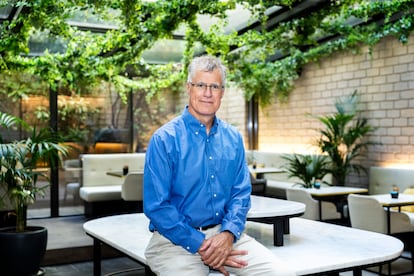

“This book was a suicide mission. I tried to walk away from the topic, but I was haunted by it.” Gardiner Harris, who covered the pharmaceutical industry for The Wall Street Journal and The New York Times, left the beat in 2012 to report on less frustrating topics, first as a correspondent in New Delhi and later at the White House. But he could not shake his anger at the impunity of an industry that, he says, “operates like a mafia in the United States.”
So in 2019 he left news journalism — where his reporting helped lead to fraud fines against the biopharmaceutical Bristol Myers Squibb and contributed to the passage of the Sunshine Act, the law requiring drug companies to disclose payments to doctors — to write a book about Johnson & Johnson.
“It’s a fascinating case study,” he says. “On one hand, it is the worst-behaved of all the pharmaceutical companies; and on the other, it has far the best reputation. That contradiction drove me mad, but it also made me curious.”
Harris is in Madrid to present No More Tears: The Dark Secrets of Johnson & Johnson, in which he dissects nine scandals involving the company, from the presence of asbestos in its iconic talcum powder to the withdrawal of its Covid-19 vaccine.
Taken together, the episodes paint a bleak picture of rapacious corporations, bought-off doctors, a regulator that functions “like a puppet of the industry,” pressure on the media, lies, revolving doors, powerful Washington lobbyists and lawsuits silenced with mountains of money…
Question. The talcum powder scandal, which linked the product to ovarian cancer, ended in July with Johnson & Johnson (J&J) agreeing to pay $5.5 billion to settle thousands of outstanding lawsuits. Was that a victory or a failure for the victims?
Answer. It’s a win for J&J. Each plaintiff — nearly 90,000 — will get just a few thousand dollars. Their lawyers also win, because they get 40% of the settlement. And the insurers that paid for their medical care…
Q. In your book you say the company continued selling the product until 2023 out of “stubbornness.”
A. In the 1960s, they discovered that their most iconic product was dangerous. It’s understandable that in the early years they dismissed those dangers — asbestos was everywhere. But as asbestos was eliminated from our lives, it remained in J&J’s Baby Powder because of that stubbornness, which twisted the company: once you can poison babies and mothers, you will do anything.
Q. You accuse the company of contributing to two million deaths. How do you arrive at that figure?
A. It includes 500,000 deaths from the opioid crisis, one million who died — mostly elderly people — from the misuse of antipsychotics used to keep them sedated [Risperdal was one of the five most prescribed drugs], and 500,000 oncology patients harmed by the abuse of EPO [erythropoietin, used to mitigate chemotherapy effects, which can stimulate tumor growth]. J&J was the coauthor of the three largest drug disasters in American history. Although the share caused by its specific drugs may be smaller, you can’t separate by brand, only by categories.
Q. How common are these practices across the industry?
A. They’re widespread. The U.S. health system is deeply corrupt. The pharmaceutical industry has pleaded guilty in hundreds of cases and paid tens of billions of dollars in fines. J&J has spent about $35 billion on litigation since 2013 alone. No industry in American history has ever gone through such an era of criminality as the pharmaceutical industry. It’s extraordinary that we have allowed the industry that should care for us to cause so much harm with impunity.
Q. Regulation in Europe is stricter, but multinationals’ strategies are global. Do they affect us in the same way?
A. The U.S. healthcare system makes everything worse. We allow drug makers to pay doctors directly to promote their products. They know that for every dollar they spend on a doctor, they get five back. Since the 1970s, there has been a law that made it illegal for American corporations to pay money to government servants around the world, and because in Europe most doctors work for the government, you were protected… However, in 2025 the Trump administration suspended that law.
Q. Does the situation get worse depending on who’s in power?
A. No. In 1992, the Clinton administration struck a deal that basically sold the FDA [the U.S. Food and Drug Administration] to the industry. It was the height of the AIDS crisis: the FDA was not approving drugs quickly enough and needed money. Instead of funding it, the government made it dependent on the industry.
Q. What do you make of Health Secretary Robert F. Kennedy and the Make America Healthy Again movement?
A. I think he has tried to take some measures to crack down on the sector. The MAHA movement is naturally skeptical of the pharmaceutical industry. There are reasons to be skeptical; but of course, part of the anti-vaccine movement, which I disagree with, stems from that disbelief.
Q. Are you concerned that exposing the sector’s bad practices fuels denialism?
A. Yes. It can add to the skepticism that, in some cases, leads people to disbelieve science generally.
Q. Without strong regulation, problems are resolved after the harm is done through litigation, a very American approach.
A. It’s absurd: like saying let’s do away with the police and if someone rapes or murders a family member, the victim or their family should take them to court. No one would think that is fair or appropriate. In aviation, the regulator approves the airplane, but if there’s a crash, an independent body investigates to avoid conflicts of interest. That’s the kind of system that should happen for drugs and devices. By the way, Europe doesn’t have that either.
Q. But the European Medicines Agency (EMA) has public funding as well as private funding.
A. For drugs, Europe has a better system than the U.S., but not for medical devices… Both the EMA and the FDA need to be empowered and to be more independent, most importantly to follow these drugs and devices much more closely once they’re approved.
Q. Regulatory agencies can also be captured through the revolving door between industry and government. How blatant are these conflicts of interest?
A. Every FDA commissioner in history, with the exception of the most recent, has gone to work for drug makers. And it happens elsewhere. Three of the four prosecutors in the Risperdal case, in which no J&J executive was prosecuted, ended up working for law firms that count the company among their biggest clients.
Q. In court, the company has generally prevailed.
A. For many reasons. They destroy records, hide studies, lie to judges. They have enormous amounts of money and use tactics such as creating subsidiaries and declaring them bankrupt. Even if it doesn’t always work, the trick drags out proceedings for years. And damages are higher when the victim is alive and suffering than when they have died.
Q. You attack scientific institutions that also rely on corporate funding. How can that source of revenue be cut off without harming scientific progress?
A. Some clinical trials are marketing disguised as research. We could enact laws that allow funding while reducing pharmaceutical influence, but we have chosen not to, because the industry is also funding politicians.
Q. Regarding perks for doctors, what was the most outrageous thing you found in your investigation?
A. There are many trips, conferences, meals… and cash payments. To promote metal hip implants, J&J paid a dozen top orthopedic surgeons $15 million to tour the country talking up the benefits of the device. Some knew so well how dangerous it was that they stopped using it on their own patients. In the case of EPO, oncologists promoting it could double their incomes. About 200 academics knew it made tumors grow but remained silent. I spoke to many of them. They told me: “Do you know what kind of lawyers these people have?” J&J is a law firm that sells drugs.
Q. What role do the media play in the “culture of impunity”?
A. Some journalists tried to tell the stories I recount, but J&J threatened to pull its ads. In the U.S., many outlets have not wanted to interview me even though the book is on The New York Times best-seller list, which would normally mean it would be published across Europe — but the book has not been published in Germany, France, or the U.K.… Publishers and media have become easier to intimidate. And there is an element of self-censorship. It’s hard to hold the powerful to account when you’re trying to survive.
Q. How long was the legal review of the manuscript?
A. Months, but it was important to have all the documentation tied down. The book [500 pages] was much longer. Taking on such an influential company is always crazy. I regret having written it, but I’m proud of the documents I ended up getting and of the writing, which is as good as I could make it. It is not an easy read, and it wasn’t easy to write. How do you build a compelling narrative about a faceless organization? The Empire of Pain [Patrick Radden Keefe’s bestseller about the Sackler dynasty, owners of Purdue Pharma, and their responsibility for the opioid crisis] reads like a novel, although it’s wrong to say the crisis was theirs alone. Purdue was an easy target, without the army of lobbyists or the advertising budget of J&J.
Q. What kept you writing for five years?
A. I was so mad that they had gotten away with it for so long.
Q. Did you talk to them to write the book?
A. I spoke with many employees, but the company never gave me on-the-record comments. That is a weakness of the book and they know it. They have limited themselves to issuing a statement after that does not deny anything specific.
[Contacted by EL PAÍS, the Spanish subsidiary referred to the statement: “At Johnson & Johnson we stand behind the safety of our products and remain focused on delivering medical innovation to patients worldwide.”]
Q. Since 2022, after the events you describe, the international CEO has been Valencian Joaquín Duato. Have things improved?
A. There’s no reason to think so. Duato is the successor and a close friend of Alex Gorsky, the executive who appears most in the book. There is something weird about J&J: its credo [a pioneering 1943 statement, etched in stone at its headquarters and repeated at important meetings, which places the user ahead of profit]. They gaslight their employees better than anyone, making them believe — even executives — that despite all the evidence to the contrary, J&J is, on balance, a uniquely beneficial force in the world
Q. Is it, in any way?
A. It was one of the first manufacturers of antiretrovirals for HIV/AIDS that saved millions of lives (although it was among the few that did not share its patent to allow generic manufacturing for Africa). Many of its drugs save lives, and if you have surgery, you are likely to be stitched up with J&J sutures. From its founding in the late 19th century through the mid-20th century, it was an ethical company.
Q. The book begins with a chance meeting in an airport bar with a J&J sales representative who told you about her moral conflict.
A. It’s surprising, over the course of my career, how wrong my first impressions have been. When I was a police reporter, I thought I knew who the good guys and bad guys were, but I ended up helping put a police chief I admired very much under suspicion for corruption. In the pharmaceutical sector, at first I thought researchers and doctors were admirable; then there were the executives, who sometimes did bad things. The worst, I thought, were the sales reps: they drank and even slept with doctors to get them to do the wrong thing. In the end, I completely reversed that moral hierarchy. Almost all industry whistleblowers were sales reps. They earn less and have the least education, but the greatest moral fibre.
Q. Given the landscape, who can a sick person trust in the U.S.?
A. Themselves. Read as much as you can. And don’t rush to take the newest drug. Wait and watch how it works in the market.
Q. Which is the best country to get sick in?
A. Because of the huge spending, the U.S. has leading laboratories and excellent hospitals; that’s why Saudi princes go to the Mayo Clinic… But for the average sick person, Denmark or Norway offer by far the best clinical care, better vaccination rates and an excellent system of peer auditing. Overall, Europe is better: you should be proud of a system that protects its citizens.
Sign up for our weekly newsletter to get more English-language news coverage from EL PAÍS USA Edition