
Robert F. Kennedy strengthens Trumpism with his ‘Make America Healthy Again’ movement
Trump’s health secretary confounds experts with his baseless claims about vaccines and diets, but his ideas are resonating with the Republican voter base
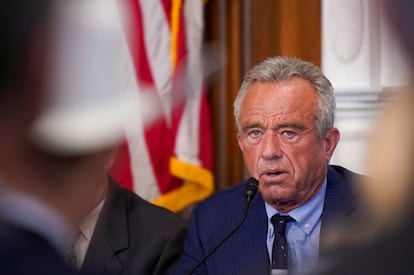

The U.S. Department of Health and Human Services is finalizing the departure of thousands of employees after a Supreme Court ruling last week cleared the way for the massive layoffs undertaken by the Donald Trump administration. That’s in terms of the department’s structure; when it comes to its substance—theoretically, the management of public health—its leader Robert F. Kennedy Jr. does not need any help to gut it. Purges in his management team, controversial claims that doctors are profiting from vaccines, and an apparent dereliction of responsibilities, including failing to take action against the largest measles epidemic in the country in 33 years—a disease declared eradicated in 2000—characterize Kennedy’s performance during the first six months of his term.
Medical associations representing thousands of physicians and scientists have sued Kennedy, as well as the heads of several agencies within his department, for limiting who has access to Covid-19 vaccines—they are no longer recommended for children and pregnant women—and for undermining the public’s general confidence in immunization, feeding on a suspicion that is in the DNA of many Republican voters. In his campaign against ultra-processed foods, one of the supposed goals of his platform, Kennedy has expressly recommended a company that creates meals for the sick and elderly with a high preservative content. When he took office following a controversial Senate confirmation due to his well-known vaccine skepticism, Kennedy proposed combating chronic diseases, which he linked to an unhealthy diet.
As far-fetched as they may seem, his theories and recommendations are fueling an increasingly identifiable movement, one that resonates with the grassroots of Trumpism—especially among middle- and lower-middle-class women in suburban areas—and takes its name from the president’s MAGA slogan. Under Kennedy, the MAHA (Make America Healthy Again) wave is surging despite criticism from experts and scientists. MAHA has become so autonomous that this past Monday it made its official presentation in Washington, at a roundtable discussion, the first convened by Kennedy himself. Quite an achievement for someone outside of Republicanism (he was a Democrat until he backed Trump).
His tenure as Health Secretary coincides with the massive cuts that Trump’s sweeping tax reform, known as the Big Beautiful Bill, entails for health programs aimed at the lowest earners. It is estimated that millions of Americans will lose the precarious coverage they once enjoyed, in a country where health is a commodity and healthcare is one of the most lucrative businesses around. And it is precisely the profit motive, according to Kennedy, that is behind doctors’ habit of prescribing vaccines, he explained in a recent interview with the ultra-conservative firebrand Tucker Carlson. For the Health Secretary, the benefits of vaccines create “perverse incentives” for pediatricians to overpromote immunizations.
In the interview, Kennedy claimed, without evidence, that “50 percent of revenues to most pediatricians come from vaccines,” a statement that has put these specialists on the warpath. “If we were motivated by profit, we’d make more money treating the complications of preventable diseases than by preventing them in the first place,” said David Higgins, a pediatrician at the University of Colorado Anschutz Medical Campus, in statements to The New York Times. “This idea that we vaccinate kids to make money honestly is misleading and dangerous,” due to the diminished public confidence it causes in immunizations.
Prominent Democrats have demanded that Kennedy declare the measles epidemic a public health crisis. It appears to be out of control, with nearly 1,300 cases so far this year, according to the Centers for Disease Control and Prevention (CDC), an agency that answers to him. The last time the country had recorded such an incidence was in 1992, eight years before the disease was declared officially eradicated.
The vast majority of those infected this year were unvaccinated. According to the CDC, a 95% immunization threshold prevents community transmission, in what is known as herd immunity. But in the U.S., the percentage is currently below 93%, due to rising vaccine hesitancy fueled by misinformation or conspiracy theories, which Kennedy embraces. In addition to recommending home remedies for infected individuals, such as cod liver oil and vitamin A, Kennedy dismissed the 17 members of the CDC’s vaccine policy board in June. Two days later, he appointed eight new members, several of whom—like himself—have questioned the safety of immunizations. Two of them have even testified in lawsuits against the pharmaceutical companies that manufacture them.
The agencies that comprise the Department of Health are constantly making waves. Last week, a meeting of the U.S. Preventive Services Task Force, established in 1984 and which recommends cancer screening, sexually transmitted disease screening, and other preventive care, was unexpectedly called off without explanation. This task force, which is supposed to be covered theoretically at no cost to insurance companies, was no longer expected to be convened. No one dares to imagine what the group’s future might hold, despite Kennedy’s earlier advocacy of prevention.
In his stated commitment to making America healthy again, he has reiterated that his goal is to convince Americans to follow a healthier diet. That’s why it’s particularly striking that he recommended the $7-a-plate meals from a company that produces them for low-income, sick, and elderly people on Medicaid or Medicare. According to a nutritional analysis commissioned by the Associated Press, the meals are high in salt, sugar, saturated fats and additives.
In a recent social media post criticizing the large amount of ultra-processed foods that make up the standard American diet, Kennedy urged the population to take their health seriously, starting with their plates: “This country has lost the most basic of all freedoms — the freedom that comes from being healthy,” he wrote.
His growing power within the MAGA nebula is also also confusing scientists studying human exposure to chemicals and environmental pollutants. The health official has drawn attention to the health effects of the plastics industry, fossil fuels, and chemicals. He did so in April at a conference where he denounced the presence of microplastics in 99% of the seafood analyzed by researchers in Oregon. An hour after the talk, the scientist leading the project received an email notifying her of the termination of a federal grant from the Environmental Protection Agency (EPA), the only source of research funding.
Sign up for our weekly newsletter to get more English-language news coverage from EL PAÍS USA Edition









































