Matt Barreto: ‘More than a reversal or a shift in voting trends, the Latino vote is a repudiation of Trump’
The campaign strategist and pollster is confident Democrats will win back the House of Representatives, but warns that Hispanic voters are not broadly or firmly aligned with either party


Matt Barreto has spent years studying the Latino vote and advising the Democratic Party on an electorate whose support, while often taken for granted, is far from guaranteed, as became clear in 2024 when Latino voters helped propel Donald Trump to victory. Barreto worked on Hillary Clinton’s 2016 presidential campaign, Joe Biden’s 2020 campaign, and Kamala Harris’s 2024 bid. He also led Latino outreach for the Senate campaigns of Catherine Cortez-Masto in Nevada and Michael Bennet in Colorado. Between 2021 and 2025, during the Democratic administration, he served as a White House adviser.
He is currently a professor of Political Science and Chicana/o and Central American Studies at UCLA and president of BSP Research, the polling and research firm he co-founded. His latest polling for the November 3 midterm elections points to a return to the Democratic Party among Latino voters who backed Trump two years ago, helping Democrats regain control of the House of Representatives. However, he warns that this does not reflect growing support for Democrats so much as a rejection of President Trump. He believes that while both parties have begun to rethink how they engage with Latino voters, this remains an electorate that, despite being the fastest-growing voting bloc in the country, still does not receive the attention it deserves.
Question. You have worked on several election campaigns. What are the differences between presidential elections and midterms in terms of voter turnout and motivation?
Answer. Presidential elections always have the highest motivation and the highest enthusiasm for all Americans, and this is especially true for racial and ethnic minorities. Some people just don’t feel as connected, especially if they’re in a state that maybe doesn’t have an exciting election contest. We know there will be a drop-off this year compared to 2024, but the question will be whether or not it is a large drop-off or a small drop-off. Some states like Texas are running very close to presidential-level turnout.
Q. Early voting has increased in these midterm elections, even setting records in some places compared with 2022. What do you think is driving that trend?
A. Latino voters are very frustrated about the lack of economic recovery. Trump came into office on a campaign promise of economic recovery. He talked about his business experience and said he would understand how to manage the economy. But the economy has gotten worse, especially for Latino and working-class voters. This is the single biggest factor that is holding him back, and the entire Republican Party: voters are frustrated with grocery prices, gas prices, and tariffs. What’s more, health care costs have gone up because they’ve canceled the Affordable Care Act subsidies, and they’ve canceled Medicaid expansion. Everything is expensive, and when you’re the incumbent, you have to answer to the voters. And so that’s what is motivating the election far and wide for Latino voters.
Q. Polls are showing now that the Democratic Party has an advantage over the Republican Party. How reliable are the surveys? Could there be any surprises?
A. I don’t think there’s going to be any major surprises this year. Almost every single survey is showing that Democrats are on pace to win back the House, with seven points on average; I think that is almost a certainty. The Republicans have a lot of negative ratings, by the fact that they haven’t differentiated themselves from Trump. The Senate is definitely much more up for grabs.
Q. Are we truly seeing a return of Latinos to the Democratic Party, or is it rather a move away from Trump?
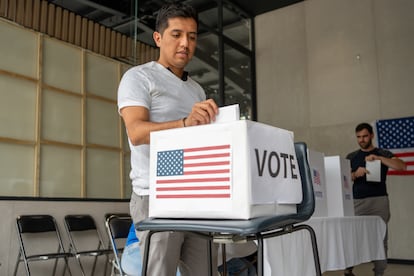
A. It is a sharp move away from Trump. And because we have a two-party system in the United States, Latino voters are going to the Democrats. I wouldn’t say it’s a reversal; I would say it’s a repudiation of Trump. It’s definitely not a trend. It’s one data point, and that’s what we said in 2024. What happened in 2024 wasn’t a trend — although a bunch of people thought it was — and now here we are looking at the opposite.
But the Democrats will need to have a message after this election about why Latinos should continue to support them, and they will need to have some deliverables. This is part of the reason that the Latino vote looks as though it swings back and forth: there’s no overarching partisan alignment among Latinos, so each party always needs to make their case every two years.
Q. Why is the Latino vote so relevant this year?
A. Because it has appeared to shift between Democrats and Trump for the last three or four elections. Democrats had a very good election in 2018, the first time Trump was president during that midterm. The Democrats took the House back, and Latinos voted pretty heavily Democratic. But then, in the next few elections, Republicans started to get more votes, especially in 2024. And now in 2026, it looks like the Latino vote is shifting back.
The other factor is that the Latino vote is growing faster than any other vote. Latinos are now an important voting bloc, not just in Texas, but in North Carolina, in Georgia, and in a number of states. The Senate race in Iowa might be decided by two or three percentage points and Latinos are up to about five or six percent in that state.
Q. Latino voter turnout has traditionally been lower than that of other voter groups. What accounts for this?
A. Historically, there has not been a lot of party outreach, and so if the candidates don’t come knock on your door or call you, then you’re less likely to vote. And the candidates focus on people who they think are likely voters, and so if they don’t think you’re a likely voter, they don’t call you.
There has been a long history of under-mobilization of the Latino community, and that’s the primary reason, not because Latinos don’t care about politics. That’s starting to change. We are seeing a big change in places like Texas. There’s lots of outreach and lots of ads in English and Spanish. There is a Latina running for governor. It’s a very exciting time to be seeing this dramatic increase in Latino voter outreach.
Q. Which groups of Latinos are more likely to abstain from voting?
A. Younger people. And part of the reason that Latinos appear to have lower voter turnout is that we’re the youngest group. So the same trend exists for young white voters, young Black voters, young Asian voters, especially in a midterm. And for Latinos, our largest demographic segment is voters under 40, while for white voters, their largest demographic segment is voters over 60. People who are over 60 — whether they are Latino, Black, or white — vote at super high rates because they’ve been around, they see the political system, and understand why their vote can influence things. Whereas younger people don’t have as much faith in the system.
Q. There are around four million Latinos who can vote for the first time because they turned 18 years old. Is there anything that defines them?
A. They are very concerned about getting a good-paying job and being able to afford a place to live. They want to make sure they have health care. They are just starting out in their careers, and typically the political parties and the established politicians don’t do a good job of talking to younger voters, especially younger Latino voters. So if they don’t hear from the political parties and the candidates, they’ll probably vote at low rates. And this is a very, very important group because it’s substantial in size.
Q. The first concern of the Latinos is the economy. That is also the main concern of all citizens. Is it right to keep speaking about them as a separate group?
A. All Americans have the same worries this election: the cost of living, affordability, gas prices, and the war in Iran, which has very low support. So there are a lot of similarities. There is also a sense of anti-establishment, anti-incumbent sentiment that we’re seeing across the board. At the same time, all voters want to feel like the politicians care about their community. Latinos might have the same concerns, but if the politicians never show up in the Latino part of town, or they never air any ads in Spanish, or they don’t have any Latinos on their staff, then it doesn’t matter if you have the same concerns because you feel left out.
Q. Latino organizations insist that Hispanics do not vote as a monolithic bloc. Does it still make sense, then, to study them as a single electoral group?
A. Most Latinos agree that they have a lot in common with other Latinos. However, you shouldn’t think of them as a cohesive unit. Do all 40 of them like the same food, music, and candidates? No. So the diversity doesn’t mean that Latinos aren’t a voting bloc; they are, but they still have diversity in the same way that all groups do. If you think about the groups that have gotten other attention — such as working-class white men — they don’t all vote the same, they don’t all vote 100% Republican, and they don’t all have the same issues. But they’re an interesting demographic group because they do have a lot in common, and that’s the same with Latinos.
Q. Beyond the economy, Latinos are the group most affected by this administration’s aggressive immigration policies. To what extent does this influence whether Latino voters change their vote?
A. Immigration is not the number one issue for Latinos, but it is the number one anger issue. And anger leads to mobilization. Many people are very upset; they didn’t think Trump would be as extreme. They thought he was only going to be finding these so-called criminals, but he’s not. So when you have an economy that’s not recovering, and you have your immigration police in the streets — literally shooting people —, it’s a terrible situation. That’s why you see people like María Elvira Salazar in Florida and others distancing themselves from Trump. It’s a double negative in the same cycle. If the economy was doing amazing and everyone was making $300,000, people would still be mad about immigration, but the economy always drives people’s vote.
Texas barometer
Q. The race for the Senate seat in Texas between Democrat James Talarico and Republican Ken Paxton has attracted enormous attention and campaign spending. Trump has been more involved there than in other contests. Will it serve as a barometer for the supposed shift in the Latino vote?
A. Texas is interesting, and we need to look at the results by region. We have the South Texas Rio Grande Valley region that has gotten a lot of attention because it has voted heavily Democratic and more 50-50 for Trump in recent years. That is a very interesting region because it is very working class, it’s lower income, less educated, and near the border. That’s the first region to pay attention to because it does send a signal, not just for Latinos, but for its large rural areas.

Given Trump has generally done very well with rural voters and Republicans, it tells us something not just about Latinos down there, but about rural Americans, working-class Americans in general, as well as Latinos in the rest of the country who might be in a similar situation. And then you have the cities, which tend to be much more democratic. In the past, they have not been a particularly strong electoral force, because they haven’t had high voter turnout. Houston, for example, has one of the lowest voter turnout rates of any big city in America. Definitely, there are a lot of clues in Texas that we’ll get as we get the data.
Q. Beyond Latino voters, is there another group that could drive a shift into Congress?
A. We’re seeing similar trends with Asian Americans, another group that is very immigrant-heavy and also shifted in 2024. We’re seeing similar shifts back: this group, which is also very economy-oriented, thought that Trump was going to recover the economy; however, they are very upset about the cost of living and the lack of progress on affordability.
Q. Republicans have made a major effort to redraw electoral districts in ways that reduce the influence of minority voters, a practice known as gerrymandering. What impact will this have on the election results?
A. They drew these districts based on the 2024 vote, where Trump did much better with Latinos, but now he’s doing much worse. In states such as Texas and Florida, the districts that got redrawn may not perform for Republicans. They made some wrong assumptions by only looking at the 2024 data.
Sign up for our weekly newsletter to get more English-language news coverage from EL PAÍS USA Edition