Feeling blamed and deceived: Latinos who voted for Trump rebel against the Republican Party
‘I think the devil got into him,’ says the hairdresser Celia Salmerón, one of the voters who will change her choice in the midterms
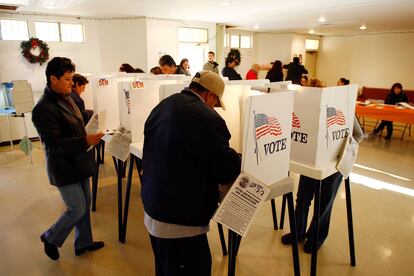

Celia Salmerón had never voted for a Republican candidate. Not until 2024. Then, in the presidential election, she became one of many Latino voters who believed Donald Trump when he promised at every rally that he would deport all criminals and improve the economy. Two years after giving him her support, Salmerón — like so many other Hispanic voters — regrets her decision and says she will vote for the Democratic Party in the midterm elections on November 3. “For everything he’s doing to poor people, for separating parents from their children,” she says as she inserts hair extensions.
There are no more customers in her small beauty salon in a Montgomery County, Maryland, shopping center because most of her clients had to leave or were deported. “Since he came in, my whole business collapsed because I work with people who are undocumented. Now people don’t go out, business has dropped, I don’t even have enough to pay my rent,” laments Salmerón, who was born in El Salvador but has spent 40 of her 56 years in the United States.

Her modest business is located in Hyattsville, one of the neighborhoods where a large share of the population is Latino. In the La Unión shopping center, Spanish language is prevalent and you can buy cosmetics, medicines, candies, clothing, accessories and other Latin American products not found in U.S. chains.
The area has been hard hit by the Trump administration’s immigration policy, and the hope that he injected a few years ago has turned to disappointment. “I think the devil got into Trump. Everything he’s doing is the work of the devil,” she insists.
“I feel guilty”
In the same mall, fellow Salvadoran José Flores runs a shop selling fresh juices, fruit spiced with hot sauce, esquites and other typical Latin American treats. Two years ago he was convinced that Trump was the best candidate because he was going to expel criminals and improve the economy. The Republican message was a huge hit in his community, which has since been confronted with a different reality. The economy has not improved, and most of those deported are not criminals.
Flores is one of those who regrets having believed him and having contributed to the persecution his community now faces. “I feel guilty, honestly,” he confesses.
Flores, who also owns an air-conditioning business, is among the few Latinos who say they have done well financially over the past two years. He is not sure it’s due to the administration’s actions, but he acknowledges he has had more work. Still, his business’s prosperity does not make up for the suffering he sees in his community, and this time he will vote for the Democrats.
“I agree with removing criminals, but not people who really dedicate themselves to work. And it makes me angry because I see that those who should be in prison are not,” he explains.
He estimates that at least 10 people close to him have been detained or deported. One of his employees is a Salvadoran beneficiary of Temporary Protected Status (TPS), a program that allowed workers to obtain work authorization and that the administration has ended for at least 13 countries. El Salvador’s TPS expired on September 9, but the administration has not spoken on the matter, leaving 170,000 Salvadorans in limbo. “He’s someone who has never gotten into trouble, who has always paid his taxes, who is very hardworking. People like him should have a residency permit,” he says.

Latino voters’ disillusionment with Trump is set to exact a toll on the Republican Party in the midterms. According to every poll, the support he received has evaporated. A UnidosUS survey in September found that 46% would not support him if they had to vote again, and that figure rises to 57% among those who crossed party lines to back him in 2024.
In the presidential election two years ago, Hispanics split almost evenly between Democratic candidate Kamala Harris and her Republican rival Trump. Some statistics show that male support for Trump surpassed that for a Democratic candidate for the first time. The Latino swing at the ballot box was largely credited with Trump’s victory.
“There really were more people who voted for Trump, but not in the way they say,” argues Ray Serrano, director of LULAC (League of United Latin American Citizens).
Serrano explains that the shift at the polls was due to the Republican’s economic promises and to fake news spread on social media like WhatsApp, YouTube and Facebook — channels Latinos favor for news. “They believed the messages that the Democrats are all socialists, that they were going to bring all Venezuela’s, Nicaragua’s and Cuba’s socialist policies to the United States,” he says, adding that they were frightened “by the big lie that millions of people were invading this country.”
That was compounded by disappointment with the Democrats, who also failed to solve their problems. “On economic and immigration issues they did not do enough and Trump was the businessman who was going to change that,” he explains. In fact, rejection of the Republican Party has not translated into immediate support for the Democrats. According to a September poll, 38% of Latino voters had not yet decided on a party.
It’s the economy
The economy is the main concern of Latino voters: higher grocery and fuel prices, loss of work permits, arrests of families’ main breadwinners… Forty percent of Hispanics say their finances are worse than a year ago.
According to the UnidosUS survey conducted with BSP Research, 83% of Latinos place the cost of living as their top concern and 61% say they are just managing or struggling to pay monthly expenses. Sixty percent of Hispanics fear they will not be able to pay their rent, and 78% have taken extra measures to stay afloat, such as buying cheaper food, using savings, getting a second job or adding overtime to their existing work.
Workers are not the only ones suffering. Business owners are complaining about the labor shortages that have forced closures and the inability to replace workers with U.S. employees. More than 200 Hispanic leaders — including elected officials and representatives from the business, religious, civil rights and community sectors — gathered in the Committee of 100 and sent a letter to the president and congressional leaders in late September urging them to grant work permits and legal protections to undocumented migrants who have long lived in the country.
Massey Villareal, owner of software company Precision Task Group, based in Houston, and co-chair of the Committee of 100, has denounced that since January of this year, 200,000 workers per month have been lost. Sectors such as construction, agriculture, caregiving and hospitality are suffering labor shortages.
Villareal also criticizes the administration’s trade protectionism and relations with neighboring countries. “The State of Texas has about $290 billion in trade with Mexico. And this president mocks that relationship,” he protests.
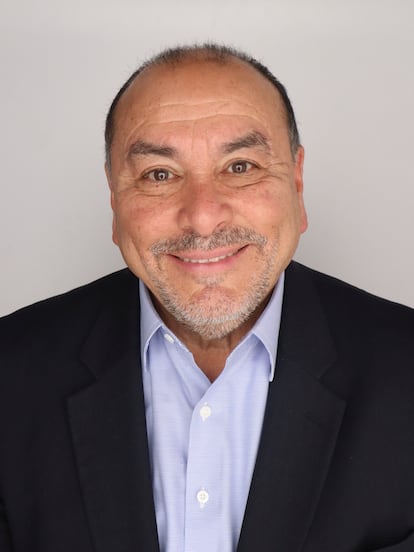
Villareal is one of the Republican Latinos who, because of Trump, is no longer one. He was part of the Republican committee during George W. Bush’s campaign, doing outreach among Hispanics. Today he no longer identifies as a Republican, only as a conservative. “I joined the Republican Party, not the party of MAGA,” he says.
“We already regret having voted for this president. What will happen on November 3 is a punishment vote; Latinos are going to punish the Republican Party,” he predicts.
Villareal feels betrayed by the harassment of his community. His father came from Tamaulipas, Mexico, at 17 to work. He voted for Trump because he supported the campaign promise to deport criminals. “But they came after us. Not because we were criminals, but because of the color of our skin. They didn’t go after the Chinese mob, the Russians, the terrorists… They went after the people who are working, who came to this country seeking the American dream,” he complains.
“Are they all idiots?”
Latinos’ disappointment with Trump has also reached states such as Florida, where the Cuban community has traditionally supported the Republican Party.
“The Hispanic voter in Miami-Dade County voted for order, discipline and for migration to be legalized. And suddenly this man shows up and targets the county where he received the most support and it’s where the most deportations are happening, badly affecting the economy. And I ask myself: are they all idiots?” says Liliam López, president of the South Florida Hispanic Chamber of Commerce.
López emigrated to the United States from Cuba with her family when she was three. She is part of ABIC (American Business Immigration Coalition), a group that brings together Republican and Democratic business leaders who have sent several alerts to Washington about labor shortages in the market caused by deportations and the elimination of work permits.

López, who voted for the Republican Party multiple times, says she will not do so again. “They are treating my people, Hispanics, like dogs,” she laments. “I can no longer vote for them,” she declares.
Sign up for our weekly newsletter to get more English-language news coverage from EL PAÍS USA Edition