
David Jolly, the former Republican seeking to flip Florida for the Democrats: ‘We are seeing overenforcement and cruelty’
In an interview with EL PAÍS, the candidate for governor criticizes Trump’s immigration policy and his party’s mistakes with Hispanic voters
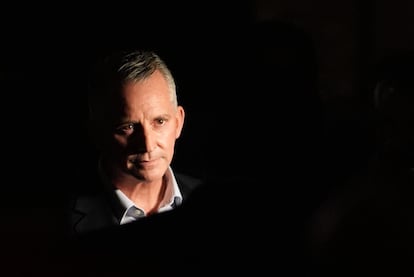

David Jolly, the Democratic candidate for governor of Florida, does not need to be asked about U.S. President Donald Trump to distance himself from his former party and its leader.
“What we’re seeing is overenforcement and cruelty, and I would take a different direction,” he says in an interview with EL PAÍS.
Jolly, 53, born in Dunedin in the Tampa metropolitan area on Florida’s west coast, was a Republican member of the U.S. House of Representatives from 2014 to 2017. He left the party in 2018, during Trump’s first term, and became nationally known as one of the president’s most outspoken television critics.
Last year, he registered as a Democrat and, in August, won the party’s gubernatorial primary by a wide margin. On November 3, he will face Republican Byron Donalds, who has been endorsed by Trump, in the race to succeed Ron DeSantis, who is finishing his second term and is ineligible for re-election.
Jolly is betting that Republican discontent with Trump’s anti-immigrant policies will translate into votes for Democrats — even among Cubans, Venezuelans and other Hispanic voters who helped Trump carry Miami-Dade County in 2024, after decades as a Democratic stronghold.
“Republicans have moved from border security to cruelty and broken promises. When you take a baby from a mother’s arms or make a father disappear from his workplace without having committed a property crime or a violent crime, that’s cruel,” he says.
Jolly says that, if elected governor, he would suspend 287(g) agreements, the cooperation programs that allow state and local law enforcement agencies to work with federal immigration authorities. DeSantis expanded those programs to all Florida counties, positioning the state at the forefront of immigration enforcement.
“I don’t believe that mandate by our governor was appropriate,” says Jolly. “To the extent that federal agents still are active in the state, I think I would join the suit of other governors to insist on the due process reforms. Show us your judicial warrant, show us your face, show us your badge.”
“As a state, we can rescind the 287g agreements,” he continues. “We can litigate where we need to on behalf of the due process of people in the state. I think we can draw down our state law enforcement resources as well.”
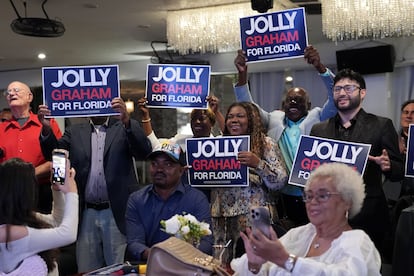
Jolly says opposing those agreements does not mean he’s against border control, and that many voters who want stronger border security are upset by arrests of immigrants in their communities.
“I support border security, but that’s not what this is about anymore. This is now about whether or not someone who is here contributing to the economy has the opportunity to pursue the American dream,” he says. “Those who are here without the documentation, if they’re here without a property crime or a violent crime, I still support a pathway to legal status and work status.”
Despite this, Jolly warns that Democrats need to offer more than changes to immigration policy. “Something Democrats have done wrong in the past few cycles is, a lot of times, politicians will look at a community and think, ‘Well, they must only care about one thing.’ Politicians might think immigrants only care about immigration, and that’s not true. Every community wants good schools, access to healthcare, and the ability to buy a house or stay in their house or afford rent in the community in which you work,” he says.
In that sense, Democrats “have taken a few things for granted” with Hispanic voters, he says. “I think part of it is we didn’t focus our message on an economic message. Secondly, we didn’t acknowledge that all communities want border security, including our immigrant communities. And I do think, on some cultural issues, that Democrats have too quickly brushed aside some of the real cultural convictions, whether it’s around faith teachings related to abortion, life and reproductive care, or traditional marriage.”
Jolly is the son of a Baptist pastor and often talks about his faith on the campaign trail. When he launched his candidacy last year, he said his views on abortion had changed — he had opposed it in Congress and later defended it — and that “we need more politicians willing to admit they were wrong.”
“My faith teaches one thing, but I understand the Constitution, and my job as governor is to protect everybody’s liberty and everybody’s freedom,” he says. “Our immigrant communities have rich cultural and faith traditions that need to be respected and given liberty and freedom for communities to practice and to evangelize.” “I talk about my faith. I welcome people of all faiths alongside those who practice no faith at all,” he adds.
On distrust of Democrats among some immigrants who fled regimes like Cuba, Venezuela and Nicaragua, Jolly is blunt. “I reject socialism and communism, and I reject the DSA [Democratic Socialists of America]. I think a capitalist economy creates opportunity when government provides some basic partnerships, like educating kids, providing access to healthcare and housing. But we let the private sector lead.”
He also rejects the red-scare rhetoric Republicans stoke about progressive candidates gaining ground in parts of the country, including Florida, where Angie Nixon, a DSA member, won the Democratic nomination for the Senate race. “I don’t think that the threat in America today is the rise of socialism. I think it’s the rise of right-wing authoritarianism, the right-wing strongman, frankly, that Donald Trump wants to emulate and Byron Donalds wants to insulate,” he says.
“The fact that [Trump] wants to send $5,000 checks to people if they vote for him and elect Republicans — it’s the right-wing authoritarianism, strongman theory that I think is a greater threat than socialism,” he says.
His political outlook could be described as an American version of social democracy. “Blending that capitalism with responsible social investments of taxpayers’ dollars in education, healthcare, housing, safe communities, clean water and clean air is not a threat.”
One of the central economic proposals of his campaign is a reform of homeowners’ insurance. He wants to cut premiums by 60% through the use of an existing state catastrophe fund that is currently used to “bail out insurance companies.” “Let’s use their platform but qualify homeowners,” he says.
On health care, he proposes expanding services with “platforms that work.” He cites a nonprofit in Miami’s Little Haiti “that sees 300 patients a week,” and clinics in Broward County, north of Miami-Dade. “They currently fund them, just not sufficiently,” he says.
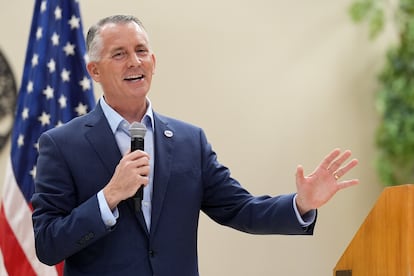
He also says he wants to “lead a renaissance in public education,” so families don’t have to look for alternatives. But if they still prefer other options, he is not opposed to them. “Let’s protect the families and kids going into choice schools and make sure those schools have to teach kids to read and provide the same services that our public schools do,” he says.
In a Florida that has become increasingly Republican over the past few decades, Jolly faces a steep challenge on November 3. A recent poll published by NBC6 and Telemundo put Donalds at 48%, compared with 41% for Jolly, with 10% of voters still undecided.
While other polls show a narrower race, Florida has not had a Democratic governor since the last century. The most recent was Buddy MacKay, who took office following the death of Lawton Chiles and served until January 1999.
Florida’s legislature is also dominated by a Republican supermajority. Jolly says that if he wins, he will “lead with grace” and work with Republicans. “Where we can’t, I’ll lead with executive action. I get to replace the Surgeon General on my first day in office, bring back public health. I get to replace the education commissioner. Where we can use executive authorities, we’ll do it, but we’ll also work with the legislature,” he says.
With U.S. President Donald Trump, he expects a similar relationship. “I hope President Trump will be prepared to provide resources to our state, certainly in moments of a natural disaster or when it comes to investments in education, healthcare and housing. If there are ways to work together, we will,” he says. “But we know there are ways that there are things he does that confront the due process protections that are due to every Floridian. So where we have to litigate on behalf of Floridians, we’ll do it.”
“The issue of ICE [Immigration and Customs Enforcement] is a strong example,” he continues. “Other Democratic governors have litigated against ICE operating within a state without judicial warrants. We will probably join some of those litigations, and some efforts to expand Medicaid. But we will apply the same principle as with a Republican legislature: where it benefits the people of Florida, we’ll work together. Where it doesn’t, I’ll stand up to them.”
First, Jolly must beat the odds and get elected as the governor of Florida.
Sign up for our weekly newsletter to get more English-language news coverage from EL PAÍS USA Edition









































