
Donalds and Jolly win Florida primaries and will face off to succeed DeSantis in November
Donalds, the Trump-backed Republican, aims to become the state’s first Black governor, while Jolly seeks to return the office to the Democrats after more than 30 years
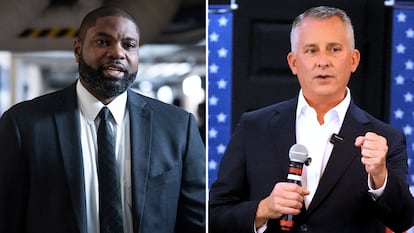

Florida voters on Tuesday nominated Republican Byron Donalds and Democrat David Jolly as their parties’ candidates in the race to succeed Governor Ron DeSantis, as well as other contenders for the state legislature in Tallahassee and for the U.S. Congress. Donalds won more than 50% of the Republican vote, while Jolly took 63% of the Democratic vote, with 72% of precincts reporting. After these primaries, the two will face off on November 3 aiming to make history: Donalds as the state’s first Black governor, and Jolly as the first Democrat elected to the office in more than 30 years.
Donalds used his victory remarks to thank supporters, call for party unity, and attack his Democratic rival. “Now is the time for the Republican Party to unite. By working together, we can make Florida more affordable and defend the Florida Dream for our families, seniors, and young people. My Democrat opponent would raise taxes, make life more expensive, and bring the Democrats’ radical left agenda to the Sunshine State — Florida cannot afford Liberal David Jolly,” he wrote on his X account.
DeSantis, who is barred from seeking a third consecutive term, did not endorse any candidate, not even his lieutenant governor, Jay Collins, who ran as someone who would carry on his legacy. Collins finished second among Republicans on Tuesday, behind Donalds, with 24% of the vote.
Donalds’ victory — at age 49, he is a former congressman from Naples in the southwest of the peninsula — has served as validation of the strength ofDonald Trump’s backing among Florida Republicans, despite the president’s low national approval. Trump endorsed Donalds in February last year, before he had even formally declared, and the Florida politician went into Tuesday’s ballots with a wide 49-point lead in polls over the other 10 GOP contenders.
Jolly, 53, is a former congressman from the Tampa Bay area who left the Republican Party in 2018 and joined the Democrats last year. He has presented himself as someone who can attract voters across the political spectrum, including independents and moderate Republicans disillusioned with Trump. Jolly’s nearly 50-point margin over his nearest rival shows Democratic voters have consolidated behind his candidacy and chosen to back a former Republican to try to regain ground in November in a state that has shifted rightward, while in other parts of the country Democrats are nominating candidates much further to the left.
For decades Florida was one of the so-called swing states, where voters leaned one way or the other across the political divide, but it has shifted from purple to red, in part because of a turn by Hispanic voters toward the Republican wing, including in former Democratic strongholds such as Miami-Dade.
Republicans hold broad control of Florida government, from the executive branch to a supermajority in the state legislature that lets them pass laws with minimal Democratic opposition. The party holds 27 of 40 seats in the Senate and 83 of 120 in the House of Representatives.
On Tuesday voters also chose both parties’ nominees for three major state cabinet posts: chief financial officer (CFO), agriculture commissioner, and attorney general, as well as dozens of seats in both chambers of the state legislature.
According to preliminary results, former state senator Annette Taddeo will win the Democratic nomination for CFO and will face Republican Blaise Ingoglia, the current officeholder, in November. Taddeo emphasized oversight of public spending during her campaign and has criticized Ingoglia for, she says, turning a blind eye to state expenditures, in particular the state funds used to build and operate the notorious immigrant detention center Alligator Alcatraz in the Everglades, which at times cost nearly $1 million a day, and the no-bid contracts awarded to manage it.
For agriculture commissioner, Republican Wilton Simpson, who currently holds the office, is leading his party’s nomination and will face Democrat Joey Mendoza Atkins in November.
The attorney general contest, between Republican James Uthmeier and Democrat José Javier Rodríguez, had already been decided before Tuesday because neither faced an intraparty challenger and both advanced automatically.
Florida’s primaries are considered “closed,” meaning only voters registered with a party can choose that party’s nominee — Republicans vote in the Republican primary and Democrats in the Democratic primary. In some contests where the winner will face no opponent from the other party, known as universal primaries, all voters may participate.
No-party-affiliated voters (NPA) can vote in some nonpartisan contests, such as judicial elections, and in universal primaries.
Several universal primaries on Tuesday decided who will occupy various seats in Tallahassee without having to wait until November. In Senate District 16, Democratic representatives Fentrice Driskell and Michele Rayner ran against each other, and with no candidate from another party, Driskell — who led with more than 59% of the vote at press time — is expected to be the next senator.
District 47, in central Florida, flipped from red to blue before the primaries when incumbent Republican Representative Paula Stark was removed from the ballot for failing to meet filing requirements on time. Democrats Jorge Figueroa and Anthony Nieves contested the seat, and Nieves is ahead in the unofficial results.
According to data from the Florida Division of Elections, nearly two million people voted before polls opened Tuesday, including 1.15 million by mail, among them Trump — a fierce critic of the method who has sought to restrict it — who cast a ballot in Palm Beach County, where he resides.
About 818,000 voters cast early in-person ballots, the majority Republicans. Most mail ballots were from Democrats.
More than 1.32 million people voted in person on Tuesday, according to preliminary results while not all counties had completed their reports.
The ballot also included several elections for circuit and local judges, which are nonpartisan posts. But Blanca González, a 71-year-old Cuban who voted in Coral Gables, southwest of Miami, said she looked up which judges were closer to Democratic positions to vote for them. “We need more judges who decide without being guided by whatever Trump says,” she said.
Sign up for our weekly newsletter to get more English-language news coverage from EL PAÍS USA Edition









































