
Culture refocuses attention on the Palestinian cause: ‘It has always been central to political struggle’
Musicians’ tours, film festivals and literary forums keep the flame for Gaza alive and spark debates about the limits of free expression and the concepts of censorship and cancellation
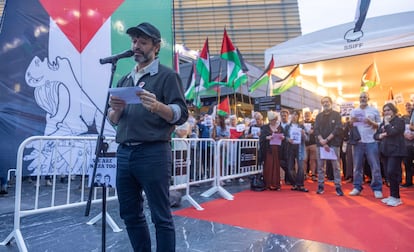

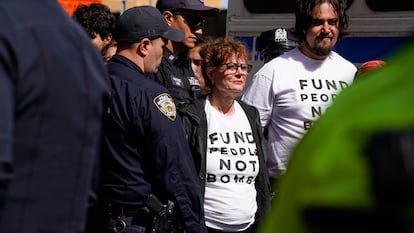
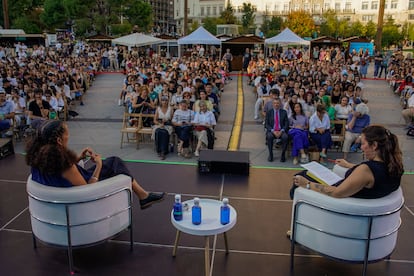
Culture has once again placed the Palestinian cause at the center of social conversation, while political leaders — especially those from the Global North — have progressively dropped the issue from their public remarks. In less than a month, rapper Macklemore was dropped from opening for Ed Sheeran on his tour after shouting: “Free Palestine!” Actresses Susan Sarandon and Hannah Einbinder were arrested in New York for calling on the United States to stop funding Israel’s war while Benjamin Netanyahu was attending the UN General Assembly. Yuval Abraham and Rachel Szor, directors of NAZA, after being branded traitors by the Israeli government and threatened with revocation of their citizenship, decided to release online and for free the documentary that won an award at the Venice Film Festival. The Festival of Ideas in Madrid hung by a thread when more than 30 participants demanded the organizers withdraw Allianz’s sponsorship because the company holds Israeli bonds. At the same time, at the Cultura Alh festival in Granada, the exchange of manifestos continues between those who oppose and those who support the decision to rescind an invitation to Argentine writer Ariana Harwicz for denying a genocide in Gaza.
As these cases unfolded, various offshoots of the cultural debate about Palestine began to emerge. Should politics be separated from culture? Are limits being set on freedom of expression? Censorship or cancellation? Is a cultural boycott legitimate? All these questions have occupied the space that cultural actors leading such initiatives sought to use to place the focus on the more than 70,000 Palestinians killed by the Israeli army since 2023 — a figure that Israeli commanders have ended up acknowledging — in an offensive the UN described as genocidal.
Art has moved in step with society historically, sources consulted agree, who note that “culture seeking to reflect and denounce what is happening in Palestine is not a historical anomaly.” Film, books, theater and the visual arts have addressed other wars such as those in Iraq and Vietnam, depicted the social consequences of major economic crises, and denounced the situation of women, among many other topics.
“Politics and culture are not compartmentalized spaces. Culture has always been central to political struggle because through cultural products — those narratives and stories, some hegemonic and others counter-narratives — are formed the imaginaries in which we socialize,” says Itziar Ruiz-Giménez Arrieta, professor of international relations at the Autonomous University of Madrid. “It has never been mere decoration; it has always been the space where societies decided what they were capable of seeing, naming, who they mourned, which deaths they found lamentable and which they simply ignored. It is a dispute that has always been at the heart of art,” says political scientist Máriam Martínez-Bascuñan, who also signed the letter that led the Festival of Ideas to withdraw Allianz’s sponsorship and who contributes to this newspaper.
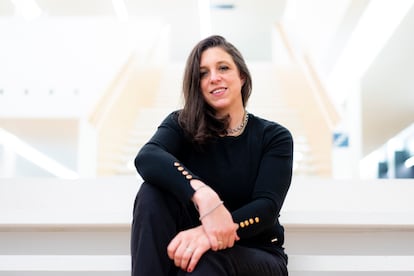
In this age of attention economy, artists, as communicator Nerea Pérez de las Heras explains, take advantage of the spotlight on them — even if that peak is so fragile and fleeting it lasts only a few hours — and the reach and impact provided by social networks. “I try to use that visibility constructively,” says the author of Fantasma (Alfaguara, 2026), a signatory of the Madrid festival letter and one of more than 500 authors supporting the writers and students who backed the decision to expel Harwicz from the Granada event. “We are accused of being inconsistent to paralyze us with the excuse that 100% ethical work and consumption under capitalism is impossible when we point to a company like Allianz; obviously we are all subject to survival pressures, but our level of commitment is constant,” she argues.
Macklemore, a rapper who accepted opening for a megastar like Sheeran to restart creating content, forced the British artist to apologize for the fallout caused by his tepidness — what some call “ideological neutrality” — and announced a three-concert tour whose entire proceeds will go to organizations working in Palestine. Javier Bardem, another highly visible figure showing support for the cause on influential platforms such as the Oscars ceremony, has spent months risking a career already jeopardized for others like Sarandon and Mark Ruffalo, two actors who have been blacklisted in Hollywood — an industry intertwined with Israeli capital since its origins — and smeared as antisemitic.

“Cultural voices, by virtue of their fame, are the only ones managing to get a small foothold on the political-media stage,” says Ruiz-Giménez Arrieta, who finds bastions of resistance in countries in the Global South, such as South Africa, and in Francesca Albanese, the UN special rapporteur for the occupied Palestinian territories, which help prevent the issue from being abandoned in strictly political discourse.

“Discursive political gestures, which are not gestures of solidarity, for example from Pedro Sánchez, must now be placed in a context in which global elites — especially European and U.S. elites, who from the outset aligned with Netanyahu’s government — are also determined by commercial collaboration in this government’s war economy. All have used Trump’s supposed peace plan to claim there is no longer a war and therefore say they no longer need to fulfill international obligations in the face of a genocide that does not exist, even though Palestinians’ living conditions remain terrible,” Ruiz-Giménez Arrieta points out.
Precarity in the sector
Pérez de las Heras and writer Dahlia de la Cerda, one of the promoters of the manifesto supporting the Cultura Alh Festival, note that many signatories of these documents are in precarious situations that distinguish them from major stars. “The publishing industry is the book chain: publishers, publications, distribution, bookstores. And within it there are publishers with clear political positions that back pro-Palestinian authors and anti-genocide stances to the end,” the writer says, “but the literary industry is far broader. It is the whole circuit that determines who circulates, who has visibility, and who gains access to opportunities.”
Valerio Rocco, director of the Círculo de Bellas Artes in Madrid, one of the organizers of the Festival of Ideas, elaborates on the cultural sector’s precarious situation in Spain: “I have learned that cultural projects and institutions are tremendously fragile. When they face attacks and accusations, withdrawn support and unimaginable pressures, the vulnerability of the cultural sector is felt very clearly, even physically. Citizens are not always aware of this fragility. We need to show it and reflect on its causes.”
Some who defend allowing Ariana Harwicz to participate in cultural events — or who denounce that Israeli intellectuals are being barred simply because of their birthplace regardless of their political positions — say there is indiscriminate persecution of Jews. “If I belonged to another minority nobody would have done this to me. In the cultural sphere cancelling Jews is justified,” the author told this newspaper in an interview. “We Israelis have become toxic people. Our presence at a conference, a film festival, or a book fair can create problems,” said Uri Rosenwaks, filmmaker and former director of the Israeli Forum of Documentary Directors, in another feature for this paper. “And if Netanyahu is re‑elected we won’t be able to cope. There will be a mass emigration, because the last few years have already been a challenge.”
Luis Salazar, spokesperson for the cultural area of the Solidarity Network Against the Occupation of Palestine (Rescop), which is part of Boycott, Divestment, Sanctions (BDS) — the platform calling for a boycott of Israel — argues that their actions are grounded in a debate spanning more than two decades. “These movements are not spontaneous or random; there is coordination with working groups across Europe,” he explains of their approach to proposing boycotts. “If artists choose to benefit from the occupation and genocide, or else lose contracts and jobs, then they will have to test their integrity, as many others do in countless life situations. Racism shows up in our feelings and priorities. We understand there may be injustices, but none like what Israel commits against Palestine,” he maintains, recalling the letter in which 50 Israeli documentary filmmakers supported boycotts of their country’s institutions, as well as other historical moments such as apartheid in South Africa or now Russia’s invasion of Ukraine, where the same criteria were used to try to exclude intellectuals or athletes from public spaces.
Censorship, cancellation and boycott
The dispute over the limits of free expression, cancellation, and censorship and the consequences these boycotts produce in culture is exemplified by the manifestos exchanged among the hundreds of intellectuals who supported or opposed Harwicz’s presence in Granada. “Organizing a peaceful boycott is not censoring. Criticizing is not censoring, protesting is not censoring,” argued Rodrigo Sorogoyen, Cristina Rivera Garza, Camila Sosa Villada, Alejandro Zambra, Pilar Quintana, Nona Fernández, Andrea Abreu, Alana S. Portero and Marta Sanz. “Defending freedom of expression only for those who think like us is not defending it: it replaces the free confrontation of ideas with ideological selection,” countered Piedad Bonnett, Maria Negroni, Margo Glantz, Ana María Shua, Valeria Correa Fiz, Karina Sainz Borgo, Fernando Savater, Cayetana Álvarez de Toledo and Manuel Valls, among others.
The City Council and the Madrid regional government, organizers of the Festival of Ideas, denounce along the same lines that at the core of this debate is “censorship and cancellation,” in the words of Mariano de Paco, culture councilor for conservative regional premier Isabel Díaz Ayuso. “We condemn any ideological interference both in artistic activities and in their funding, as we have recently seen with Ariana Harwicz or with Allianz at the so-called Festival of Ideas, promoted by the Círculo de Bellas Artes. We deplore that ideological debates substitute persuasion and reasoning with pressure and intimidation,” the politician tells this newspaper. Ayuso has invited the Argentine writer — whose books are reportedly enjoying a boost in sales in her native country, according to Argentine booksellers — to take part in any forum in Madrid she wishes.
It will be in Madrid where, from October 15 to October 17, the contemporary dance piece Sadeh21 by the Israeli dance company Batsheva can be seen at the Teatros del Canal; this newspaper contacted the company without receiving a response. According to its own accounts, it is an organization funded by Netanyahu’s government and has become a national emblem. “The [Madrid regional government] uses it to whitewash the genocide,” says choreographer and dancer Nacho Duato. “If they end up dancing, then let them dance, but this needs to be discussed,” he adds, while acknowledging that at the moment he spends much of the year dancing in Russia, the country currently invading Ukraine. “I am against the war and against Putin; he is a dictator, and Russian artists are not allowed to perform outside their country.”
That was the case at Eurovision in 2022, after Russia invaded Ukraine: the country was expelled from the competition in application of its statutes. The European Broadcasting Union did not take the same decision regarding Israel, leading countries like Spain and Ireland to withdraw from the musical contest in protest. “There is no doubt that boycott serves to internationally isolate a state that systematically breaches international law,” continues Salazar of Rescop.
Some of these sources wonder what will happen when attention turns to the next issue. Will any reflection remain fixed in the public sphere about what is still happening in Palestine? “That push from culture, society, universities, is vital, but what must happen above all is a reduction of repression worldwide by governments that claim to be very sympathetic to Palestine so that, for example, reception programs for refugees and exiles can exist,” concludes political scientist Ruiz-Giménez Arrieta.
Sign up for our weekly newsletter to get more English-language news coverage from EL PAÍS USA Edition









































