
Francesca Albanese, UN rapporteur: ‘The United States’ intimidation techniques are mafia-style’
The Italian lawyer, who is being targeted with sanctions by the Trump administration over her support for the Palestinian people, rules out resignation and proposes the total end of relations with Israel’s ‘apartheid regime’
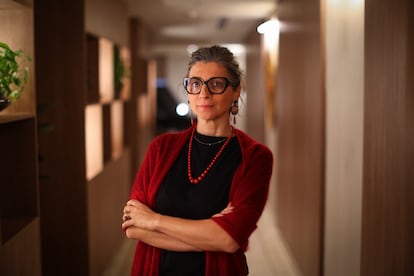

This week, all eyes were on Colombia in terms of international diplomacy. The country hosted the first summit of the Hague Group, a bloc of eight countries from the so-called Global South, who looked to reach agreements on diplomatic and economic measures with which to pressure Israel to accept a ceasefire and end its war in Gaza. Despite the fact that delegations from some 30 countries, including Mexico and Spain, were present, the guest that stole the show was Francesca Albanese, the UN Special Rapporteur on the Occupied Palestinian Territories. The Italian lawyer, who is not afraid of calling what is happening in Palestine “apartheid,” was sanctioned last week by the United States, who is accusing her of “supporting terrorism” and of promoting “blatant antisemitism.”
Albanese (Ariano Irpino, Italy, 48 years old) says that the steps taken by Donald Trump’s administration set an “awful precedent.” “Every state could do the same towards special rapporteurs in order to paralyze their function,” she says during an interview with this newspaper at her hotel in downtown Bogotá. “I am not immune from criticism. But if the United States has something substantive, why don’t we sit and discuss?”
The retaliatory measures imposed by the U.S. State Department, led by Marco Rubio, range from a ban on entering the United States to the freezing of any assets she may have in the country. “The sanctions are going to affect my life, of course. I would not be able to hold a bank account in any circuit that is connected to the United States. I will find one, but still, it might create a chilling effect around me, because it would be problematic for anyone holding American citizenship to engage with me without the risk of facing consequences.” Her life, she says, is in danger. “I started receiving more serious death threats, and threats against my family, after the publication of my report Anatomy of a Genocide [in July 2024]. Now, the pressure has changed. These are mafia-style intimidation techniques.”
Every state which continues to maintain ties with a state that commits war crimes violates its third-state responsibility not to aid and assist a state that is committing this crime
Is she being pressured by the United States to resign? “Of course!” she responds, vehemently. And, has she considered doing so? “I will not resign. Why would I? As long as I have this mandate, I will continue. I’m not giving into U.S. pressure at all. It’s not that I’m doing this because I’m attached to the gains of this mandate. Like me, many, many others are putting their life on the line. There are so many civil servants who have been fired and academics and students who have been punished. There are so many who are resisting this barbarism, and I would feel awful if I didn’t use the positionality I have to stand with them,” she says.
In her most recent report, the rapporteur denounces more than 60 companies from around the world for being “complicit” with “the corporate machinery sustaining Israel’s settler-colonial project of displacement.” “I could have written this report years ago,” she says. “Decades ago, they knew that Israel was violating Palestinian rights. But now, they have even profited from the genocide.” Among the companies that are mentioned are U.S. firms BlackRock and Vanguard (investment); Colombia’s Drummond and Glencore (coal) and the Spanish company Construcciones y Auxiliar de Ferrocarriles (transportation).
To Albanese, companies are not the only ones who bear responsibility — governments are also to blame. That’s why she proposes that all nations cut diplomatic and economic ties with Israel. Those that fail to do so, she says, “are violating international law.” “Every state which continues to maintain ties with a state that commits war crimes violates its third-state responsibility not to aid and assist a state that is committing this crime,” she holds.
Her claims face strong resistance, especially from the most powerful parties. Trump has shown almost unwavering support for Israeli Prime Minister Benjamin Netanyahu’s government, and the European Union failed to agree this week on sanctions against Israel, despite having confirmed its violations of humanitarian obligations in Gaza.
What is happening in Palestine is creating a sense of mistrust and impotence
Other smaller actors have tried to take action. A dozen countries, including Colombia, Bolivia, Indonesia, Iraq, Libya and Malaysia, agreed in Bogotá on measures such as preventing Israel from being supplied with arms and stopping ships linked to the Israeli military industry from docking in their ports. According to Albanese, these actions are a step in the right direction but are still not enough. “I’m never satisfied with the political process, because [governments] should be much bolder and daring. But this is the minimum, and we need to start somewhere.”
The rapporteur’s most recent declarations transmit a sense of urgency to act now for Gaza. Since the war began in October 2023, more than 58,000 Palestinians have been killed in the Strip. Are we at a breaking point? “We are beyond that. It’s like when you are running low on fuel and the red light comes on,” says the expert, who warns that we are entering a decisive moment for the course of humanity. “My generation grew up thinking that the law is to be respected and that there are institutions enforcing international law. Now we see that the law doesn’t count for anything and that political will aligns with financial interest. What is happening in Palestine is creating a sense of mistrust and impotence.”
This stance has earned her harsh criticism. One of the most serious accusations came directly from the Trump administration, which claimed that Albanese promotes “blatant antisemitism.” That hasn’t stopped her from making statements against the Israeli government leadership. “The apartheid regime will collapse, which doesn’t mean the end of Israel. People are scared, but my question to them is, is the only way you claim Israel can exist, an apartheid? No, I think that Israel can exist as a state that respects the rights and freedom of all. It cannot be a state predicated on the suprematism of one group over another,” she says.
In contrast to its powerful censure, international agreement on this position is growing. A global campaign supported by tens of thousands of people from all over the world is pushing for the rapporteur to receive the Nobel Peace Prize, a recognition that Trump is determined to achieve. Albanese emphasizes that, “I’m very touched by how many people are expressing their love, their support, but to them I’d say, I don’t really need a Nobel Prize. I need to see the end of the genocide.”
Sign up for our weekly newsletter to get more English-language news coverage from EL PAÍS USA Edition









































