
Held without evidence and handed to ICE: How police cooperation in Texas led to a Hispanic man’s arrest
A woman accused him of assaulting a child without proof. This single testimony led to the Mexican man’s detention and transfer to immigration authorities, who held him for two months
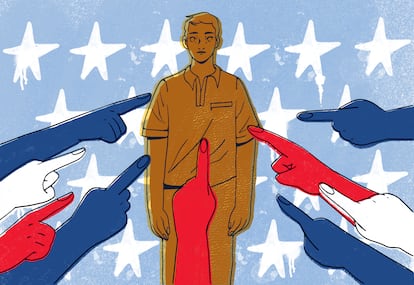

On October 5, 2025, Aurelio was driving along the Texas Gulf Coast in Galveston because he needed “a moment to catch his breath.” He turned onto a street he and his wife had wanted to see when he felt a pickup truck almost on top of the trunk of his car. While making a U-turn in the alley, a white woman rolled down her window and yelled something in English about one of the children that he barely understood. An hour later, while he was playing with his three-year-old daughter in the front yard of his house, two patrol cars from the Galveston County Sheriff’s Office arrived at his door, questioned him and arrested him.
“They asked me for an ID and I gave them the one I always use, the Mexican one. They asked if I had another one; I said no. The officer asked, ‘Are you illegal?’ I said, ‘Yes.’ That was when he handcuffed me, put me in the patrol car and told me he was taking me in for not having a license, for nothing else,” says Aurelio, who prefers to use only his first name for fear of retaliation by authorities.
The ride did not take him directly to the county jail. Aurelio says they took him to the woman’s house in the alley and, once there, rolled down the window so she could identify him: “I felt anger (...) As if I weren’t worth anything, as if I had no words because I didn’t understand the language and because of my skin color.”
With no evidence, the woman accused him of having hit one of her children. There were no questions for Aurelio; he only watched the conversation from the back seat of the police cruiser. From there they took him to Galveston County Jail on charges of “assault,” according to his intake report. The next day, local authorities transferred his custody to U.S. Immigration and Customs Enforcement (ICE), a Department of Homeland Security (DHS) spokesperson confirmed in an email.
EL PAÍS attempted to contact the Galveston County Sheriff’s Office to ask about Aurelio’s arrest procedure but received no response.
The immigrant recalls that in the van ICE used to transport him there were six people: two of them Hispanic, like him, who had been detained by ICE agents at construction sites where they were working. Once at the detention center, he was issued a red uniform—the one assigned to people considered the most dangerous or high risk. “I was a criminal without being one.”
EL PAÍS learned of five other cases of immigrants who also say they were detained by Texas police allegedly because of their skin color. They declined to tell their stories for fear.
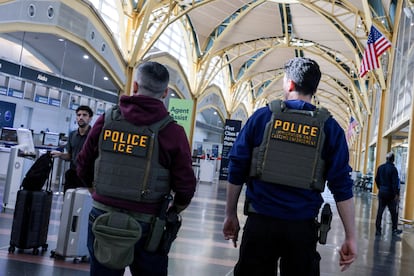
Police action
Aurelio’s immigration lawyer, Jessica Basilio, believes this Mexican man’s arrest was “100%” based on racial profiling: “There was no evidence to arrest him. It was inappropriate to take him out of his home and bring him to the other person’s house to be identified. Only with her word they said, ‘He hit a minor and we’re going to take him to jail.’” The lawyer also argued the arrest could not be justified on the grounds that he lacked a driver’s license: “When they detained him, he was not driving. He was at home.”
Basilio took Aurelio’s case in November 2025 and at a hearing in late February 2026 asked the Galveston district attorney for access to the evidence the prosecutor was using to keep the Mexican immigrant locked in an ICE detention facility in Houston. A mid-March 2026 exchange of emails—accessed by EL PAÍS—between a prosecutor’s office staffer and the case prosecutor shows she had requested the evidence from the officer who arrested Aurelio “several times.” She wrote that she had received no response to any of her requests. “Please prepare a motion to dismiss the case,” ordered the district criminal prosecutor, Ted Mora, that day.
EL PAÍS contacted the Galveston County prosecutor’s office and confirmed that the case was dismissed on March 26, 2026. There is no record of prior offenses for this immigrant.
“There was no evidence that he was an aggressor,” Basilio insists. “The child had no injuries to show, was never touched (...) In a case where a minor has injuries, the first thing they do is take the child, bring in medical staff, document everything and measure all the injuries. None of that happened,” Basilio says.
Since the first Trump administration, Texas—along with Florida and Georgia—has been among the states that have most advanced local laws and policies to promote the former president’s detention-and-deportation agenda. And although many of those measures have been challenged in court, this year they have begun to take effect with judges’ approval.
SB 8, for example, requires Texas police and sheriff’s offices to enter cooperation agreements with federal immigration authorities known as 287(g). Nearly 440 local agencies in the state have signed these agreements to detain immigrants and hand them over to ICE.
The Galveston County Sheriff’s Office—the agency covering the area where Aurelio lives—is one of them. ICE records show it signed memoranda of understanding for all three 287(g) cooperation models—one in August 2020 and the other two in March and July 2025—so its local officials can execute administrative orders against immigrants detained in their jails and transfer custody to ICE. They can also act as immigration agents during routine street procedures.
A DHS spokesperson told EL PAÍS in an email that by June 2026, 287(g) agreements signed by agencies across the country had increased from 135 to 1,934.
In addition to SB 8, another law took effect at the end of May that allows Texas police and judges to arrest, detain and deport immigrants who entered the state without being admitted by any authority. This piece of legislation is known as SB 4. The American Civil Liberties Union (ACLU) calls it “unconstitutional” and “one of the most extreme anti-immigrant laws ever enacted by a state legislature.”
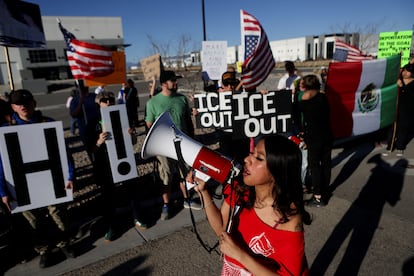
Osvaldo Grimaldo, a policy strategist and border and immigrant-rights advocate at the ACLU of Texas, believes instruments such as SB 4, SB 8 and 287(g) agreements will allow local police to be “more aggressive” on the street and will lead to more detentions based on racial profiling.
“The effect is large, sadly. It’s an effect that will last many years. It impacts society, the economy,” he says in an interview.
An analysis by the Deportation Data Project, an organization that collects and systematizes ICE data, estimates that by March 2026 detentions of immigrants with no criminal records, like Aurelio, had increased more than eightfold.
Freedom
On December 4, 2025, Aurelio was released from the ICE facility after posting $8,000 bond, according to the Houston immigration court order in his case. He was eligible for that alternative measure because when he entered the United States in December 2021 he held a temporary agricultural worker visa, the H-2A. He is now awaiting the same judge’s decision on an asylum request and another petition to adjust his status based on marriage to a U.S. citizen.
Since January he has worn an electronic ankle monitor that limits his movement to a 100-mile radius. He is ashamed that people can see the device, as if authorities had marked him again. He fears that in his community—estimated to have just over 3,000 residents, according to unofficial estimates—people will once more label him a criminal.
“You come with the mindset that the United States is great, that you’re going to work. But as time goes by you open your eyes, you see that not everything is as they tell you and that racism is around every corner,” he laments. In the past he experienced, for example, a Walmart employee in Oklahoma who chased him through the store and accused him of stealing. He also remembers his first boss on a watermelon and cauliflower farm in Florida: to make them work faster he would shout “animals” at them or insult them.
During the two months he was detained at an ICE facility in Houston, Aurelio missed important family events. His eldest son, who has been diagnosed with autism, said his first words. During that time the boy turned five and Aurelio was not present. Instead, he accumulated debts—rent, legal fees, the bond—that he must now repay, even though he cannot work.
One of his fears is running once again into the woman who accused him of assaulting the child. He says he prays to God to take care of her; he bears her no grudge. To people like her, Aurelio would say “you almost destroyed a family.”
Sign up for our weekly newsletter to get more English-language news coverage from EL PAÍS USA Edition









































