
The hoaxes that fostered the migrant avalanche in Ceuta: ‘The door is open’
A study by a Moroccan researcher who followed the crisis in real time shows that online videos of the first successful crossings had millions of views and increased the tide of young people flocking to the border
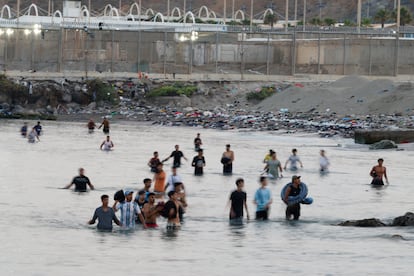

“In the morning I saw videos on Instagram and TikTok of people crossing the border (of Ceuta) saying, ‘The door is open’.” This is one of the hundreds of messages, posts and recordings analyzed by Moroccan computer engineer Marouane L. Alaui, who has been following the migration crisis in the Spanish territory in North Africa from the start. In a study published on Instagram, he found that the human avalanche was triggered by social media falsehoods distorting a Spanish Supreme Court decision that banned on-the-spot deportations of migrants entering by sea.
The coincidence of the low tide at midday on July 30 with an unusual stand-down by Moroccan security forces combined so that “the border stopped functioning as a barrier for several decisive hours” at the barbed-wire breakwater of El Tarajal, concludes this 40-year-old digital developer and artificial intelligence expert.
“The footage of two young women (who successfully swam to Ceuta) amassed 32,198,740 views,” he notes in his detailed study. They were alive and smiling as they celebrated reaching their destination. For an audience of potential young migrants, this meant, in Alaui’s words, “a practicable, immediate and humane route,” compared with the dangerous currents of the Strait of Gibraltar.
The researcher had been following the rise in migratory pressure in the area from late June. In the days before the mass exodus of July 30 and 31, he had already “hooked into” social networks to observe the digital projection. Before they vanished from the digital ecosystem, he collected links, images and text messages on which he based his analysis.
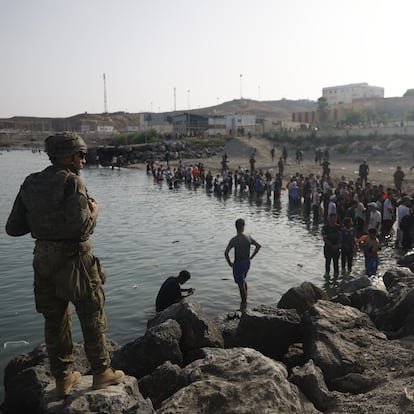
“There is no evidence that Rabat, Algiers, Madrid, a political party, a media outlet or an influencer designed this or gave the order to mobilize,” he concludes in his report. Alaui insists that the manipulated promise of an open, paperwork-free border—emphasized after the Supreme Court decision published on July 8—and the “credible crossing” theory confirmed on social media by the first young people who entered Ceuta without restrictions intensified the migratory flood. “The absence of police surveillance did the rest,” he says.
“Everyone was online (…) when the emergence of a walkable route and the lack of police intervention suddenly prompted tens of thousands to cross (the border), but social media alone cannot explain how the flow went from hundreds of attempts (in the preceding days) to a massive breach,” he argues in his research.
Alaui does note that “private and public” messaging groups supplied contacts and logistical information. Reports of actual crossings of the border between the Moroccan city of Fenideq and Ceuta were more “persuasive” than digital rumors. “The migration market already existed beforehand in forums such as Korob Haraga (‘irregular migrant’) or Haraga Spain,” this expert says. Travel companions are sought to share costs, boat or jet-ski rides are offered, contact phone numbers are available, discussion groups about entry routes exist… and details are referred to private groups via direct message (DM). “Pay when you arrive (in Ceuta). This is a walking route. Contact by DM,” reads one message, which provides a price list and even ratings from previous users. Paid crossings were predominant in the days before the Ceuta crisis.
At 6.00 am on July 30, social media reported numerous swimmers reaching El Tarajal beach in Ceuta. At midday, with the low tide, the migrant tsunami began. “It occurred in conspicuous coincidence with the stand-down by security forces. The two overlapping circumstances turned a risky swim into a pedestrian walk,” Alaui stresses in his report.
“You don’t need to swim, you just have to go around the border fence,” read the WhatsApp messages. Within hours, calls by public groups to cross the Ceuta border were spreading through channels in Morocco’s main cities, organized into private channels. “Spain has opened the door” was the slogan circulating on Facebook and Instagram. Controls were not restored until August 1.
‘Online-directed mobilization’
The National Human Rights Council of Morocco (CNDH), an official state agency separate from humanitarian NGOs, states in a preliminary report that “digital groups played a central role in coordinating the sea crossings.” The CNDH notes that the sale of swimming and diving equipment, dissemination of itineraries, meeting points and real-time information about routes from Tangier and Tetouan to Ceuta were widely circulating before July 30.
This agency says it identified on WhatsApp and Instagram “potential activity of networks or intermediaries linked to human trafficking,” an official explanation of the origin of the migration crisis shared by the governments of Rabat and Madrid.
The CNDH also reports the presence of “foreign accounts within Moroccan groups” that incited clandestine immigration. It cites the case of numbers deleted in a group with a foreign country code, and another with 18 “numbers associated with that same State.” The report does not reveal the identity of the country, but pro-government media have circulated reports blaming Algeria, Morocco’s regional rival, for having been behind many of the irregular crossings to the Spanish autonomous city.
It is not only African rivals who are cited as shadowy plotters of the migration crisis. The European Union has also observed that channels linked to Russia rapidly amplified the humanitarian emergency after the mass influx of migrants into Ceuta. Brussels has reported that it is investigating a possible disinformation campaign about the chaos at the Ceuta–Morocco border, without being able to verify Kremlin involvement or that of its affiliated networks in the direct organization of the migratory onslaught on Ceuta.
Sign up for our weekly newsletter to get more English-language news coverage from EL PAÍS USA Edition









































